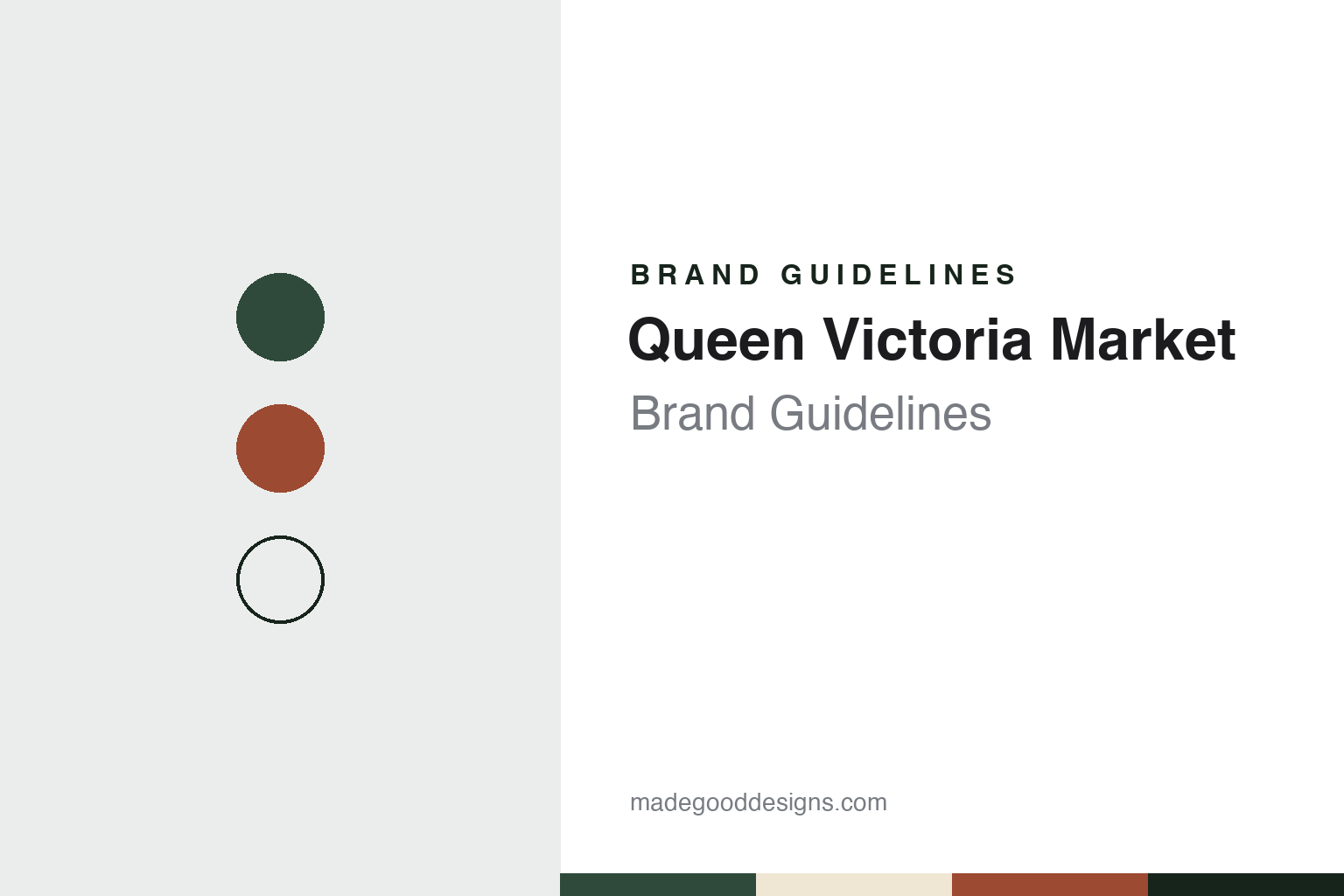
Queen Victoria Market Brand Guidelines
Melbourne’s 1878 market of open-air sheds and brick halls.
Aa
Two constants: a shed green, brick and cream palette and a Victorian market serif register. Abstract homage — not a Queen Victoria Market sign or mark; no logo, sign or building is reproduced.
From hay market to market town
A Lower Market, an Upper Market and an opening in 1878.
The Queen Victoria Market in Melbourne was officially opened on 20 March 1878, the market says in its published history, and English Wikipedia supports the month with a report in The Age of 21 March 1878. Markets had already operated on the site in several forms before that date. The market’s history describes how its oldest part, the Lower Market, bounded by Elizabeth, Victoria, Queen and Therry streets, was set aside in 1857 for fruit and vegetables to relieve crowding at the Eastern Market. Growers did not take to the site, and it served as a livestock and hay market until it was permanently reserved as a market in 1867.
The first substantial building came in those years. English Wikipedia says a brick hall was put up on the corner of Elizabeth and Victoria streets in 1867; today the Meat and Fish Hall, it is the oldest surviving building at the market, with arched side elevations from 1869 and an Elizabeth Street façade from 1884. On the Upper Market, the block bounded by Queen, Victoria, Peel and Franklin streets, construction of the A to F sheds began in 1877, the market says.
After the opening the market expanded into wholesale and retail fruit and vegetable trading, and G, H, I and J sheds followed, according to English Wikipedia. Shops were built along Elizabeth Street in 1880, and the retail rows on Elizabeth and Victoria streets went up between 1882 and 1891. Work to extend the market towards Peel Street began in 1920, and sheds K–L and M were built, leaving the market spread across two city blocks.
In 1930 a row of sixty brick stores was added at the Franklin Street end to house wholesale agents and merchants. The wholesale fruit and vegetable trade moved out to Footscray in 1969, English Wikipedia says, and a row of shopfronts along Franklin Street is what remains of those stores.
Colour
A city-owned market on two heritage registers.
The departure of the wholesale trade left the site’s future open. The market says a plan in the 1970s would have turned it into a trade centre, office and hotel complex; instead the market was classified by the National Trust, and the site and its buildings were later placed on the Historic Buildings Register. It has been on the Victorian Heritage Register since 3 April 1989, according to English Wikipedia, which cites the Victorian Heritage Database, and the market’s own history gives the same year.
A national listing followed. CBD News reported on 26 July 2018 that the market had been formally added to the National Heritage List, and that the Lord Mayor of Melbourne, Sally Capp, and the federal environment minister announced it at the market on 22 July. The market says the listing rests on two values: its links with Melbourne’s early colonial population, and its ability to show the principal characteristics of a nineteenth-century metropolitan produce market.
The City of Melbourne owns the market. Queen Victoria Market Pty Ltd, a wholly owned subsidiary of the city, runs its day-to-day operations, while the city is responsible for capital improvements on the site, the company says on its corporate page; the company prepares an annual report each year for presentation to councillors.
The market covers about seven hectares across two blocks on the northern edge of Melbourne’s central business district, the company says. English Wikipedia describes stalls selling fruit and vegetables, meat, poultry and seafood, and delicatessen foods, alongside a large non-food section of clothing, shoes, jewellery and handmade crafts; the market adds homewares, art, plants and books. The market says its Meat Hall was remodelled in 1975, with stalls doubled in size to take cool rooms, a depot for meat deliveries and an overhead rail on which meat can be pulled to any stall, a system it says is still in use.
The market trades on five days of the week and closes on Mondays and Wednesdays, according to English Wikipedia and the market’s own trading calendar, and English Wikipedia says a night market is held on Wednesday evenings in the summer and winter months. In 2003 the market was fitted with solar panels, English Wikipedia says, citing The Age.
Typography
Markets, halls and the city.
Public markets and food halls in North America and Australia usually introduce themselves through who stands behind the name and when the market began. Some are run by a city council or a public development authority set up by a city charter, some by a non-profit corporation and some by a private property company. A founding date tends to sit close to the name, and a market’s documented origins and its present building often carry different dates.
The buildings do much of the work of an identity. Several markets occupy structures built for something else: space under a former railway train shed, a ferry terminal on a waterfront, or the brick and timber blocks of a former biscuit factory. Others grew as rows of covered arcades and open-sided sheds added stall by stall over decades, with halls for meat and fish and long tables for farmers who rent space by the day.
Lettering is often attached to the architecture rather than drawn for a page. A rooftop sign, a clock above an entrance, painted lettering on a wall or old company monograms set into an entryway can become the image that a market protects as a trademark, and in a historic district a commission may need to approve any change to that signage.
Inside, most of these markets describe their mix in general terms: fresh produce, fish, butchers, bakers and delis alongside food counters with seating, craft stalls and shops. Some are not buildings at all but weekly open-air markets that set up in a park or on a waterfront lot. Each guide in this series describes one market from dated sources and pairs it with a palette and typeface of our own.
Aa
A Victorian market serif for a nineteenth-century streetscape. (Specimen set in Fraunces, a serif STAND-IN; NOT the Queen Victoria Market logo or signage.)
The sheds
Open-air sheds, restored in place.
The open-air sheds are the structures that define the market’s plan, and many have been in continuous use since the market opened in 1878, the market says. Restoration of the sheds began in May 2020, the market says, carried out while trading continued.
The institute’s project summary says every column, beam and truss was reviewed, repaired and strengthened; a new insulated roof replaced the original roofing while keeping the same appearance, with new members added inside the existing structure; and services for traders were laid in underground trenches. The work was staged in place so that the market did not close, the jury citation says, and the jury described the great strength of the project as “the invisibility of its outcome.” The architects say they worked with the City of Melbourne, the market company and Heritage Victoria on a site listed at both state and national level.
Beyond the sheds, the market’s look is set by its nineteenth-century brick fronts. English Wikipedia describes the retail rows on Elizabeth and Victoria streets as an extensive and intact nineteenth-century streetscape, and the Meat and Fish Hall’s 1884 façade faces Elizabeth Street. The market uses the shorter name “Queen Vic Market” in its own channels, and English Wikipedia records “Vic Market” and “Queen Vic” as everyday names for it.
For a design guide, Queen Victoria Market shows how a working municipal market can carry its identity in sheds, brick halls and a streetscape rather than in a single sign. Compare St. Lawrence Market, another nineteenth-century city market, and Pike Place Market. For this guide we use a deep shed green, a brick red and a warm cream with a serif, an unofficial interpretation; no product or logo is reproduced.
Explore & save
Keep Queen Victoria Market’s identity on hand — save it to a board in the Made Good inspiration library.
Queen Victoria Market identity set
Pin the shed green, brick and cream palette and the Victorian market serif register to your own board.
Source & notes
Frequently Asked Questions
What font can I use to match the Queen Victoria Market look?
This guide describes Queen Victoria Market’s type as “A Victorian market serif for a nineteenth-century streetscape”. Its type specimen is set in Fraunces from Google Fonts as a stand-in; Fraunces is not Queen Victoria Market’s own lettering.
What colours are in the Queen Victoria Market palette?
This guide’s Queen Victoria Market palette is Shed green #2F4A3A, Deep ink #17241C, Hall brick #9C4A32, Market cream #EFE6D4 and Paper #F8F6F1. The tones are the guide’s own unofficial interpretation, not official Queen Victoria Market hex codes.
Who owns Queen Victoria Market?
Queen Victoria Market is owned by City of Melbourne.