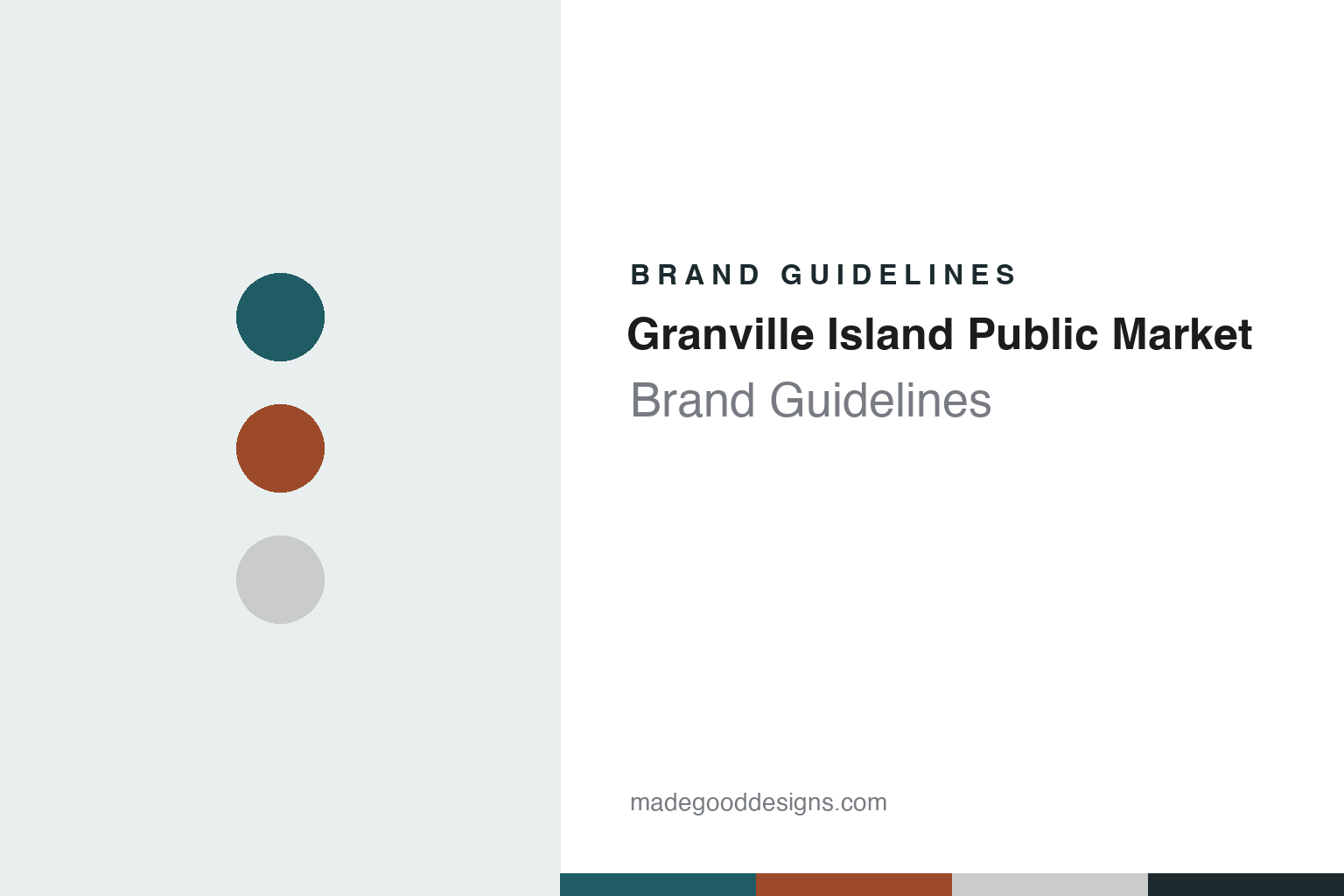
Granville Island Public Market Brand Guidelines
Vancouver’s 1979 market in old factory sheds under a bridge.
Aa
Two constants: a teal, rust and tin grey palette and an industrial sans register. Abstract homage — not a Granville Island sign or mark; no logo, sign or building is reproduced.
Industrial Island
From a sandbar to corrugated-tin factories.
Granville Island Public Market stands on a small peninsula in False Creek, Vancouver, under the south end of the Granville Street Bridge. Before it was an island of factories it was a sandbar. Granville Island’s own history page says the Salish peoples used the large sandbar and the waters around it for hunting, gathering and fishing, and English Wikipedia says the area was a fishing ground for the Musqueam and Squamish peoples, with a village known as Sen̓áḵw in the Squamish language. CBC News described it in 2017 as a mud bank used by the Musqueam for fishing.
The island was built for industry. English Wikipedia says that in 1915 the newly formed Vancouver Harbour Commission approved a reclamation project that raised a 14-hectare island from dredged fill, joined to the shore by a road and rail bridge; CBC News, in its 2017 archive feature, dated the creation of the artificial island to the 1890s. It was first called Industrial Island, but the name that stuck was Granville Island, after the bridge overhead — itself named for the city’s earlier name, Granville, which honoured Granville Leveson-Gower, 2nd Earl Granville.
The first tenant, according to English Wikipedia, was B.C. Equipment Ltd., which built a wood-framed machine shop clad in corrugated tin at the western end of the island; the same structure now houses part of the public market. By 1923 almost every lot was taken, mostly by similar corrugated-tin factories serving mining, forestry and shipping. CBC News reported in 2019 that the market buildings had once housed companies that made and sold equipment for the logging, mining and shipping industries.
By the early 1960s the sawmills around False Creek were in decline, CBC News wrote in 2017. Granville Island remained under federal jurisdiction, and in 1972 a federal order-in-council assigned the management of the site to the Canada Mortgage and Housing Corporation (CMHC), English Wikipedia says. According to CBC News, the gradual transformation began in October 1977, after Vancouver city council approved the formal redevelopment plan, and buildings were restored or repurposed rather than replaced.
Colour
Heavy timber, columns and cranes.
The market opened on 12 July 1979, CBC News reported on its 40th anniversary in 2019; an earlier CBC News archive feature, from 2017, gave 1978. English Wikipedia says that in 1979 the federal and provincial governments converted a building of about 50,000 square feet into the public market.
The design came from two architects, Norman Hotson and Joost Bakker, whom CMHC asked to propose what should be done with the island. Speaking to CBC News in 2019, Bakker said that after studying every building on the island, the pair settled on four industrial buildings along Johnson Street, heavy-timber structures whose closely spaced columns suited the stalls of a market. They kept the character of the buildings, including some of the overhead cranes, so that visitors would see the island’s industrial history. Bakker also recalled that when it opened the market was only half full of vendors.
Today the market is an indoor hall. Granville Island describes an assortment of food shops, produce stores and farmers’ stalls, alongside market artisans selling locally made, handcrafted goods. English Wikipedia lists fresh produce, meat, fish and seafood and cheeses, many sourced locally, and an outdoor eating area beside the hall that looks across False Creek towards downtown Vancouver. Granville Island says the market is open daily and is home to more than 50 independent food purveyors; in 2019 CMHC told CBC News that of about 70 merchants, counting permanent stalls and pop-up shops, nearly a third had been there for more than 30 years. The market closes on Mondays in January for annual maintenance, Granville Island says.
The hall is one part of a mixed island. Granville Island describes the Net Loft shops and an Artisan District nearby, and English Wikipedia lists theatres, a marina, a hotel and a community centre. The Vancouver School of Art, later Emily Carr University of Art and Design, moved to the island in 1980, CBC News reported. Small passenger ferries link the island with downtown and other points on False Creek.
Typography
Markets, sheds and halls.
Public markets and food halls in North America and Australia usually introduce themselves through who stands behind the name and when the market began. Some are run by a city council or a public development authority set up by a city charter, some by a non-profit corporation and some by a private property company. A founding date tends to sit close to the name, and a market’s documented origins and its present building often carry different dates.
The buildings do much of the work of an identity. Several markets occupy structures built for something else: space under a former railway train shed, a ferry terminal on a waterfront, or the brick and timber blocks of a former biscuit factory. Others grew as rows of covered arcades and open-sided sheds added stall by stall over decades, with halls for meat and fish and long tables for farmers who rent space by the day.
Lettering is often attached to the architecture rather than drawn for a page. A rooftop sign, a clock above an entrance, painted lettering on a wall or old company monograms set into an entryway can become the image that a market protects as a trademark, and in a historic district a commission may need to approve any change to that signage.
Inside, most of these markets describe their mix in general terms: fresh produce, fish, butchers, bakers and delis alongside food counters with seating, craft stalls and shops. Some are not buildings at all but weekly open-air markets that set up in a park or on a waterfront lot. Each guide in this series describes one market from dated sources and pairs it with a palette and typeface of our own.
Aa
An industrial sans — a nod to timber sheds and corrugated tin. (Specimen set in Archivo, a sans STAND-IN; NOT the Granville Island logo.)
Granville Island Public Market
A federal landlord and a neon sign under the bridge.
The market and the island around it belong to the federal government’s housing agency. CBC News reported in 2019 that the Canada Mortgage and Housing Corporation owns both the island and the market, and Granville Island’s own website says the island is managed by CMHC on behalf of the Government of Canada. The website adds that Granville Island is not part of the City of Vancouver, that it operates on a not-for-profit model, and that it is home to more than 300 businesses. CBC News reported in 2019 that more than 10 million people visit Granville Island every year, most of them drawn by the public market.
The market does not stand alone as a brand. It is presented on the Granville Island website as one part of the island, next to the Net Loft, the Artisan District, the theatres and the restaurants. Its public notices are signed “CMHC-Granville Island,” and they open with an acknowledgement of the Musqueam, Squamish and Tsleil-Waututh First Nations, on whose traditional territory the island sits.
The island’s most visible lettering is a neon sign. Granville Island describes the sign at its bridge entrance, which hangs from the Granville Street Bridge, as one of its most photographed landmarks; its archive records that the pieces were once carefully lowered from the bridge and taken away for refurbishment, and that the island’s Artisan District signs had their neon refurbished at the same time. Beneath it stand the industrial buildings that the architects kept in 1979, with their heavy timber frames and some of their overhead cranes still in place.
For a design guide, Granville Island Public Market shows how a market can take its identity from reused buildings, a working waterfront and the name of the island it shares. Compare Marché Jean-Talon, a city-run market in Montreal, and St. Lawrence Market in Toronto, another Canadian public market. For this guide we use a False Creek teal, a rust and a tin grey with a sans, an unofficial interpretation; no product or logo is reproduced.
Explore & save
Keep Granville Island Public Market’s identity on hand — save it to a board in the Made Good inspiration library.
Granville Island Public Market identity set
Pin the teal, rust and tin grey palette and the industrial sans register to your own board.
Source & notes
Frequently Asked Questions
What font can I use to match the Granville Island Public Market look?
This guide describes Granville Island Public Market’s type as “An industrial sans — a nod to timber sheds and corrugated tin”. Its type specimen is set in Archivo from Google Fonts as a stand-in; Archivo is not Granville Island Public Market’s own lettering.
What colours are in the Granville Island Public Market palette?
This guide’s Granville Island Public Market palette is False Creek teal #1F5C63, Rust #9C4A2A, Tin grey #C9CCC8, Harbour ink #1C2A2D and Paper #F5F4F0. The tones are the guide’s own unofficial interpretation, not official Granville Island Public Market hex codes.
When did Granville Island Public Market open?
Granville Island Public Market opened on 12 July 1979, in Granville Island, Vancouver, Canada.
Who owns Granville Island Public Market?
Granville Island Public Market is owned by Canada Mortgage and Housing Corporation (CMHC).