Mercado de San Miguel Brand Guidelines
Madrid’s 1916 iron market, reopened as a food hall in 2009.
Aa
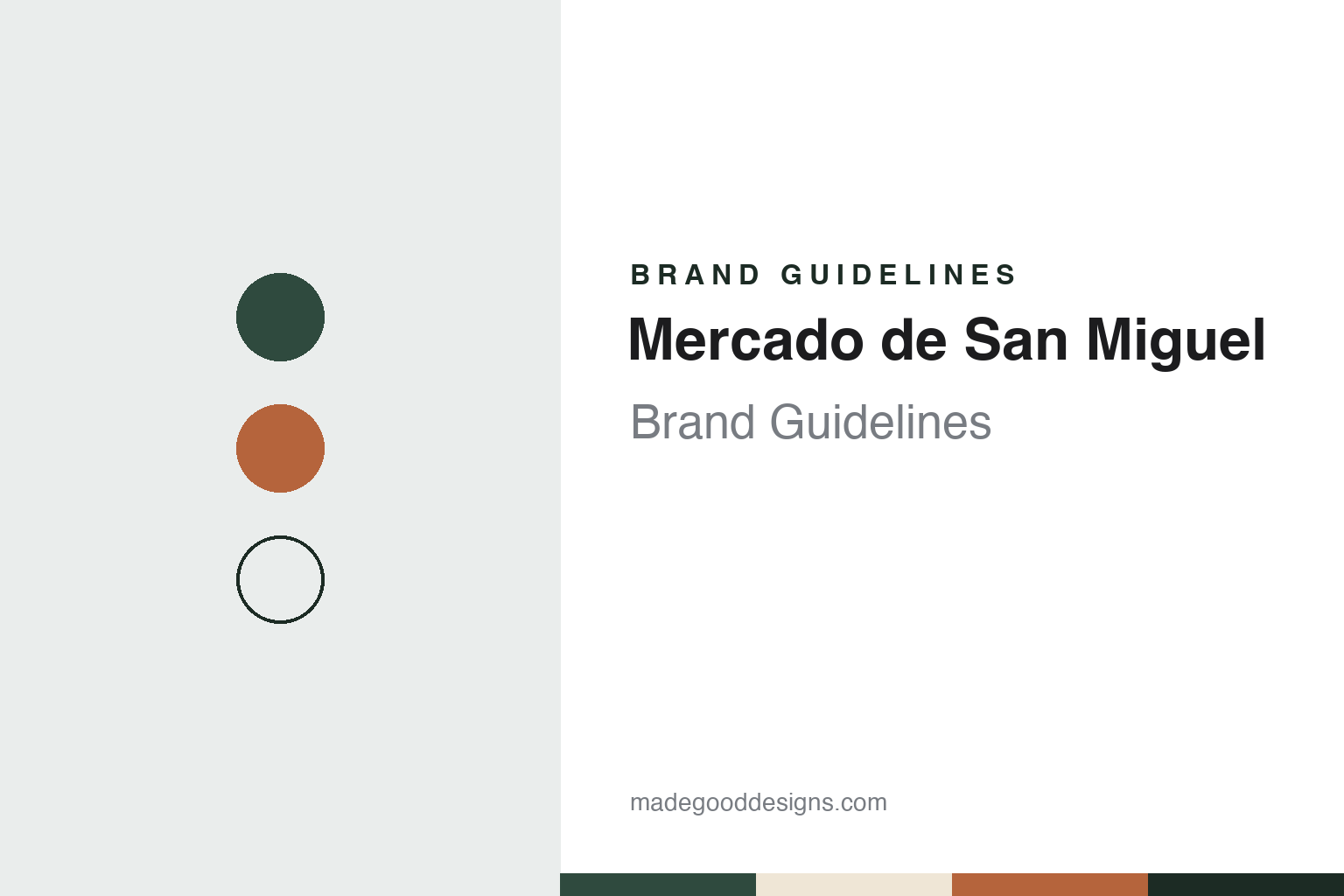
Two constants: an iron green, terracotta and cream palette and a plaza serif register. Abstract homage — not a Mercado de San Miguel sign or mark; no logo, lettering or photograph is reproduced.
From church square to iron hall
A market square since 1809, a covered market since 1916.
The Mercado de San Miguel (Saint Michael’s Market) stands in the Plaza de San Miguel, beside the Plaza Mayor in the old centre of Madrid. Its site is older than its building. Spanish Wikipedia says the square was once occupied by the parish church of San Miguel de los Octoes, already recorded in the early thirteenth century, which was demolished on 28 November 1809 on the orders of King José I Bonaparte, as part of a policy of opening up space in the crowded old town. The cleared plot became a public square where perishable food was sold from rows of wooden boxes, known as cajones, and small stalls; a geographical dictionary of Spain published in 1847 counted 128 boxes and 88 stalls there, according to the same article.
In the second half of the nineteenth century Madrid’s city council began to build covered markets with iron frames. Spanish Wikipedia lists los Mostenses and la Cebada, both of 1875, Chamberí of 1876 and la Paz of 1882, and notes that open-air trading carried on in the city’s squares because there were still too few halls. The covered market at San Miguel was built between 1913 and 1916 under the supervision of the architect Alfonso Dubé y Díez. It went up in two phases, the first finished in 1914, so that trading did not have to stop, and its design drew on other European iron markets in the manner of Les Halles in Paris, Spanish Wikipedia says. The market opened on 13 May 1916, a date also given by El Mundo in May 2009.
The building is a rectangle whose long sides run east to west, with two floors. Spanish Wikipedia singles out its cast-iron supports, the composition of its roofs, its drainage system and the ceramic cresting that crowns the roof; the glazing of the outer walls was added later. When it worked as a food market, the stalls were arranged along nine aisles. The iron markets built in Madrid in the last third of the nineteenth century were all later demolished, and elDiario.es described San Miguel in April 2026 as the only iron market that survives in the city. El Mundo and El País both recorded in May 2009 that the building is listed as a Bien de Interés Cultural (Property of Cultural Interest), Spain’s heritage designation.
In 1999 the regional government, the Comunidad de Madrid, supported a remodelling that returned the building to its original appearance, Spanish Wikipedia says.
Colour
A food market reopened as a food hall.
By the 2000s the market had a new owner. Spanish Wikipedia says a group of private individuals with interests in architecture, food and culture formed a company, El Gastrónomo de San Miguel, which became the majority owner. After almost two years of building work and six of preparation, El País reported on 14 May 2009, the market reopened on 13 May 2009 as a gourmet destination in the style of Barcelona’s La Boqueria. El Mundo, carrying an Efe agency report the same day, described a space of about 1,500 square metres with 34 stalls selling Spanish and imported produce, bread, wine and prepared food, and quoted the owners’ wish to make it “a centre of culinary culture.” El País noted the long glass frontage that lets passers-by watch the activity inside, and that the remodelling respected the original iron structure of 1916.
Ownership has changed since. El País reported in January 2026 that the property company Redevco acquired most of the market in 2017 and completed a refurbishment at the end of 2018. In April 2026 elDiario.es reported that the American fund Ares, which had bought the market together with Redevco in 2017 and held 75 per cent of the owning company, had left the shareholding and been replaced by direct investment from the family office of the Dutch Brenninkmeijer family, founders of the C&A clothing chain. Formal ownership and management stayed with Redevco, part of the same family group, through its subsidiary Aleda Investment, the paper said. The market’s own website named Redevco in March 2026 as the company that owns the building.
Its closures are short and dated. La Razón reported on 1 July 2021 that the market would reopen the next day after almost nine months closed. In 2026 it closed on 7 January for conservation work on the structure and reopened on 26 February 2026, according to El País and the market’s own website; El País added that maintenance work on the iron structure had also been carried out in 2024 and 2025.
Inside, the former stalls have become bars and counters with high standing tables, Spanish Wikipedia says. The market describes more than twenty stalls that between them cover Spanish cooking and produce, from seafood and cured ham to rice dishes and regional cheeses, and its website groups them under drinks, coffee, carts, food, sweets and takeaway. It says it receives more than seven million visitors a year; El País gave a figure of more than ten million a year in January 2026.
Typography
Food markets and market halls in Europe.
Europe’s food markets present themselves through a few recurring elements. Behind the name there is usually a public or charitable body rather than a single trader: a city council or its markets office, a charitable trust with volunteer trustees, or a company that runs a food hall inside an older building. Most give a founding date, and many separate the market’s origins, sometimes recorded centuries earlier in charters, acts of parliament or town records, from the date of the building that houses it today.
The buildings carry much of the identity. Many halls of the 19th and early 20th centuries are iron-and-glass structures: cast-iron columns, lattice beams and glazed roofs over open naves, sometimes added over an older open square when stallholders asked for cover. Entrances are often treated as set pieces, with iron arches, coloured glass, a city coat of arms or the market’s name in large lettering, and some markets have taken in parts of other buildings. Halls of the 21st century have tried other forms, such as a single arched shell or pavilions of glass.
Inside, the layout is usually described in general terms: fresh-produce stalls, fishmongers, butchers and delicatessens in rows or aisles, and, more and more, food counters with seating or a street-food area grouped in one section. Signs, clocks and painted lettering on stall fronts and gateways help visitors find their way, and often date from different periods of the same market.
Many of these markets have changed their role. Some began as, or grew into, wholesale markets supplying greengrocers and restaurants, and turned toward retail when that trade declined or moved to sites on the edge of the city. The guides in this series set out each market’s owner, buildings and dates as dated sources give them, and treat colours and type as an unofficial interpretation.
Aa
A high-contrast serif for a name on an iron roofline. (Specimen set in Playfair Display, a serif STAND-IN; NOT the Mercado de San Miguel logo or sign lettering.)
Mercado de San Miguel
Iron, glass and a name kept since 1916.
The market’s identity rests on its building more than on any published logo system. The features the sources describe are the cast-iron frame, the glazed walls and the ceramic cresting along the roof, and Spanish Wikipedia illustrates a lettered sign with the market’s name set high on one of the façades. The name itself has not changed since the hall opened: it comes from the parish church of San Miguel that stood on the plot until 1809. Its two lives, as a neighbourhood food market and, since 2009, as a food hall, share the same frame.
For a designer, that frame suggests a restrained system. A dark iron green can carry headings and rules the way the structure carries the roof; a warm terracotta can stand in for the ceramic cresting as a sparing accent; a pale cream and a cool glass grey can serve as grounds, echoing the light that the iron-and-glass design lets into the hall. A high-contrast serif keeps the tone of an early twentieth-century name on a roofline, while a plain sans handles stall categories, days and directions. Photography of the real building, where licensed, does more than any decoration; an abstract grid of bays and glass is enough for a cover.
For a design guide, the Mercado de San Miguel shows how a single surviving iron hall can keep one name across a century of changing use, from open-air boxes and stalls to a food market and then a food hall. Compare Museo del Prado, another Madrid institution with a historic building at its centre, and El Corte Inglés, the Madrid-based department-store group. For this guide we use an iron green, a terracotta, a cream and a glass grey with a serif, an unofficial interpretation; no product or logo is reproduced.
Explore & save
Keep Mercado de San Miguel’s identity on hand — save it to a board in the Made Good inspiration library.
Mercado de San Miguel identity set
Pin the iron green, terracotta and cream palette and the plaza serif register to your own board.
Source & notes
Frequently Asked Questions
What font can I use to match the Mercado de San Miguel look?
This guide describes Mercado de San Miguel’s type as “A high-contrast serif for a name on an iron roofline”. Its type specimen is set in Playfair Display from Google Fonts as a stand-in; Playfair Display is not Mercado de San Miguel’s own lettering.
What colours are in the Mercado de San Miguel palette?
This guide’s Mercado de San Miguel palette is Iron green #2F4A3E, Deep ironwork #1C2B24, Cresting terracotta #B5643C, Plaza cream #EFE6D6 and Glass grey #D9DEDB. The tones are the guide’s own unofficial interpretation, not official Mercado de San Miguel hex codes.
When did Mercado de San Miguel open?
Mercado de San Miguel opened on 13 May 1916, in Plaza de San Miguel, Madrid.
Who owns Mercado de San Miguel?
Mercado de San Miguel is owned by Redevco (through Aleda Investment) (2026).