Space Center Houston Brand Guidelines
The nonprofit visitor center beside NASA’s Johnson Space Center.
Aa
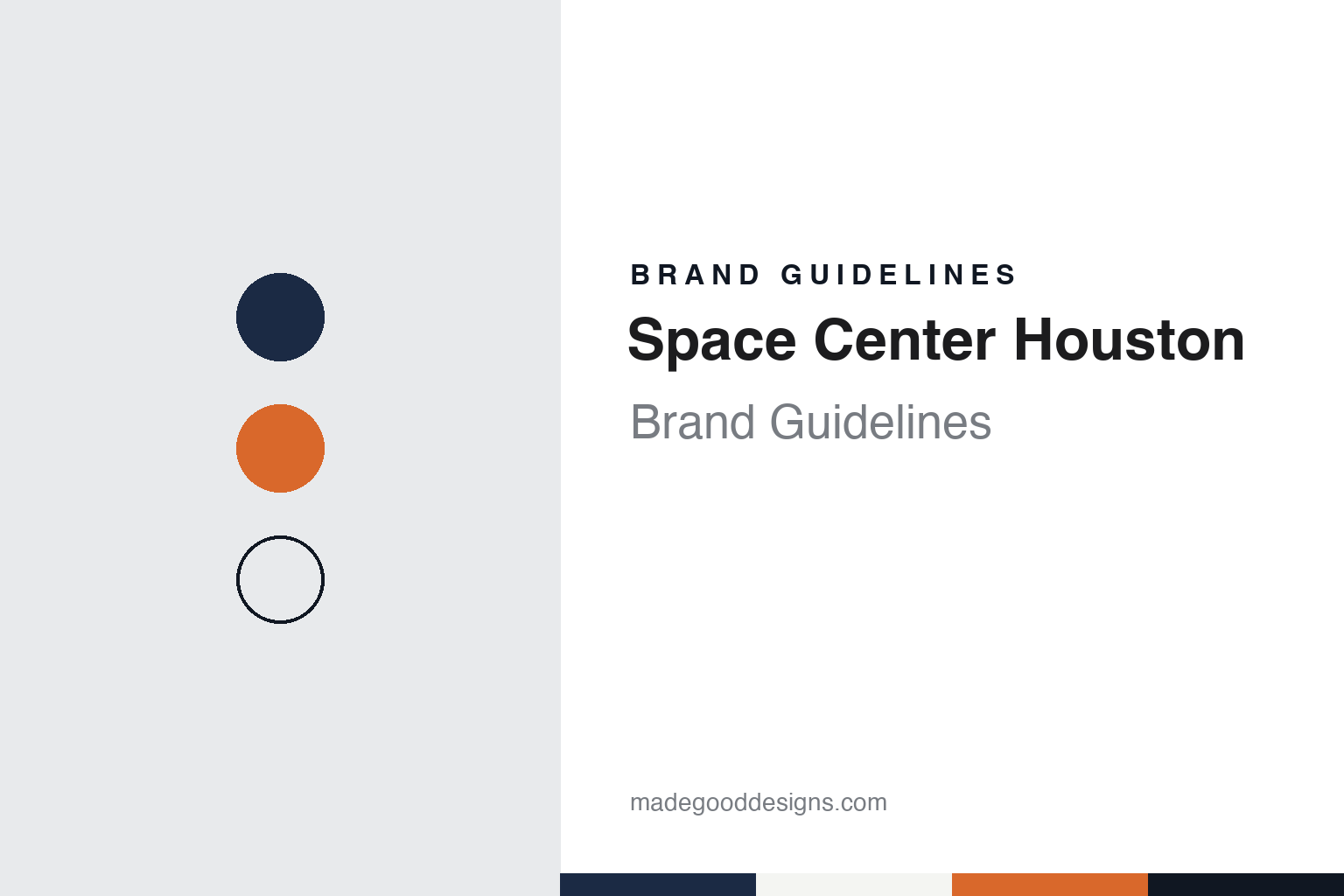
Two constants: a navy, white and orange palette and an engineered sans register. Abstract homage — not a Space Center Houston asset; no spacecraft, logo or sign is reproduced.
A visitor center outside the gate
From hallway displays to a purpose-built hall.
Space Center Houston opened on 16 October 1992 beside NASA’s Johnson Space Center in Houston, Texas, The Christian Science Monitor reported three days later. English Wikipedia describes it as a science museum that serves as the official visitor center of the Johnson Space Center, and says it replaced an earlier visitor center housed in the space center’s Building 2.
The Monitor’s 1992 report explains how it came about. Before the new building, the space center’s public displays occupied available hallway spaces filled with artifacts, in the words of Harold Stall, then the Johnson Space Center’s director of public affairs, whom the paper named as the initiator of the new facility. In 1986, the paper said, he approached Walt Disney Imagineering to discuss how the public could be received in a way that was entertaining, educational and inspirational. Disney in turn contracted BRC Imagination Arts of Burbank, California, to create the attractions.
To build and run the center, Stall set up the Manned Space Flight Education Foundation, which, the Monitor reported, built a 183,000-square-foot facility with corporate contributions and local bond money. English Wikipedia describes the foundation as a nonprofit 501(c)(3) organisation and says Space Center Houston is its cornerstone project; it adds that the center is not owned by NASA and does not receive federal funds, while keeping a close partnership with the space center next door.
The 1992 layout set the pattern that visitors still follow. The Monitor described an entrance hall called Space Center Plaza, with an Apollo lunar lander hanging overhead and the nose of a space shuttle containing a mock-up of the crew quarters; a collection of spacesuits; the Space Center Theater with a five-storey screen; a multiscreen Mission Status Center showing live views from across NASA; and the Starship Gallery, a spacecraft museum that opened with a short film on the history of American human spaceflight.
Colour
Flown capsules, a gallery and a plaza.
The collection is built around flown spacecraft, trainers and full-size mock-ups. English Wikipedia gives the museum’s size as about 250,000 square feet and says it displays more than 400 space artifacts. In the Starship Gallery it lists three flown capsules, among them the Mercury capsule Faith 7 of 1963 and the Apollo 17 command module America of 1972, alongside a lunar module test vehicle, a lunar roving vehicle trainer, a Skylab trainer and a vault of lunar samples. The Monitor’s 1992 account already described the gallery ending in a recreated lunar surface with a training rover, moon rocks including one that visitors could touch, and the large Skylab training module.
Another exhibit stands outside. Independence Plaza pairs NASA’s original Shuttle Carrier Aircraft, NASA 905 — a modified Boeing 747 that ferried the orbiters between sites — with a full-size space shuttle replica mounted on its back. English Wikipedia says the replica, formerly called Explorer, was previously shown at the Kennedy Space Center Visitor Complex in Florida and was moved to make way for a new hall there. The aircraft was brought to Space Center Houston from Ellington Airport on 30 April 2014, and on 14 August 2014 a heavy lift known as “The Rise of Independence” placed the replica on top of it.
The plaza opened to the public on 23 January 2016, collectSPACE reported that day, describing an eight-storey exhibit in which visitors can board both the jet and the orbiter. Visitors reach the orbiter through a steel tower beside the aircraft.
Other halls cover living and working in orbit. English Wikipedia lists an Astronaut Gallery of spacesuits, an International Space Station gallery, the Space Center Theater, a Destiny Theater with a short history film by BRC Imagination Arts, and a Mission Briefing Center with updates on current NASA missions. A pair of NASA T-38 jets marks the street entrance, in a space Wikipedia calls Talon Park.
Typography
Hangars, terminals and visitor halls.
Aviation and space museums usually present themselves through the body behind the name. Some are national institutions, such as a museum that belongs to the Smithsonian Institution in Washington, D.C.; others are private non-profit museums, trusts, foundations or associations that grew out of a group of enthusiasts; and some visitor centres are run by a company on behalf of a space agency. The name on the door often says which: “national”, “royal”, a city or a founding society.
Their buildings tend to carry much of the identity. Many sit on or beside airfields, and several occupy structures that had another life first: a hangar, an early aircraft factory, an airport terminal or an exposition hall, and in some cases a ship that became a museum. Others are purpose-built galleries with clear spans and glass roofs large enough to hang aircraft in mid-air, or open-sided shelters that keep the weather off airliners parked in rows.
The collections are described in general terms: aircraft, spacecraft, rockets, engines, instruments, models and archives of photographs and drawings, usually with a handful of objects that the museum and the press return to again and again. Restoration workshops, libraries and observatories sit alongside the galleries, and most of these museums run school and family programmes, learning centres and summer camps.
The graphic language is often borrowed from aviation itself: stencilled lettering, registration marks and roundels, runway and taxiway markings, instrument dials and the plain sans-serif type of signage on airfields and launch sites. In this guide we look at how each museum uses its building, its objects and its name, described plainly and in our own unofficial colours and stand-in typefaces.
Aa
An engineered sans for a hall of capsules and mock-ups. (Specimen set in Archivo, a sans STAND-IN; NOT the Space Center Houston logo.)
Space Center Houston
A foundation, a partner and a tram.
Space Center Houston sits outside the Johnson Space Center fence but works as its front door. English Wikipedia says the partnership with the space center — home of Mission Control and astronaut training — lets the museum take the public onto the grounds. Its open-air tram tours stop at Building 30, which houses the historic Apollo-era Mission Operations Control Room and the current Mission Control Center, at Building 9 with its full-size spacecraft mock-ups, and at Rocket Park, where a restored Saturn V on loan from the Smithsonian is displayed. The rocket was displayed outside the space center’s main entrance from 1977 to 2004 before its restoration, Wikipedia says.
The museum was designated a Smithsonian Affiliate in 2014, according to English Wikipedia. A Falcon 9 first-stage booster that flew two cargo missions to the International Space Station has stood near Independence Plaza since March 2020, Wikipedia adds.
Education is the foundation’s other main activity. English Wikipedia lists day camps, distance learning, field trips, a girls’ STEM academy, home-school days, overnight stays, scout camp-ins, sensory-friendly evenings and the Space Exploration Educators Conference among its programmes, all built on science, technology, engineering and mathematics activities related to human spaceflight. In 1992 the Monitor described shuttle-landing simulators and a space-station habitation mock-up staffed by mission briefing officers, and quoted Stall on showing students the link between classroom mathematics and spacecraft design.
Visually, the center borrows the language of the space programme rather than of a classical museum: flight hardware hung in open halls, a shuttle mock-up against the sky, and a visit that moves from galleries to a tram and onward to working NASA buildings. It is a visitor center whose most important exhibit is partly the campus next door.
For a design guide, Space Center Houston shows how a nonprofit visitor center can speak for a working space agency site while keeping its own name and its own collection. Compare NASA, whose Johnson Space Center the museum serves, and the Kennedy Space Center Visitor Complex, where the Independence replica was previously shown. For this guide we use a deep navy, an off-white and a warm orange with a sans, an unofficial interpretation; no product or logo is reproduced.
Explore & save
Keep Space Center Houston’s identity on hand — save it to a board in the Made Good inspiration library.
Space Center Houston identity set
Pin the Space Center Houston navy, white and orange palette and the engineered sans register to your own board.
Source & notes
Frequently Asked Questions
What font can I use to match the Space Center Houston look?
This guide describes Space Center Houston’s type as “An engineered sans for a hall of capsules and mock-ups”. Its type specimen is set in Archivo from Google Fonts as a stand-in; Archivo is not Space Center Houston’s own lettering.
What colours are in the Space Center Houston palette?
This guide’s Space Center Houston palette is Mission navy #1B2A44, Ink #101722, Orbit white #F4F5F2, Plaza orange #D9682B and Paper #FAFAF7. The tones are the guide’s own unofficial interpretation, not official Space Center Houston hex codes.
When did Space Center Houston open?
Space Center Houston opened on 16 October 1992, in Houston, Texas, USA.