Cité de l’espace Brand Guidelines
Toulouse’s space park of rockets, stations and domes.
Aa
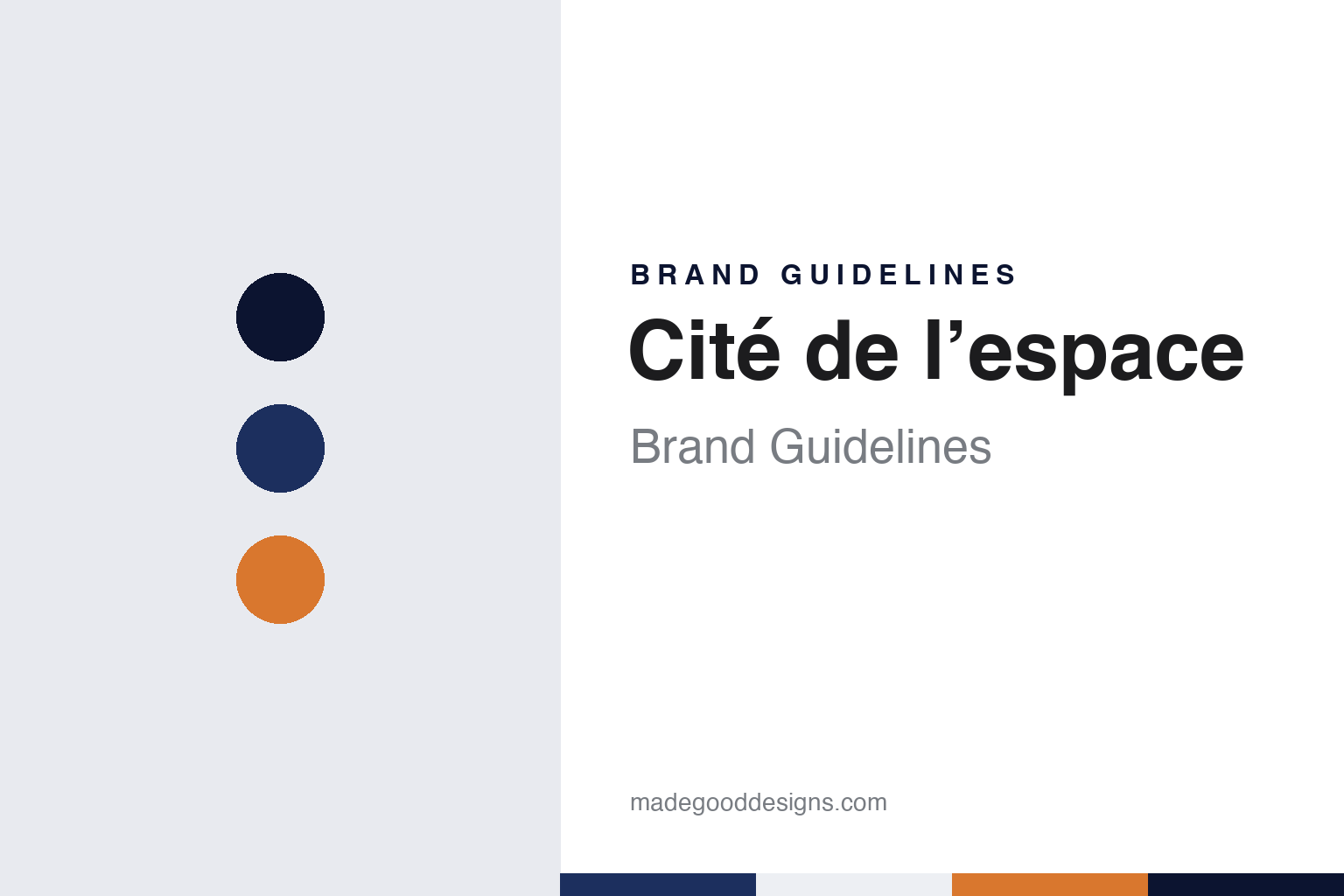
Two constants: a navy, orange and white palette and a geometric grotesque register. Abstract homage — not a Cité de l’espace asset; no spacecraft, logo or sign is reproduced.
Space City
A city project, a group of cofounders and an unfinished building.
The Cité de l’espace (“Space City”) is a science-culture centre on the eastern outskirts of Toulouse, devoted to spaceflight and astronomy. It opened in June 1997, inaugurated by Dominique Baudis, then mayor of Toulouse, according to French and English Wikipedia. French Wikipedia dates the project to 1994–1997, launched by the city through its development company Setomip.
The organisation behind the name is a partnership. The Cité says it was created on the initiative of Toulouse city hall with the support of the region, now Occitanie, and with its cofounders CNES, the French space agency, Airbus Defence and Space, the weather service Météo-France and the Ministry of National Education; later partners it names include Thales Alenia Space, the Caisse des Dépôts, the European Space Agency, the CNRS research body, Toulouse’s Paul Sabatier University, Safran and the aerospace research agency Onera. French Wikipedia gives a similar list of founding partners, including CNES. The park belongs to Toulouse Métropole and has been managed since it opened by SEMECCEL, a mixed public-private company whose name translates as the operating company for cultural, educational and leisure centres; the Cité says the same company has also run L’Envol des Pionniers, a heritage site on Toulouse’s early airmail history, since it opened in 2018.
The main building has an unusual origin. French Wikipedia says the reception and exhibition building was fitted into the unfinished shell of a museum-foundation designed by the Toulouse architect Roger Pagès and bought by the city, a building meant to show the work of the sculptor Henri-Georges Adam and still crowned by his monumental sculpture “La Chapelle blanche” (“The White Chapel”). The firm Cardete et Huet Architectes was chosen for the project.
Colour
A rocket in the garden, a station in the hall and two domes.
The Cité is organised as a park rather than a single gallery. French Wikipedia describes a four-hectare site with about 4,000 square metres of exhibitions, and Toulouse Métropole says the park imposes no set route, so visitors build their own visit. Its gardens hold full-size spacecraft, either test models or reproductions, the Métropole says.
The landmark is a full-size model of the Ariane 5 launcher. The French tourism agency’s site France.fr gave its height as 53 metres in 2021, as does French Wikipedia; English Wikipedia gives 55 metres. Toulouse Métropole describes the Cité as recognisable from the tip of the rocket. Nearby stand reproductions such as a Soyuz capsule and an Apollo lunar module, French Wikipedia says, and in April 2025 replicas of the James Webb Space Telescope’s mirrors were added to the gardens.
The second key object is Mir. French Wikipedia dates the opening of the full-size station to July 1998. The Cité says the three modules on show are “Earth twins” of the real station, taken from test models made at the Khrunichev production centre to check materials and the fitting of interior and electrical equipment, and that CNES lends objects that actually flew in orbit for the visit. The Cité notes that the first module of Mir was placed in orbit in 1986.
Smaller objects carry the same weight. French Wikipedia lists among the Cité’s “treasures from elsewhere” Moon rocks and Martian meteorites, and dates the acquisition of a Martian meteorite to 2013. The two planetariums measure 15 and 20 metres across, according to French and English Wikipedia, and seat about 140 and 280 people.
Astronomy has its own building. Astralia, opened in April 2005, houses a 280-seat planetarium with a 600-square-metre hemispherical screen and a 300-seat IMAX cinema, according to English and French Wikipedia; the planetarium was renovated and reopened in July 2017. A smaller planetarium, the Stellarium, shows programmes for younger children, and an astronomy dome, the Coupole de l’Astronome, opened in April 2014 with new educational laboratories. Other halls cover the Solar System, Earth-observation satellites, launch centres and the Moon, and France.fr describes a 350-square-metre children’s area on two levels for children from four.
Typography
Hangars, terminals and halls.
Aviation and space museums usually present themselves through the body behind the name. Some are national institutions, such as a museum that belongs to the Smithsonian Institution in Washington, D.C.; others are private non-profit museums, trusts, foundations or associations that grew out of a group of enthusiasts; and some visitor centres are run by a company on behalf of a space agency. The name on the door often says which: “national”, “royal”, a city or a founding society.
Their buildings tend to carry much of the identity. Many sit on or beside airfields, and several occupy structures that had another life first: a hangar, an early aircraft factory, an airport terminal or an exposition hall, and in some cases a ship that became a museum. Others are purpose-built galleries with clear spans and glass roofs large enough to hang aircraft in mid-air, or open-sided shelters that keep the weather off airliners parked in rows.
The collections are described in general terms: aircraft, spacecraft, rockets, engines, instruments, models and archives of photographs and drawings, usually with a handful of objects that the museum and the press return to again and again. Restoration workshops, libraries and observatories sit alongside the galleries, and most of these museums run school and family programmes, learning centres and summer camps.
The graphic language is often borrowed from aviation itself: stencilled lettering, registration marks and roundels, runway and taxiway markings, instrument dials and the plain sans-serif type of signage on airfields and launch sites. In this guide we look at how each museum uses its building, its objects and its name, described plainly and in our own unofficial colours and stand-in typefaces.
Aa
A geometric grotesque — the clean lettering of launchers and mission patches. (Specimen set in Space Grotesk, a sans STAND-IN; NOT the Cité de l’espace logo.)
Cité de l’espace
A park that follows the news from orbit.
The Cité describes itself as a centre of scientific culture for every audience, built on participation and immersion, and says it works with the French, European and international space agencies, laboratories and industry. Its programme follows current missions: a hall styled as a control centre, the Carré de l’Actu, relays daily life on the International Space Station, and French Wikipedia lists later additions such as a Mars hall in October 2002, a children’s base in May 2006 and a Martian terrain in April 2022.
Visitor figures are given by the Cité and its encyclopaedia entries rather than independent counts: French Wikipedia says the park welcomed its eight-millionth visitor in July 2023. Toulouse Métropole says the Cité has held the national “Tourisme & Handicap” accessibility mark since 2003 and received the scheme’s trophy in 2015.
Visually, the Cité is a skyline of objects. The white rocket in the garden, the long cylinders of the Mir modules and the domes of the planetariums do the work that a facade would do elsewhere, and the sculpture on the main building adds a further white form. The Cité sits in a city with a long aerospace industry, which its own site and its list of cofounders make plain.
For a design guide, Cité de l’espace shows how a city and its space sector can present a shared subject as a public park. Compare CNES, one of its cofounders, and Airbus, another Toulouse name in aerospace. For this guide we use navy, orange and white with a sans, an unofficial interpretation; no product or logo is reproduced.
Explore & save
Keep Cité de l’espace’s identity on hand — save it to a board in the Made Good inspiration library.
Cité de l’espace identity set
Pin the navy, orange and white palette and the geometric grotesque register to your own board.
Source & notes
Frequently Asked Questions
What font can I use to match the Cité de l’espace look?
This guide describes Cité de l’espace’s type as “A geometric grotesque — the clean lettering of launchers and mission patches”. Its type specimen is set in Space Grotesk from Google Fonts as a stand-in; Space Grotesk is not Cité de l’espace’s own lettering.
What colours are in the Cité de l’espace palette?
This guide’s Cité de l’espace palette is Orbit navy #1C2F5E, Deep space #0C1430, Launch orange #D9772E, Fairing white #EDEFF3 and Paper #F7F7F5. The tones are the guide’s own unofficial interpretation, not official Cité de l’espace hex codes.
When did Cité de l’espace open?
Cité de l’espace opened in June 1997, in Toulouse, France.