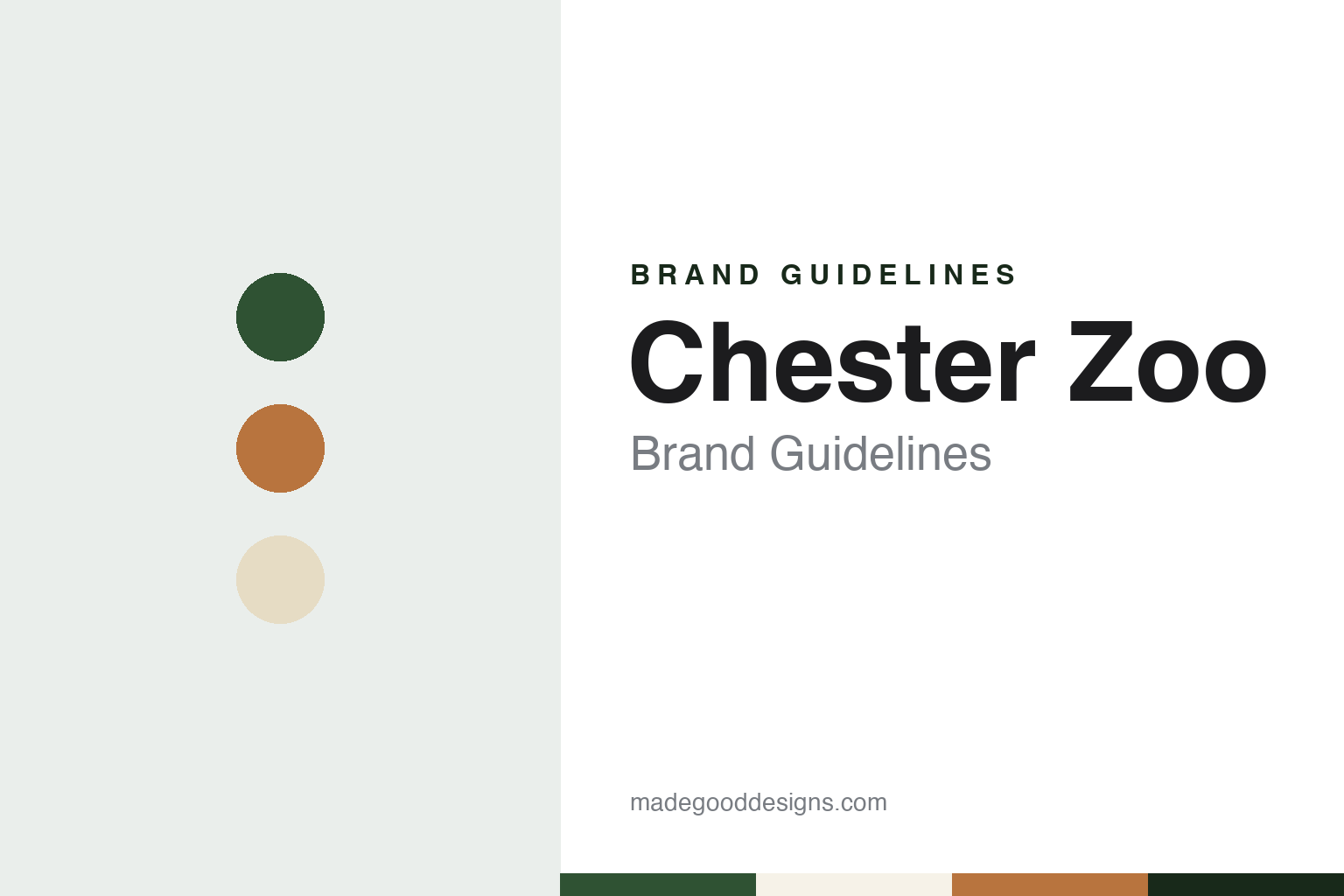
Chester Zoo Brand Guidelines
A family zoo at a Cheshire manor house that grew into a charity-run site of moats, islands and savannah.
Aa
Two constants: a deep green, clay and sand palette and a garden-estate serif register. Abstract homage — not a Chester Zoo asset or mark; no logo, sign, photograph or wordmark is reproduced.
A manor house and a family
Oakfield, Upton-by-Chester, 1931.
Chester Zoo stands at Upton-by-Chester, on the northern edge of Chester in Cheshire, England. It was opened by George Mottershead and his family, and the zoo itself dates its first opening of the gates to 10 June 1931, in an anniversary article it published on 10 June 2021. English Wikipedia says the Mottershead family ran a market-garden business at Shavington, near Crewe, and that Mottershead collected small animals that arrived with imported plants before he set out to find a home for a zoo of his own.
The home he chose was Oakfield, a manor house with about nine acres of gardens in what was then a country village and is now a suburb of Chester. English Wikipedia says he bought it in 1930 and that the first animals were shown in pens in the courtyard of the house. The house still stands inside the zoo: English Wikipedia describes The Oakfield as a restaurant in a Victorian mansion near the lion enclosure, used for private functions as well as for visitors.
The zoo became a charity early. Its own 2021 anniversary article says it first became a charity in 1934, and English Wikipedia names the operator as the North of England Zoological Society, a registered charity, which it says receives no government funding. The society is the organisation that holds the zoo today, governed by a board of trustees.
The site grew steadily after the Second World War. English Wikipedia says materials were scarce, so that an enclosure of 1950 was built from recycled wartime road blocks and pillboxes, and that “Always building” was the zoo’s slogan at the time. The zoo now covers about 51 hectares, within a total land holding of about 160 hectares, according to English Wikipedia, which counts more than 500 species in the collection.
Colour
Moats instead of bars, and a site cut by a bridleway.
The zoo’s layout follows an idea about bars. English Wikipedia says Mottershead wanted a zoo without the iron cages of the Victorian era, and that he took Carl Hagenbeck’s use of moats and ditches as separators and extended it across the site. In 1956, it says, a group of grassy islands surrounded by a strip of water opened for chimpanzees, and those islands remain a centrepiece of the grounds. A large planted tropical house, now called Tropical Realm, opened in 1964, with free-flying birds and paths running through the planting under one roof.
The site is split by a public bridleway, Flag Lane. English Wikipedia says that for years a single bridge near the elephant area was the only crossing inside the grounds, until a second, Bats’ Bridge, opened in April 2008. The public entrance moved in the summer of 1995 from the east side to the north, with its own access from the A41 Chester by-pass, and was remodelled in 2012. A monorail carried visitors around part of the grounds from 1991 to 2019. In 2025, English Wikipedia says, the zoo divided the grounds into colour zones, yellow, pink, orange, green and blue, to make the large site easier to navigate.
One of the main additions of the 2010s is Islands. The BBC reported on 27 November 2012 that planning permission had been granted for a project with a boat ride and a series of bridges, showing animals and plants from south-east Asia. Place North West reported on 29 April 2015 that the 12-acre development would open on Monday 13 July 2015, with recreations of islands from the Philippines, Papua New Guinea, Bali, Sumatra, Sumba and Sulawesi, and named the architect as dan pearlman, with Laing O’Rourke on site since early 2014. Its centrepiece, the indoor Monsoon Forest house, opened in August 2015; blooloop reported on 21 August 2015 that the building, designed by dan pearlman, had its own tropical weather system.
Typography
Zoos in Europe, North America and Australia.
A zoo usually presents itself through the body that stands behind its name. Some are run by a zoological society founded for the purpose, some by a charity, a company or a city, and some by a state agency that took over from an older society; the Encyclopedia of Melbourne, for example, describes how Melbourne’s acclimatisation society handed its zoo to a state board in 1937. The founding date matters as much as the owner, and many zoos give it a prominent place, whether it falls in the 18th or 19th century or in the decades of the modern site.
The grounds tell the same story in buildings. Older zoos keep historic gates, animal houses and pavilions, some of them on a heritage register, next to large landscaped habitat areas built much later. English Wikipedia describes how Chester Zoo’s founder followed Carl Hagenbeck’s use of moats and ditches in place of bars, an approach that shaped many 20th-century layouts, while the Encyclopedia of Melbourne notes that many 19th-century zoological gardens followed the example of London Zoo.
A large site also needs to be read on the move. Maps, signposts and named areas or zones guide visitors between houses and habitats, and several zoos group their animals by region or climate, so that a path leads from one landscape to the next. Education is part of the offer too, with programmes for schools and families described in general terms on the zoos’ own websites.
Visual identities draw on these layers. Logos often use an animal silhouette or a simple wordmark, signage follows the paths and zones of the site, and the buildings themselves, old and new, carry much of the character. This guide describes each zoo through what dated sources say about its founders, operators, buildings and grounds, and uses colours and type of its own choosing.
Aa
A garden-estate serif, for a zoo that began in the grounds of a manor house. (Specimen set in Fraunces, a serif STAND-IN; NOT the Chester Zoo logo.)
Chester Zoo today
Savannah, zones and a nature reserve.
The most recent large area is Heart of Africa. blooloop reported on 1 April 2025 that it would open on 5 April 2025 as a 22.5-acre zone designed to recreate grassland habitats of central Africa, home to 57 African species, with an open savannah at its centre and a new indoor habitat called Hidden Savannah. English Wikipedia says the earlier walk-through aviary and the black rhino area, both modelled on Tsavo National Park in Kenya, were folded into the new zone, which also has three places to eat, including Pamoja Village.
Outside the paid grounds, English Wikipedia says, a nature reserve of about 600,000 square feet opened in April 2018 and is free to enter. Inside, the zoo lists catering buildings with names drawn from its areas, such as Manado Street Kitchen on the Sulawesi island of Islands and June’s Pavilion on the west side. The zoo’s website describes it as a registered charity. Its learning pages offer school resources and talks in general terms.
On the ground, a Victorian manor house, moats and islands of the post-war decades, a 1960s tropical house, and the timber, water and planting of Islands and Heart of Africa sit side by side on one site, joined by bridges over a public lane. The palette here is our own and does not copy the zoo’s colours.
For a design guide, Chester Zoo shows how a large site can be read as a set of named places held together by paths, bridges and colour-coded zones. Compare London Zoo, another English zoo run by a zoological society, and Kew Gardens, a landscaped site of glasshouses and planting. For this guide we use a deep green, a clay and a sand with a serif, an unofficial interpretation; no product or logo is reproduced.
Explore & save
Keep Chester Zoo’s identity on hand — save it to a board in the Made Good inspiration library.
Chester Zoo identity set
Pin the Chester Zoo green, clay and sand palette and the garden-estate serif register to your own board.
Source & notes
Frequently Asked Questions
What font can I use to match the Chester Zoo look?
This guide describes Chester Zoo’s type as “A garden-estate serif, for a zoo that began in the grounds of a manor house”. Its type specimen is set in Fraunces from Google Fonts as a stand-in; Fraunces is not Chester Zoo’s own lettering.
What colours are in the Chester Zoo palette?
This guide’s Chester Zoo palette is Oakfield Green #2F5233, Savannah Clay #B8743E, Moat Sand #E6DCC4, Forest Shade #18291A and Paper #F6F2E8. The tones are the guide’s own unofficial interpretation, not official Chester Zoo hex codes.
When did Chester Zoo open?
Chester Zoo opened on 10 June 1931, in Oakfield, Upton-by-Chester, Cheshire.
Who founded Chester Zoo?
Chester Zoo was founded by George Mottershead and his family on 10 June 1931.