Zoo Zürich Brand Guidelines
The 1929 Zürichberg zoo of the Masoala hall and the elephant park.
Aa
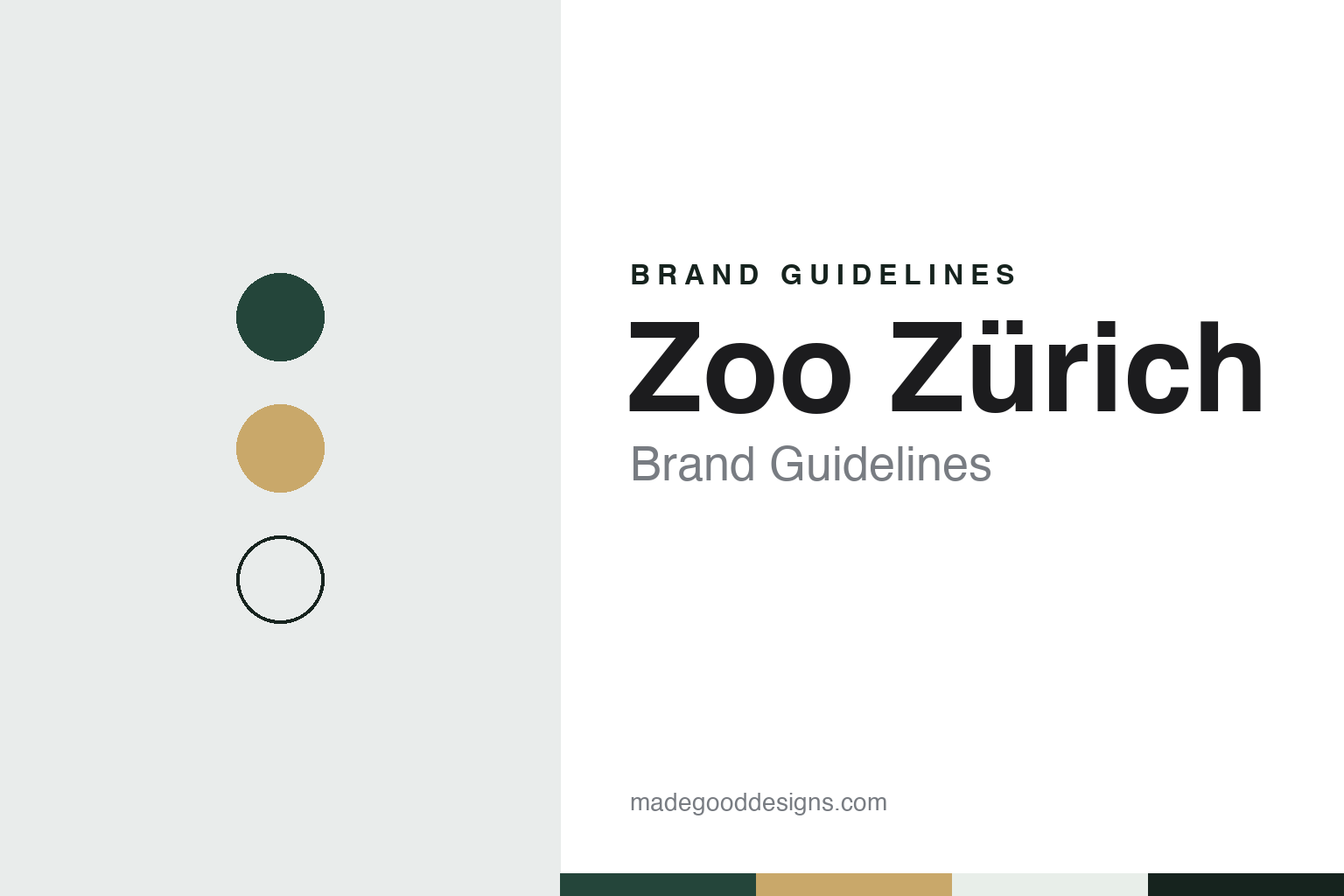
Two constants: a pine green, sand and mist palette and a Swiss grotesque register. Abstract homage — not a Zoo Zürich asset; no logo, sign or building drawing is reproduced.
A zoo on the hill
A society, a meadow and an inn above the city.
Zoo Zürich sits on the Zürichberg, the wooded hill above the city, in the Fluntern quarter, at about 600 metres above sea level. It opened on 7 September 1929. German Wikipedia calls it the third-oldest zoological garden in Switzerland, after Zoo Basel and the Natur- und Tierpark Goldau, and English Wikipedia gives the same ranking.
The zoo grew out of a citizens’ society. In 1925 supporters founded the Tiergarten-Gesellschaft Zürich (Zürich Zoo Society), which soon bought a large plot on the Allmend Fluntern, a meadow that came with an inn whose view of the Säntis gave the first zoo restaurant its name, Säntisblick. Ground was broken on 28 October 1928, and a cooperative, the Genossenschaft Zoologischer Garten, was set up to run the zoo. German Wikipedia says the society now has more than 40,000 members and remains the zoo’s official support association.
The 1929 zoo was compact: a main building with aviaries, aquariums, terrariums, monkey cages and an elephant stall, a bear pit, a carnivore house and a small-monkey house, with paddocks and simple stables in between. The first years were hard. The exposed site was cold, many animal houses were not yet heated and the site was not yet on the city water supply; through the Depression and the Second World War the zoo repeatedly relied on loans from the city and the canton, German Wikipedia says.
Information was part of the zoo from the start. In 1954 it introduced short species labels, known as Hediger labels after Heini Hediger, and German Wikipedia notes that many zoos adopted the practice. In 1999 the cooperative was converted into a company limited by shares, Zoo Zürich AG. The zoo says it is an AG of a purely non-profit and cultural character, and it sells registered shares to the public; its website lists Zoo Zürich AG alongside a restaurant company, Zoo Restaurants GmbH.
Colour
From animal houses to landscapes.
From the 1990s the zoo reorganised itself by geography. A concept presented in 1992 set out to more than double the area and to show ecosystems rather than rows of species, grouped into habitats from Eurasia, South America and Africa and Madagascar, German Wikipedia says. The site grew from almost 15 hectares in 2006 to 27 hectares by 2020, and the zoo counted about 320 species at the end of 2024, according to the same source. New areas followed in steps: a South American cloud forest in 1995, a Eurasian wetland in 1997, a Himalaya area in 2000 and 2001, the Zoolino farmyard in 2002 and the Pantanal wetland in 2012.
The Masoala Rainforest hall opened in summer 2003. It recreates a piece of the Masoala lowland rainforest of north-eastern Madagascar under a roof of inflated foil cushions, and the landscape architects Vogt, who list the Zürich architects Gautschi Storrer as collaborators on the project from 1994 to 2003, give its size as 120 metres long, 90 metres wide and 30 metres high. Vogt describes paths that lead past swamp zones to a six-metre waterfall, with plants arranged in tree, shrub and ground layers. For the hall’s tenth anniversary in 2013 the zoo added a treetop walkway rising to about 18 metres, SRF reported in March 2013.
The Kaeng Krachan Elephant Park opened in June 2014, replacing an elephant house of 1971. Dezeen reported in July 2015 that Markus Schietsch Architekten designed it with a landscape architecture practice and the engineers Walt + Galmarini. Its domed timber gridshell roof covers 6,800 square metres and is cut by 271 skylights of different shapes, which the architects compared to light falling through a canopy of trees; the roof was built from prefabricated three-layer panels that were assembled flat and bent into shape on site. The 11,000-square-metre complex gives six times the room of the old enclosure, Dezeen said, and includes a pool with a glass wall for underwater viewing. swissinfo.ch described the building in December 2015 as designed to give the sensation of standing under a tree canopy.
The Lewa savanna, completed in April 2020, is the zoo’s largest area at 5.6 hectares, German Wikipedia says, with artificial baobabs, a waterhole and kopje rocks recalling East Africa. The Africa House of 1965, built on principles set out by Heini Hediger, which held African animals until 2016 and is now the Australia House, is the only heritage-listed building at the zoo, according to the same source. The main building of 1929 was renewed in 1989 and now holds the Exotarium with its terrariums and aquariums.
Typography
How zoos present themselves.
A zoo usually presents itself through the body that stands behind its name. Some are run by a zoological society founded for the purpose, some by a charity, a company or a city, and some by a state agency that took over from an older society; the Encyclopedia of Melbourne, for example, describes how Melbourne’s acclimatisation society handed its zoo to a state board in 1937. The founding date matters as much as the owner, and many zoos give it a prominent place, whether it falls in the 18th or 19th century or in the decades of the modern site.
The grounds tell the same story in buildings. Older zoos keep historic gates, animal houses and pavilions, some of them on a heritage register, next to large landscaped habitat areas built much later. English Wikipedia describes how Chester Zoo’s founder followed Carl Hagenbeck’s use of moats and ditches in place of bars, an approach that shaped many 20th-century layouts, while the Encyclopedia of Melbourne notes that many 19th-century zoological gardens followed the example of London Zoo.
A large site also needs to be read on the move. Maps, signposts and named areas or zones guide visitors between houses and habitats, and several zoos group their animals by region or climate, so that a path leads from one landscape to the next. Education is part of the offer too, with programmes for schools and families described in general terms on the zoos’ own websites.
Visual identities draw on these layers. Logos often use an animal silhouette or a simple wordmark, signage follows the paths and zones of the site, and the buildings themselves, old and new, carry much of the character. This guide describes each zoo through what dated sources say about its founders, operators, buildings and grounds, and uses colours and type of its own choosing.
Aa
A clean Swiss grotesque for a hillside zoo of landscapes and halls. (Specimen set in Archivo, a sans STAND-IN; NOT the Zoo Zürich logo.)
Zoo Zürich
Halls, roofs and a hillside of landscapes.
The zoo’s public face today is a short line: its website signs off with “Verbinden, was zusammengehört” (Connecting what belongs together). Education has a long history here. Besides the Hediger labels of 1954, the zoo opened the Naturwerkstatt, a set of course rooms for children’s groups, in 2005, and German Wikipedia says a team of more than 300 volunteers has worked with visitors since 2000.
German Wikipedia gives 1,270,000 visitors for 2021 and 1,422,059 for 2014, the year the elephant park opened; it records that the zoo first passed half a million visitors a year in 1955. The tram stop that serves it was renamed from Allmend Fluntern to Zoo in 1952, and the site is still reached through a residential hillside, between meadows and woods at the edge of the city.
For designers, the striking thing about Zoo Zürich is how much of its identity is carried by its buildings and landscapes rather than by a single emblem. The two large roofs set the tone: the foil cushions of the Masoala hall, which let in daylight for a tropical forest on a Swiss hill, and the timber gridshell of the elephant park, whose scattered skylights the architects meant to suggest the branches of trees. Around them, the habitat areas are named after real places, Masoala in Madagascar, Kaeng Krachan in Thailand and Lewa in Kenya, so that the map of the zoo reads like a small atlas. A guide built on this would favour natural materials, daylight and generous space over decoration.
The organisation itself is plain and civic: a society founded by citizens in 1925, a cooperative that ran the zoo for seventy years and a non-profit company with shareholders from the public since 1999. That history suits a restrained, factual typographic voice, close to the Swiss tradition of clear sans-serif signage, with colour taken from forest, sand and glass.
For a design guide, Zoo Zürich shows how architecture and landscape can do the work of a visual identity. Compare ARTIS, a zoo society of 1838 with a park full of listed buildings, and London Zoo, another zoo run by a society. For this guide we use a pine green, a warm sand and a pale mist with a sans, an unofficial interpretation; no product or logo is reproduced.
Explore & save
Keep Zoo Zürich’s identity on hand — save it to a board in the Made Good inspiration library.
Zoo Zürich identity set
Pin the Zoo Zürich pine green, sand and mist palette and the Swiss grotesque register to your own board.
Source & notes
Frequently Asked Questions
What font can I use to match the Zoo Zürich look?
This guide describes Zoo Zürich’s type as “A clean Swiss grotesque for a hillside zoo of landscapes and halls”. Its type specimen is set in Archivo from Google Fonts as a stand-in; Archivo is not Zoo Zürich’s own lettering.
What colours are in the Zoo Zürich palette?
This guide’s Zoo Zürich palette is Zürichberg pine #24453A, Forest night #16231E, Savanna sand #C9A86A, Glasshouse mist #E8EEE9 and Paper #F7F6F2. The tones are the guide’s own unofficial interpretation, not official Zoo Zürich hex codes.
When did Zoo Zürich open?
Zoo Zürich opened on 7 September 1929, in Zürichberg, Zürich, Switzerland.
Who founded Zoo Zürich?
Zoo Zürich was founded by Tiergarten-Gesellschaft Zürich (1925) on 7 September 1929.