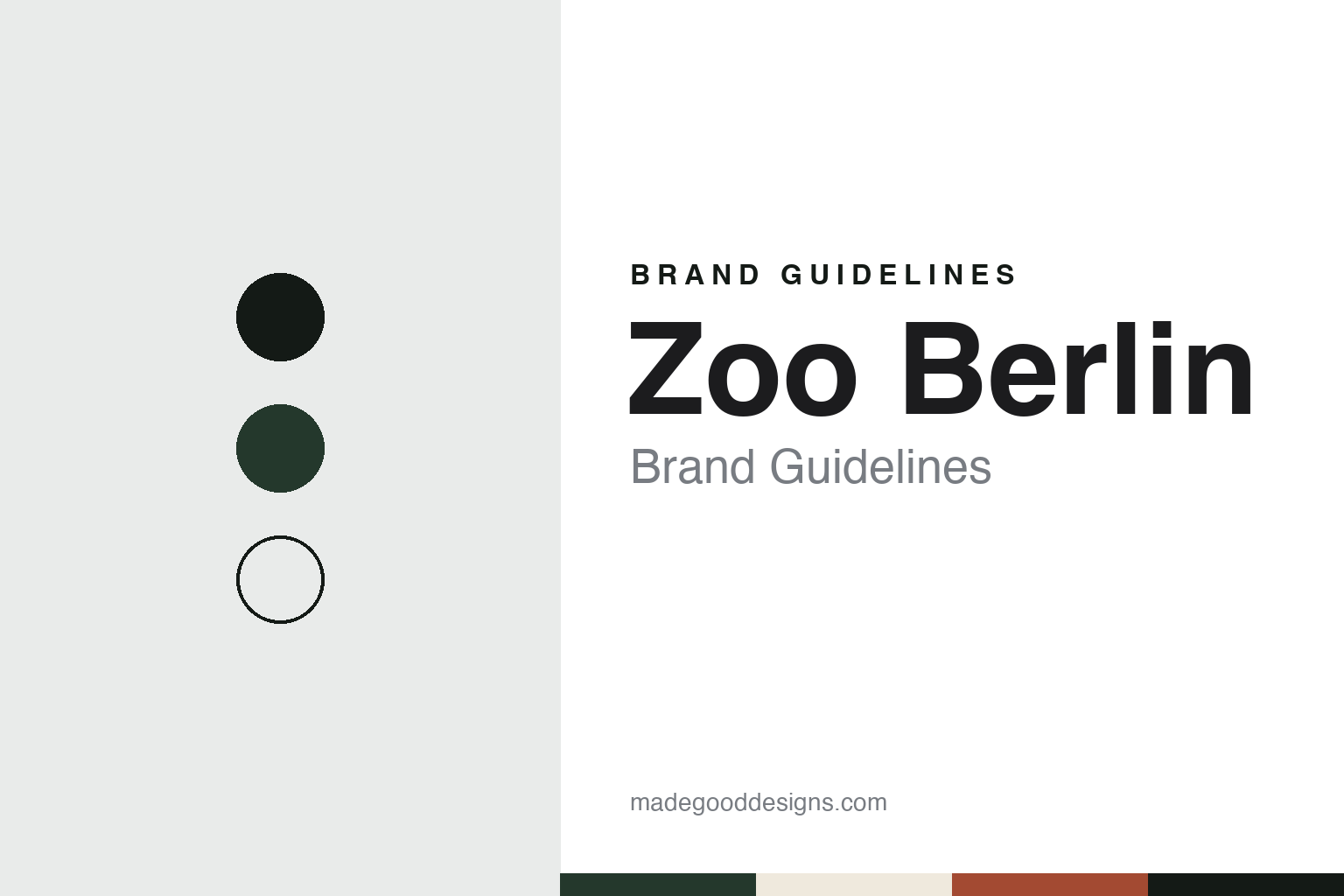
Zoo Berlin Brand Guidelines
A city zoo of 1844, its gates and its share company.
Aa
Two constants: a green, sandstone and brick red palette and a civic serif register. Abstract homage — not a Zoo Berlin mark; no logo, gate, sign or animal image is reproduced.
A royal pheasantry
A professor, a king’s land and a share company.
Zoo Berlin, formally the Zoologischer Garten Berlin, opened on 1 August 1844 on the south-western edge of the Tiergarten park. Aus Politik und Zeitgeschichte, the journal of Germany’s Federal Agency for Civic Education, called it in 2021 the oldest existing German zoo. Its roots lay in royal animal keeping: a pheasantry laid out in the Tiergarten in 1742 and a menagerie on the Pfaueninsel, the Peacock Island in the Havel, from 1820. The zoologist Martin Hinrich Lichtenstein, the first professor of zoology at the new Friedrich-Wilhelms-Universität, the journal says, won the support of the Prussian king, who in 1841 gave the pheasantry grounds for the zoo’s free use, together with a loan and animals from the Peacock Island.
The garden was not finished when it opened and showed only about 100 animals, the journal says. Lichtenstein, its founding director, expected a company of shareholders to carry it, and on 28 February 1845 fifty-four men and one woman founded the Actien-Verein des zoologischen Gartens bei Berlin, the zoological garden’s share association. Sales were slow at first: only 200 of the first 500 shares had been sold by 1868. A new statute in 1869 added 1,000 shares, and in the boom years after 1870 the zoo grew with the city.
German Wikipedia dates an Antelope House in an exotic style to 1871, followed by an elephant house, an ostrich house and the Elephant Gate, the Elefantentor, which it dates to 1899. A Marble Hall, built in 1910–1912 in the restaurant complex, was used as an inn and cinema and hosted the premiere of the film Nosferatu in 1922; the Aquarium opened in 1913. After the First World War, hyperinflation weighed on the zoo, and after a temporary closure it was kept going by loans from the city and the state, Aus Politik und Zeitgeschichte says.
Colour
Twentieth-century history, gates and houses.
From 1933 the zoo’s board and its share register changed under the Nazi regime’s laws, and its Jewish board members and shareholders lost their places, Aus Politik und Zeitgeschichte wrote in 2021. Its wartime history, including the use of forced labour, has since been documented by historians, the journal says; the zoo was heavily damaged in November 1943 and reopened on 25 July 1944. The zoo itself funded research into the share sales from 2002, unveiled a memorial plaque for its Jewish shareholders in 2011 and opened a permanent exhibition on its own history in December 2016, according to the journal and the Jüdische Allgemeine.
For a designer, the zoo’s history is easiest to read in its entrances and houses. Visitors arrive through gates rather than a single modern turnstile building, and each gate carries its own character: the Elephant Gate on Budapester Straße and the Lion Gate on Hardenbergplatz, which faces the station that shares the zoo’s name. Both are reconstructions of the 1980s based on the originals, so the zoo’s most photographed façades combine nineteenth-century design with late twentieth-century building work.
Inside, the animal houses continue that approach. Several were designed in styles associated with the regions their animals came from, so a single walk passes from an exotic-style Antelope House to a Bison House of 1905 and a Persian-style area for equids. The result is less a uniform campus than a collection of small buildings, each with its own roofline, ornament and material, set in the green of the Tiergarten’s edge.
That mix gives a brand designer two clear sources. One is the architecture: gates, roofs and buildings in borrowed styles, which suggest a warm sandstone, a brick red and a deep park green. The other is the institution: a share company founded in 1845 that still runs the zoo, which suits a calm, civic register rather than a playful one. A serif with some weight at display sizes and a plain sans for wayfinding would echo both, and a restrained palette leaves room for the photography of buildings and animals that most zoo communication relies on.
Typography
Societies, sites and signs.
A zoo usually presents itself through the body that stands behind its name. Some are run by a zoological society founded for the purpose, some by a charity, a company or a city, and some by a state agency that took over from an older society; the Encyclopedia of Melbourne, for example, describes how Melbourne’s acclimatisation society handed its zoo to a state board in 1937. The founding date matters as much as the owner, and many zoos give it a prominent place, whether it falls in the 18th or 19th century or in the decades of the modern site.
The grounds tell the same story in buildings. Older zoos keep historic gates, animal houses and pavilions, some of them on a heritage register, next to large landscaped habitat areas built much later. English Wikipedia describes how Chester Zoo’s founder followed Carl Hagenbeck’s use of moats and ditches in place of bars, an approach that shaped many 20th-century layouts, while the Encyclopedia of Melbourne notes that many 19th-century zoological gardens followed the example of London Zoo.
A large site also needs to be read on the move. Maps, signposts and named areas or zones guide visitors between houses and habitats, and several zoos group their animals by region or climate, so that a path leads from one landscape to the next. Education is part of the offer too, with programmes for schools and families described in general terms on the zoos’ own websites.
Visual identities draw on these layers. Logos often use an animal silhouette or a simple wordmark, signage follows the paths and zones of the site, and the buildings themselves, old and new, carry much of the character. This guide describes each zoo through what dated sources say about its founders, operators, buildings and grounds, and uses colours and type of its own choosing.
Aa
A civic serif for a nineteenth-century institution. (Specimen set in Spectral, a serif STAND-IN; NOT the Zoo Berlin logo.)
Zoo Berlin
Two gates, two zoos, one company.
After 1945 the zoo was rebuilt in West Berlin, while East Berlin built its own Tierpark on the grounds of Friedrichsfelde Palace in the mid-1950s. German Wikipedia says later directors had historic structures such as the Elephant Gate, the Lion Gate and the Giraffe House reconstructed. It dates the rebuilt Elephant Gate on Budapester Straße to 1984, where the Jüdische Allgemeine in 2015 gave 1983, and the Lion Gate on Hardenbergplatz, the western entrance, to 1987, the city’s 750th anniversary. The Tierpark became a state-owned company in 1991, and in 1993 the zoo, still organised as a public limited company, bought the state’s holding, linking the two, Aus Politik und Zeitgeschichte says. The operator today is Zoologischer Garten Berlin AG.
German Wikipedia gives the site as 33 hectares with about 20,000 animals of some 1,000 species, and 3.6 million visitors in 2024. Several of its buildings were designed in the styles of the animals’ regions of origin, such as the Bison House of 1905 and the Antelope House; a deer area dates from 1869–1872 and a Persian-style area for equids from 1909–1910. A service building by the architects schmucker und partner opened in 2008. The railway station opposite the Lion Gate, Bahnhof Zoologischer Garten, takes its name from the zoo, and the zoo’s archive was founded in 2015.
For a design guide, Zoo Berlin shows how a city zoo’s identity can rest on gates and animal houses in borrowed styles, and on a share company that has run it since 1845. Compare London Zoo, another nineteenth-century zoo in a city park, and Zoo Zürich. For this guide we use a deep green, a warm sandstone and a brick red with a serif, an unofficial interpretation; no product or logo is reproduced.
Explore & save
Keep Zoo Berlin’s identity on hand — save it to a board in the Made Good inspiration library.
Zoo Berlin identity set
Pin the Zoo Berlin green, sandstone and brick red palette and the civic serif register to your own board.
Source & notes
Frequently Asked Questions
What font can I use to match the Zoo Berlin look?
This guide describes Zoo Berlin’s type as “A civic serif for a nineteenth-century institution”. Its type specimen is set in Spectral from Google Fonts as a stand-in; Spectral is not Zoo Berlin’s own lettering.
What colours are in the Zoo Berlin palette?
This guide’s Zoo Berlin palette is Tiergarten green #24382C, Ink #141A16, Sandstone #EFE9DD, Brick red #A34A32 and Paper #F8F6F1. The tones are the guide’s own unofficial interpretation, not official Zoo Berlin hex codes.
When did Zoo Berlin open?
Zoo Berlin opened on 1 August 1844, in Berlin, Germany.