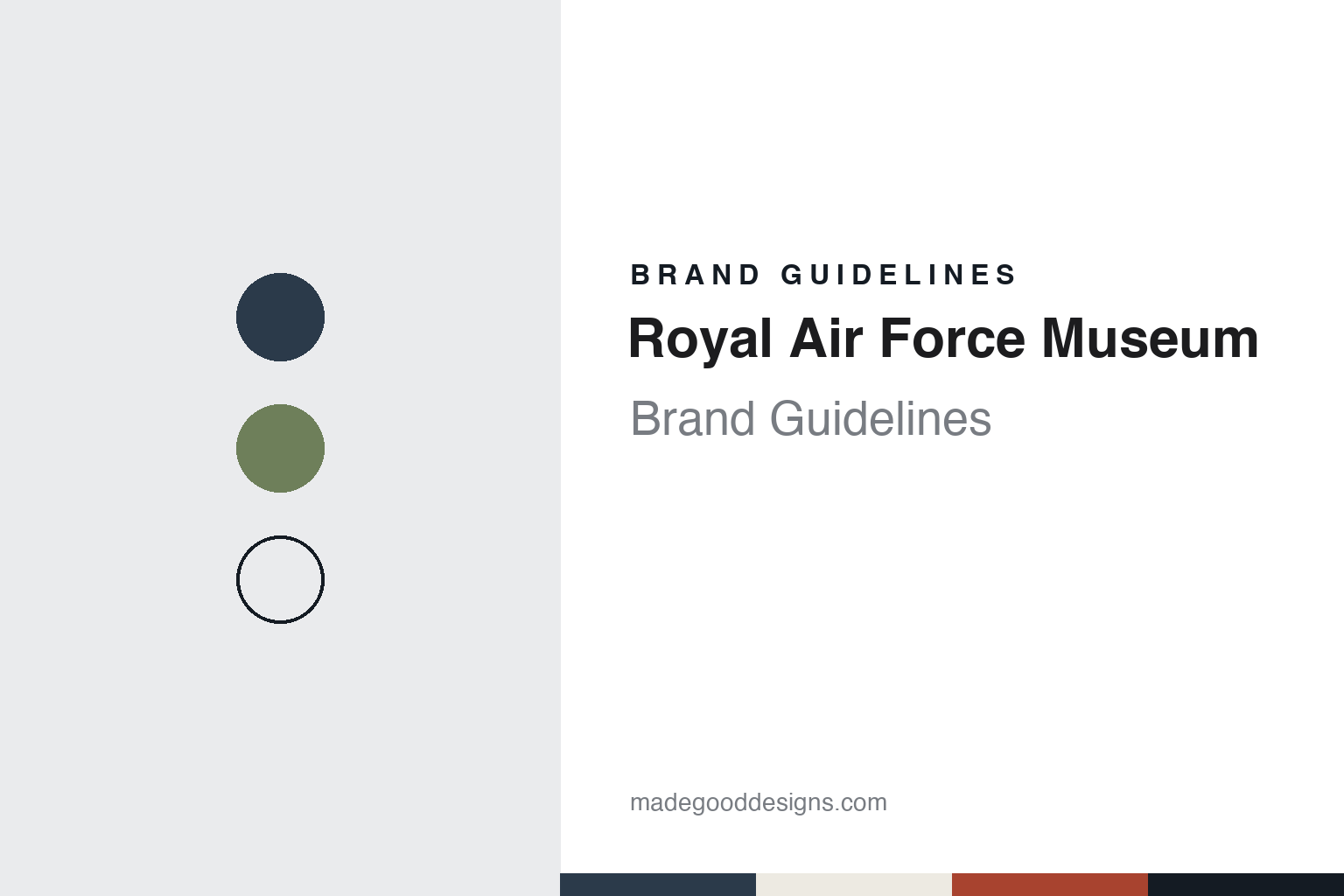
Royal Air Force Museum Brand Guidelines
A national museum on the ground of an early London aerodrome.
Aa
Two constants: a slate, grass and brick palette and a condensed sans register. Abstract homage — not a Royal Air Force Museum asset; no logo, insignia or aircraft marking is reproduced.
The London Aerodrome
A museum on an airfield older than the air force it describes.
The Royal Air Force Museum stands at Colindale, in the London Borough of Barnet, on part of what was once Hendon Aerodrome. The museum’s own history of the site starts in 1909, when a local firm built an aeroplane and put up a shed for it in a field at the end of Colindale Avenue; by October 1910 other organisations were flying there too, including a flying school.
In 1911 the aviator and businessman Claude Grahame-White bought the land and promoted it as the London Aerodrome. The museum says air displays and races were held on most weekends, that a British airmail service started there in September 1911 and that the Aerial Derby, a race around London, began and finished at Hendon from 1912. The Grahame-White Aviation Company assembled and later designed aircraft on the site. The museum says the government took possession of the airfield in 1922 and that ownership passed to the Royal Air Force in 1925; from 1920 the RAF held its annual pageants at Hendon through the interwar years.
Flying wound down after the Second World War. The museum says the last RAF flying unit left in 1957, that a Blackburn Beverley transport became the last aircraft to use Hendon’s runways in 1968 and was put on display, and that most of the airfield was sold for housing. RAF Hendon officially closed on 1 April 1987; when most remaining buildings were cleared in 1993, the Grahame-White factory buildings, the former officers’ mess and a few 1930s RAF buildings were kept.
The museum itself grew out of the RAF’s fiftieth anniversary. Its history page says that in 1962 the Air Force Board formed a committee under Marshal of the Royal Air Force Sir Dermot Boyle to advise on historical and museum matters, and that the committee recommended a Royal Air Force Museum. A board of trustees was formed with Boyle as chairman. The museum began collecting objects in 1965, stored them at RAF Henlow, and was given the two remaining Auxiliary Air Force hangars at Hendon. It was officially opened on 15 November 1972, with some 36 aircraft in the hangars.
Colour
Two public sites, a reserve store and a 2018 redevelopment.
The collection soon outgrew Hendon. The museum says some 130 aircraft had been acquired in the following years, many of them held in reserve collections at RAF stations around the country. One of those stations was RAF Cosford in Shropshire, a technical training station since 1938, where the Aerospace Museum opened on 1 May 1979, built around historic instructional airframes. The museum’s trustees managed it under an agreement with the Ministry of Defence, and the museum says Cosford formally became part of its portfolio in 1998, the year a new visitor centre with galleries and a conference centre opened there.
Cosford has since added a conservation centre, opened in 2002 when the reserve collection moved to Stafford, and the National Cold War Exhibition, opened on 7 February 2007 in a purpose-built hall with aircraft suspended in flying attitudes. In 2022 the site was renamed RAF Museum Midlands, the museum says. The Stafford store is not normally open to the public, though research visits can be booked.
The museum describes itself as a national museum, a government non-departmental public body and a registered charity. Its charitable object is to educate and inform the public and members of the Royal Air Force about the history and traditions of the service, and it says it was granted a Royal Charter in 2022, its fiftieth year.
At Hendon the oldest structures are among the most distinctive. The Grahame-White Factory, an original aircraft factory building, now holds the museum’s gallery on aviation from 1914 to 1918, and the museum’s blog has described how the Grahame-White Watch Office was taken down brick by brick and rebuilt beside it. A 2011 museum news item dates the Watch Office to 1915 and says the relocated and refurbished building opened to the public in March 2011, with displays on Grahame-White, Hendon Aerodrome and early flight in Britain.
The biggest recent change came with the RAF’s centenary in 2018. Architecture Today reported in July 2018 that the architects Nex had completed a large redevelopment at Hendon, master-planned with the landscape architects Agence Ter after a competition. A car park was moved to make a grassed “museum field” recalling the airfield, with paths laid out along runway-like axes and a circular “taxiway” linking the buildings. A large-span 1970s hangar, clad in aluminium, became the entrance galleries and visitor centre, with a 40-metre entrance under a deep cantilevered canopy, a two-storey pavilion inside whose louvred aluminium fins were meant to evoke jet turbines, and a main space arranged around a Short Sunderland flying boat. A derelict 1930s RAF supplies building became a 120-seat restaurant.
Reviewing the reopened site for the Museums Association’s Museums Journal in November 2018, Katy Barrett described three new galleries, two of them in Hangar 1: RAF Stories: The First 100 Years 1918–2018, built around personal stories of people in many trades, and RAF: First to the Future, set among white metal screens; a third, in Hangar 6, covers the service from 1980. The National Lottery Heritage Fund noted in June 2018 that the new Hangar 1 would put objects from storage on show, among them a Westland Sea King helicopter.
Typography
Aviation and space museums.
Aviation and space museums usually present themselves through the body behind the name. Some are national institutions, such as a museum that belongs to the Smithsonian Institution in Washington, D.C.; others are private non-profit museums, trusts, foundations or associations that grew out of a group of enthusiasts; and some visitor centres are run by a company on behalf of a space agency. The name on the door often says which: “national”, “royal”, a city or a founding society.
Their buildings tend to carry much of the identity. Many sit on or beside airfields, and several occupy structures that had another life first: a hangar, an early aircraft factory, an airport terminal or an exposition hall, and in some cases a ship that became a museum. Others are purpose-built galleries with clear spans and glass roofs large enough to hang aircraft in mid-air, or open-sided shelters that keep the weather off airliners parked in rows.
The collections are described in general terms: aircraft, spacecraft, rockets, engines, instruments, models and archives of photographs and drawings, usually with a handful of objects that the museum and the press return to again and again. Restoration workshops, libraries and observatories sit alongside the galleries, and most of these museums run school and family programmes, learning centres and summer camps.
The graphic language is often borrowed from aviation itself: stencilled lettering, registration marks and roundels, runway and taxiway markings, instrument dials and the plain sans-serif type of signage on airfields and launch sites. In this guide we look at how each museum uses its building, its objects and its name, described plainly and in our own unofficial colours and stand-in typefaces.
Aa
A condensed sans for hangar lettering. (Specimen set in Barlow Condensed, a sans STAND-IN; NOT the Royal Air Force Museum logo.)
Royal Air Force Museum
Hangars, a factory and a field.
The Royal Air Force Museum’s visual character comes largely from its buildings. At Hendon a visitor moves between hangars of different periods: the Grahame-White Factory from the aerodrome’s early years, the Watch Office rebuilt beside it, 1930s RAF buildings and the aluminium-clad 1970s hangar reworked in 2018. Architecture Today described the 2018 scheme as using a green open space to unite a disparate group of former military buildings, while the canopy and the turbine-like fins gave the entrance hangar a new face. At Cosford the National Cold War Exhibition sits in a hall of its own design, and the museum’s galleries hang aircraft overhead in both places.
The museum’s interpretation leans on people as much as on machines. Museums Journal noted in 2018 that the new Hangar 1 galleries open with a wall of hats and helmets from many RAF trades and life-size figures of real personnel, with touch, smell and sound points beside the display cases. The museum has spoken of an education programme built around the Watch Office, and its archive and reading room at Hendon hold documents, books and photographs for researchers.
For a design guide, the Royal Air Force Museum shows how a museum can turn the leftover fabric of an airfield — sheds, a watch office, hangars and an open field — into its own identity, rather than housing a collection in one new building. Compare the Science Museum, another London national museum with aircraft in its galleries, and the Natural History Museum. For this guide we use hangar slate, airfield grass and brick red with a condensed sans, an unofficial interpretation; no product or logo is reproduced.
Explore & save
Keep Royal Air Force Museum’s identity on hand — save it to a board in the Made Good inspiration library.
Royal Air Force Museum identity set
Pin the slate, grass and brick palette and the condensed hangar sans register to your own board.
Source & notes
Frequently Asked Questions
What font can I use to match the Royal Air Force Museum look?
This guide describes Royal Air Force Museum’s type as “A condensed sans for hangar lettering”. Its type specimen is set in Barlow Condensed from Google Fonts as a stand-in; Barlow Condensed is not Royal Air Force Museum’s own lettering.
What colours are in the Royal Air Force Museum palette?
This guide’s Royal Air Force Museum palette is Hangar slate #2B3A4A, Night ink #141B23, Airfield grass #6E7F5A, Brick red #A8432F and Canvas #F5F3EE. The tones are the guide’s own unofficial interpretation, not official Royal Air Force Museum hex codes.
When did Royal Air Force Museum open?
Royal Air Force Museum opened on 15 November 1972, in Hendon, London, UK.