Musée de l’Air et de l’Espace Brand Guidelines
A century-old air museum inside an Art Deco airport terminal.
Aa
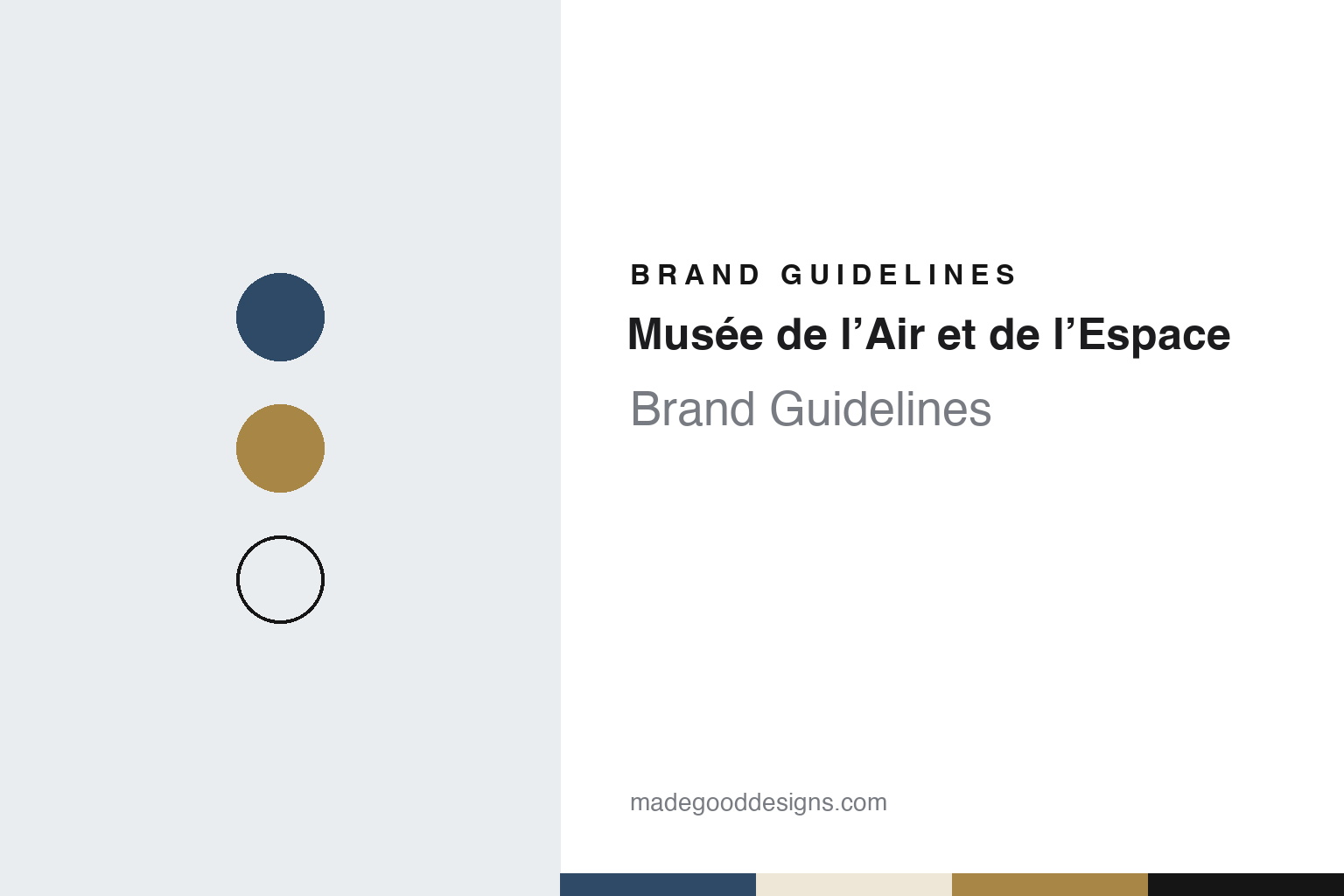
Two constants: a blue, black, gold and limestone palette and an Art Deco serif register. Abstract homage — not a Musée de l’Air et de l’Espace asset; no logo, aircraft or building drawing is reproduced.
From Issy to Le Bourget
A collection that moved four times before it found an airport.
The Musée de l’Air et de l’Espace (Air and Space Museum) began in 1919. The museum’s 2019 press kit says a conservatory of aeronautics was created that year, on the proposal of the engineer Albert Caquot, in a hangar at Issy-les-Moulineaux, on the south-western edge of Paris, under the name “Collections de l’aéronautique” (Aeronautical Collections). The trade magazine Aero VFR wrote in May 2019 that the idea was to show the progress of aviation technology to future engineers, which, it suggested, helps explain why the museum still sits under the defence ministry rather than the culture ministry.
In 1920–21 the collections moved to the military aeronautics establishment at Chalais-Meudon, and French Wikipedia says the museum was inaugurated there in 1921. In 1936, short of space, part of the collection moved to boulevard Victor in Paris’s 15th arrondissement, and the name “musée de l’Air” (Air Museum) was adopted, the press kit says.
The museum closed to the public in 1939, and its exhibition hall on boulevard Victor was partly destroyed during the war, according to the same press kit. French Wikipedia says the occupying authorities kept it closed during the occupation of 1940–44 and that the pieces shown at boulevard Victor were moved to Chalais-Meudon after the war. The press kit says the Chalais-Meudon collections did not reopen to visitors until 1960.
The move to Le Bourget, north-east of Paris, came as commercial flying left the airport for Orly and, from 1974, Roissy-Charles de Gaulle. From 1973 the collections were gathered there step by step, and the new museum was inaugurated on 27 May 1975, the press kit says; French Wikipedia notes that the first hall opened shortly before that year’s Paris Air Show. In 1983 the museum opened a hall on space exploration and took its present name.
Colour
An Art Deco “air port” by Georges Labro.
The museum’s home is the old airport terminal of Le Bourget. The airfield itself dates from the First World War; the museum says airlines opened routes from it to Brussels and London from 1919. In 1935 the architect Georges Labro, a winner of the Second Grand Prix de Rome and an architect for the French postal administration, won the Air Ministry’s competition for a new terminal, which was built between 1935 and 1937 and shown as part of the 1937 International Exposition in Paris.
The press kit describes Labro’s idea as an “air port” modelled on maritime architecture: a single straight building 233 metres long and 40 metres wide, with a vault 12 metres high, gathering every airline function under one roof like a railway station. On the airfield side it looks like an ocean liner, with terraces like a ship’s rail and the control tower as a lookout; on the city side three statues of women, added after the Second World War, stand for the main destinations served. During the war the airfield became a German base, and the press kit says Labro rebuilt the terminal almost identically in 1946; the control tower followed in 1953, the year the Paris Air Show first came to Le Bourget.
The museum spread through the site as airline traffic ended. French Wikipedia says it opened a new hall roughly every two years until 1983, that the terminal became the Grande Galerie (Great Gallery) in 1987, and that a Concorde hall designed by Jean-Luc Chancerel was built in 1994. The same year the terminal was entered on France’s supplementary inventory of historic monuments, and on 1 January 1994 the museum became a public administrative body with its own legal personality and budget, the museum says. It is a state museum under the Ministry of the Armed Forces and carries the “musée de France” label.
From 2012 to 2019 the terminal was restored. The Salle des Huit Colonnes (Hall of the Eight Columns), the terminal’s original entrance, reopened in 2013 after 18 months of work. Aero VFR reported in October 2019 that the renovated Grande Galerie would open to the public on 14 December 2019, the museum’s centenary year, with visitors entering through the Hall of the Eight Columns. The architectural restoration of the terminal, its facades and control tower was led by the studio atelier Gorka Piqueras, which spoke of returning to “an architecture of the 1930s with pure lines and light colours”; footbridges and fabric blinds over the roof lights that had crowded the hall were removed, and the agency Scénografia designed the displays.
The collection runs from ballooning in the 18th century to space. The museum’s 2019 figures list more than 400 aircraft, about 120 of them on show in 11 halls and on the apron. French Wikipedia names among them two Concordes, including the prototype Concorde 001, and full-size models of the Ariane 1 and Ariane 5 launchers outside; Aero VFR noted that the new Grande Galerie would show the gondola of the airship La France of 1884, long kept from view. Restoration workshops and reserve hangars occupy a former air force base across the airport at Dugny.
Typography
Aviation and space museums.
Aviation and space museums usually present themselves through the body behind the name. Some are national institutions, such as a museum that belongs to the Smithsonian Institution in Washington, D.C.; others are private non-profit museums, trusts, foundations or associations that grew out of a group of enthusiasts; and some visitor centres are run by a company on behalf of a space agency. The name on the door often says which: “national”, “royal”, a city or a founding society.
Their buildings tend to carry much of the identity. Many sit on or beside airfields, and several occupy structures that had another life first: a hangar, an early aircraft factory, an airport terminal or an exposition hall, and in some cases a ship that became a museum. Others are purpose-built galleries with clear spans and glass roofs large enough to hang aircraft in mid-air, or open-sided shelters that keep the weather off airliners parked in rows.
The collections are described in general terms: aircraft, spacecraft, rockets, engines, instruments, models and archives of photographs and drawings, usually with a handful of objects that the museum and the press return to again and again. Restoration workshops, libraries and observatories sit alongside the galleries, and most of these museums run school and family programmes, learning centres and summer camps.
The graphic language is often borrowed from aviation itself: stencilled lettering, registration marks and roundels, runway and taxiway markings, instrument dials and the plain sans-serif type of signage on airfields and launch sites. In this guide we look at how each museum uses its building, its objects and its name, described plainly and in our own unofficial colours and stand-in typefaces.
Aa
An Art Deco-minded serif for a 1937 terminal. (Specimen set in Fraunces, a serif STAND-IN; NOT the Musée de l’Air et de l’Espace logo.)
Musée de l’Air et de l’Espace
A glass vault, a checkerboard floor and a clock for the world.
The Musée de l’Air et de l’Espace draws much of its look from Labro’s building. Aero VFR described the restored hall in 2019: an immense glass roof, imposing columns and a black-and-white checkerboard floor typical of the 1930s, and a monumental clock framed by twelve smaller clocks showing the hours of time zones around the world, as in the terminal’s airline days. The press kit adds stone facades, a marble rotunda and wrought-iron balustrades, with daylight falling through hundreds of glass blocks set into the concrete vaults.
The 2019 display design gave each wing of the Grande Galerie its own mood, Aero VFR reported: the north wing, on the pioneers of flight, in a light setting of curves with touches of blue and gold, and the south wing, on the First World War, darker and sharper, in anthracite and red-orange, with illuminated signs marking the route. Beyond the terminal, the museum runs a planetarium, a children’s area and a media library, and its Friends association, founded in 1952, supports acquisitions.
For a design guide, the Musée de l’Air et de l’Espace shows how a historic building can become the strongest part of a museum’s identity: the terminal is both the container and one of the main exhibits. Compare the Cité de l’espace, the space museum in Toulouse, and the Louvre, another Paris museum shaped by its building. For this guide we use terminal blue, checker black, Deco gold and limestone with a serif, an unofficial interpretation; no product or logo is reproduced.
Explore & save
Keep Musée de l’Air et de l’Espace’s identity on hand — save it to a board in the Made Good inspiration library.
Musée de l’Air et de l’Espace identity set
Pin the terminal blue, checker black, Deco gold and limestone palette and the Art Deco serif register to your own board.
Source & notes
Frequently Asked Questions
What font can I use to match the Musée de l’Air et de l’Espace look?
This guide describes Musée de l’Air et de l’Espace’s type as “An Art Deco-minded serif for a 1937 terminal”. Its type specimen is set in Fraunces from Google Fonts as a stand-in; Fraunces is not Musée de l’Air et de l’Espace’s own lettering.
What colours are in the Musée de l’Air et de l’Espace palette?
This guide’s Musée de l’Air et de l’Espace palette is Terminal blue #2E4A66, Checker black #151515, Deco gold #A88645, Limestone #EEE7D8 and Paper #F8F6F1. The tones are the guide’s own unofficial interpretation, not official Musée de l’Air et de l’Espace hex codes.
When was Musée de l’Air et de l’Espace founded?
Musée de l’Air et de l’Espace was founded in 1919, in Issy-les-Moulineaux, France.