Smorgasburg Brand Guidelines
A weekly open-air food market that began on the Williamsburg waterfront.
Aa
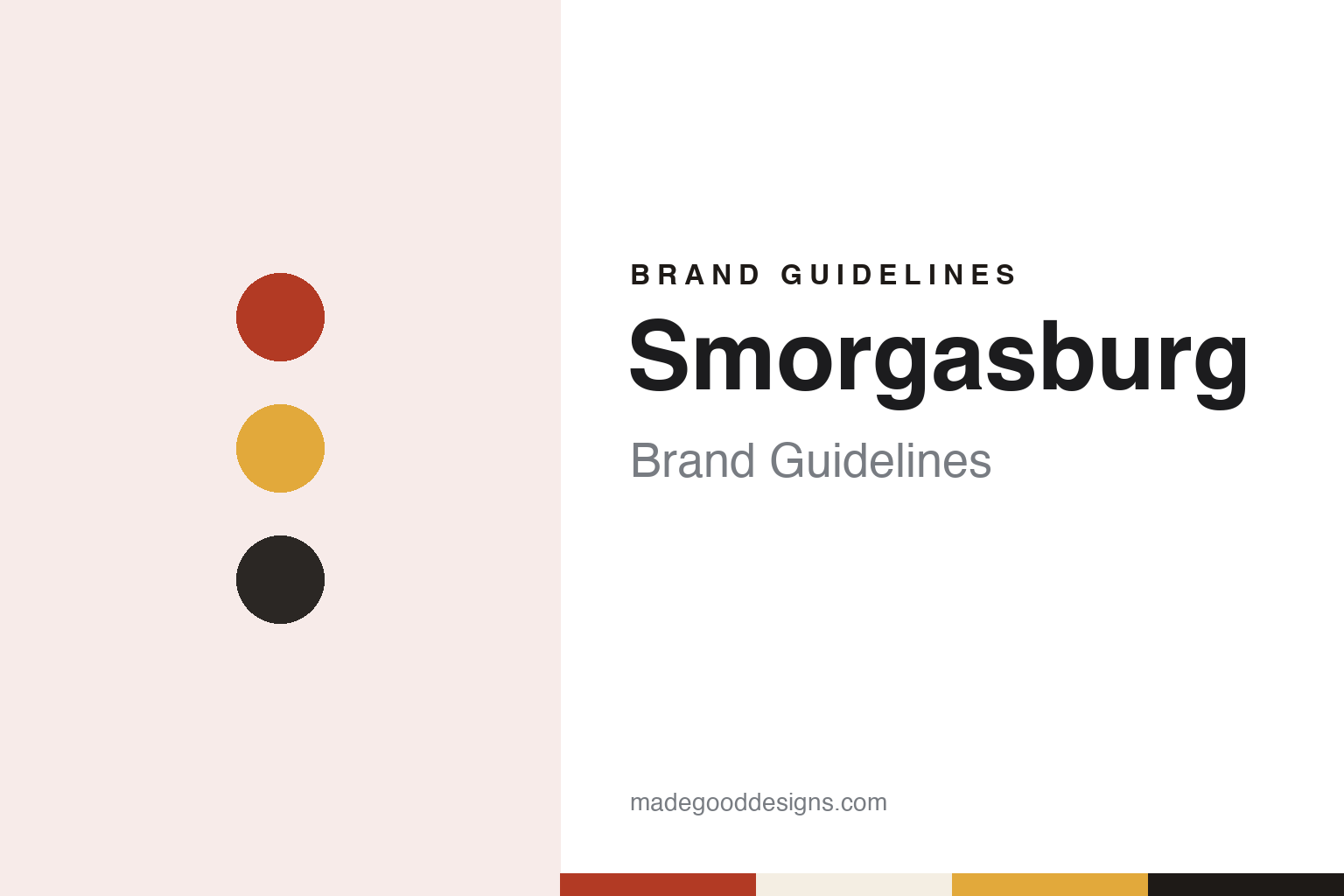
Two constants: a grill red, mustard and charcoal palette and a market-sign grotesque register. Abstract homage — not a Smorgasburg sign or mark; no logo or vendor sign is reproduced.
An offshoot of the Flea
A second-day idea on an empty waterfront lot.
Smorgasburg grew out of the Brooklyn Flea. The Princeton Alumni Weekly reported in 2013 that Jonathan Butler, who had started the Brooklyn real-estate blog Brownstoner, began the flea after pitching a “Salvage Fest” of architectural salvage on the blog; by the spring of 2008 it had become a general flea market in a Brooklyn schoolyard. The Village Voice reported in 2014 that Eric Demby, a former journalist who had been communications director for the Brooklyn borough president, contacted Butler to help make the idea happen, and that the pair ran the flea weekly from 2008 in the grounds of a school in Fort Greene.
The food market came from a search for a second site. In a 2016 interview with Commercial Observer, Butler said a developer building towers on the Williamsburg waterfront invited the pair in 2010 to run a market on an empty lot by the water, where few people then went. The Village Voice reported that they agreed to hold the flea there on Sundays and, on Saturdays, launched Smorgasburg; Commercial Observer dates the launch to May 2011. Butler told the Voice that the pair needed a new concept for a second day, and had considered an arts and crafts fair before settling on food.
The name joins “smörgåsbord” and “Williamsburg,” English Wikipedia and Urbanize Atlanta (2025) explain; Butler told the Voice it came to him while he was watching television, after weaker working titles such as “Food Fair.” The first season looked different from the market that followed. Demby told the Voice that it began with “a huge diversity of things,” including a greenmarket, stalls selling aprons and a play area, so that it was “more like a fair,” and Butler said visitors turned out to want ready-to-eat food rather than produce for the week. The market’s own history also says it began as a greenmarket.
Colour
Weekends in Brooklyn, and then Manhattan.
Smorgasburg is a weekly open-air food market: independent vendors take stalls in rows of tents and sell ready-to-eat food, and visitors walk between them. The Princeton Alumni Weekly put the number of vendors at 75 to 100 in 2013, and Demby told The Village Voice in 2014 that there were about 100. Vendors are chosen through an application and tasting process: in 2016 Butler told Commercial Observer that applicants fill out a questionnaire with photographs and a description, and that promising ones are invited to a tasting.
The Brooklyn sites have moved over the years. Butler told Commercial Observer that the developer later built on the original Williamsburg lot, so the market moved next door to East River State Park. The Princeton Alumni Weekly reported in 2013 that Smorgasburg ran at two Brooklyn sites, and Commercial Observer described it in 2016 as running in Williamsburg on Saturdays and in Prospect Park on Sundays.
The market is seasonal in New York. For its 2026 season the website lists a Saturday market in Williamsburg, a market in Prospect Park, a Friday market at the World Trade Center and a market in Central Park, and says it opened across Brooklyn and Manhattan with more than 70 vendors; at the time of writing it lists all four New York sites as closed for the season. The website now groups the markets under four regions: New York, Los Angeles, South Florida and Atlanta.
The organisers also take on special events and partner days at their market sites, the website says, alongside the regular weekly markets. The founders’ earlier venture continues separately: the Brooklyn Flea’s website lists its own flea markets in Brooklyn and Manhattan.
Typography
Markets, halls and the city.
Public markets and food halls in North America and Australia usually introduce themselves through who stands behind the name and when the market began. Some are run by a city council or a public development authority set up by a city charter, some by a non-profit corporation and some by a private property company. A founding date tends to sit close to the name, and a market’s documented origins and its present building often carry different dates.
The buildings do much of the work of an identity. Several markets occupy structures built for something else: space under a former railway train shed, a ferry terminal on a waterfront, or the brick and timber blocks of a former biscuit factory. Others grew as rows of covered arcades and open-sided sheds added stall by stall over decades, with halls for meat and fish and long tables for farmers who rent space by the day.
Lettering is often attached to the architecture rather than drawn for a page. A rooftop sign, a clock above an entrance, painted lettering on a wall or old company monograms set into an entryway can become the image that a market protects as a trademark, and in a historic district a commission may need to approve any change to that signage.
Inside, most of these markets describe their mix in general terms: fresh produce, fish, butchers, bakers and delis alongside food counters with seating, craft stalls and shops. Some are not buildings at all but weekly open-air markets that set up in a park or on a waterfront lot. Each guide in this series describes one market from dated sources and pairs it with a palette and typeface of our own.
Aa
A bold grotesque in the register of hand-lettered market signs. (Specimen set in Archivo, a sans STAND-IN; NOT the Smorgasburg logo.)
Beyond Brooklyn
Los Angeles, Miami, Fort Lauderdale and Atlanta.
The first edition outside New York opened in Los Angeles. Commercial Observer reported in June 2016 that the weekly Smorgasburg market had just been unveiled in downtown Los Angeles with 80 vendors, a project the founders said had been in the making since the previous October. The website lists the Los Angeles market every Sunday on a site on Alameda Street downtown.
Miami followed in 2022, the market’s own history says. Miami New Times reported in 2025 that Smorgasburg Miami had traded on a lot next to the Wynwood Walls since 2022 as a weekend outdoor food market, and that the Miami market’s last day there was Sunday, 7 December 2025. The website now lists a South Florida market in Fort Lauderdale.
Atlanta came next. Urbanize Atlanta reported in October 2025 that Smorgasburg Atlanta would open on Saturday, 18 October 2025, on a surface parking lot in South Downtown between the Five Points and Garnett rail stations, with more than 40 local vendors every Saturday, and named Gaston Becherano as Smorgasburg’s co-owner and chief executive. The website lists the Atlanta market as on a break between seasons.
The market’s identity is carried less by a building than by the scene it creates: rows of tents on a waterfront lot, a park or a parking lot, each with its own vendor’s sign. The website repeats the line “Everyone from everywhere is welcome here” across its pages, and presents each city’s market with its own page and season.
For a design guide, Smorgasburg shows how a market without a permanent hall can build an identity from a name, a weekly rhythm and the visual noise of many small vendors. Compare Chelsea Market, an indoor food hall in New York, and Grand Central Market in Los Angeles. For this guide we use a grill red, a mustard and a charcoal with a sans, an unofficial interpretation; no product or logo is reproduced.
Explore & save
Keep Smorgasburg’s identity on hand — save it to a board in the Made Good inspiration library.
Smorgasburg identity set
Pin the grill red, mustard and charcoal palette and the market-sign grotesque register to your own board.
Source & notes
Frequently Asked Questions
What font can I use to match the Smorgasburg look?
This guide describes Smorgasburg’s type as “A bold grotesque in the register of hand-lettered market signs”. Its type specimen is set in Archivo from Google Fonts as a stand-in; Archivo is not Smorgasburg’s own lettering.
What colours are in the Smorgasburg palette?
This guide’s Smorgasburg palette is Grill red #B23A24, Charcoal #1E1A17, Mustard #E2A93B, Tent canvas #F4EEE3 and Paper #FAF8F4. The tones are the guide’s own unofficial interpretation, not official Smorgasburg hex codes.
When was Smorgasburg launched?
Smorgasburg was launched in May 2011, in Williamsburg, Brooklyn, New York.
Who founded Smorgasburg?
Smorgasburg was founded by Jonathan Butler and Eric Demby in May 2011.