London Transport Museum Brand Guidelines
A transport collection in a Victorian flower market.
Aa
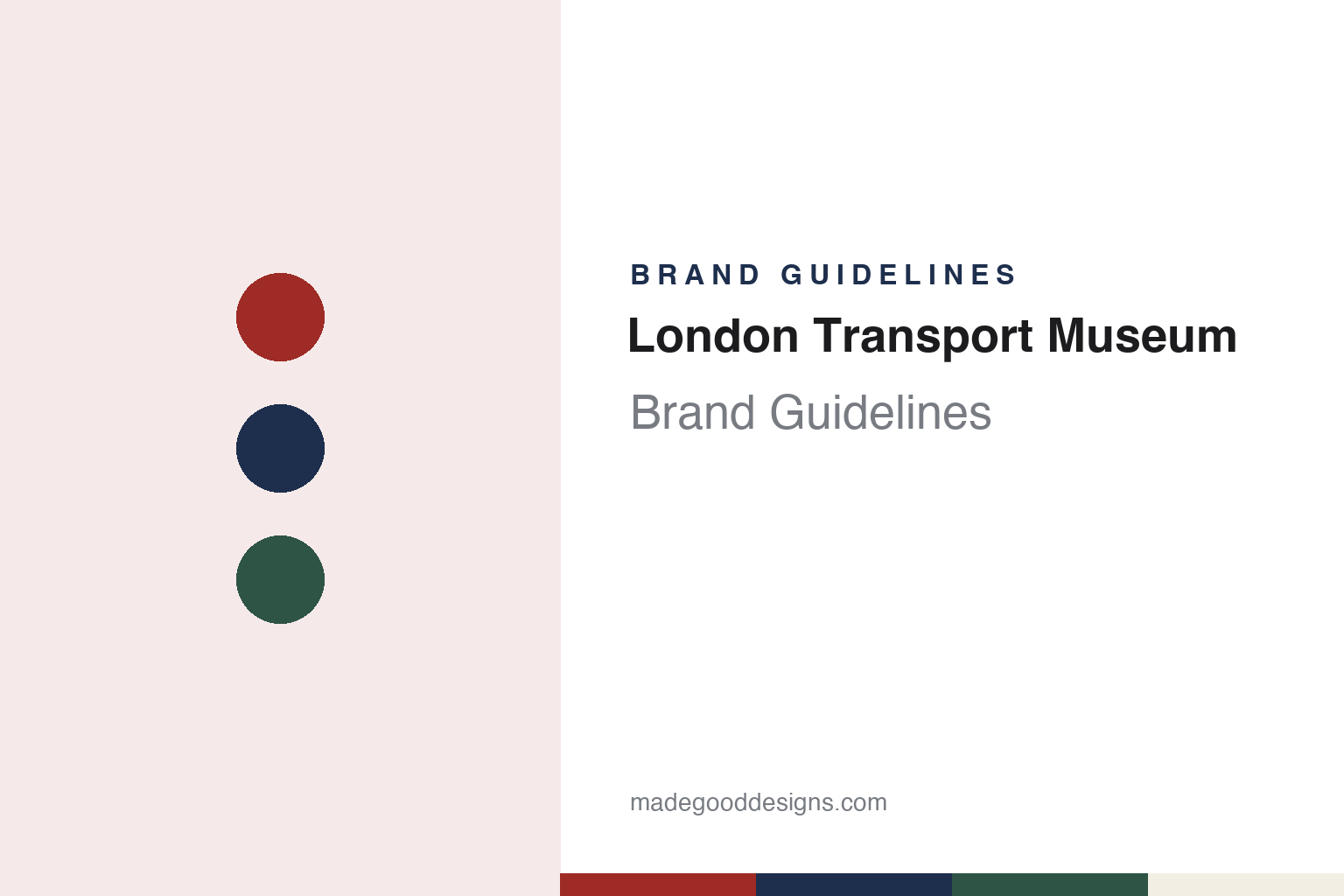
Two constants: an omnibus red, platform navy and glasshouse green palette and a humanist sans register. Abstract homage — not a London Transport Museum asset; no roundel, logo or poster is reproduced.
The Flower Market
A Victorian market hall and a collection older than the building.
London Transport Museum sits on the Covent Garden Piazza, in the West End of London, inside a Victorian iron-and-glass hall that was built as the market’s dedicated flower market. English Wikipedia, citing the Survey of London (1970), says the building was designed by William Rogers in 1871. The wholesale traders left Covent Garden for new premises at Nine Elms in 1974, The Christian Science Monitor reported in July 1980, and the empty market halls were then refitted by the Greater London Council.
The museum opened in the old Flower Market on 28 March 1980. A photograph in the museum’s own collection, published on Google Arts & Culture, records Princess Anne as guest of honour at the opening ceremony that day. The collection itself is far older than the building. English Wikipedia says its first parts were gathered at the start of the twentieth century by the London General Omnibus Company, which began to keep buses as they were retired from service. After the London Electric Railway took the company over, rail vehicles were added, and the collection kept growing through the London Passenger Transport Board of the 1930s and its successor bodies up to Transport for London.
Before Covent Garden the collection moved several times. English Wikipedia says it was shown as part of the Museum of British Transport in a former depot on Clapham High Street, in south London, during the 1960s, and then at Syon Park in Brentford from 1973 to 1977. When the Clapham museum closed, most of the national railway collection went north to the new National Railway Museum in York, while London items stayed in the capital and formed the basis of the Covent Garden museum, according to English Wikipedia’s account of the York museum.
The museum closed from September 2005 and reopened in November 2007 after a refurbishment designed by Bryan Avery of Avery Associates Architects. The work enlarged the displays so that they could cover the wider remit of Transport for London, the city’s transport authority since 2000, and added education space. For a time the museum used the name London’s Transport Museum; it went back to London Transport Museum when the Covent Garden building reopened in 2007, English Wikipedia says.
Colour
Galleries in the market, a depot in Acton.
Inside the flower market the museum shows buses, trams, trolleybuses and rail vehicles from the nineteenth and twentieth centuries, together with objects about how passenger services were run and marketed and how the growing network shaped the city. Among the vehicles English Wikipedia names an electric Underground train of 1890; a New Routemaster bus has been displayed beside a 1954 AEC Regent III RT bus. Posters, signs and photographs make up a large part of the collection.
The second site is the London Transport Museum Depot in Acton, west London, which opened in October 1999. English Wikipedia describes it as a store of about 6,000 square metres holding more than 370,000 items, from original poster artworks and signs to models, engineering drawings and uniforms, with road access and a rail link to the Underground so that large vehicles can be moved in and out. Larger exhibits there include a complete 1938 stock tube train. The depot is the base for the museum’s curators and conservators and opens to visitors on scheduled days and on themed open weekends.
Programmes go beyond the galleries. Since 2015 the museum has run guided tours under the name Hidden London, which take small groups into parts of the Underground normally closed to the public, among them the disused stations at Aldwych and Down Street; English Wikipedia says the museum had run occasional tours of disused stations since the 1990s. The Covent Garden building also has driving simulators, including an Elizabeth line cab, and a play area for children up to the age of seven. English Wikipedia describes the museum as an education and heritage charity and gives 449,599 visitors in 2025, citing ALVA visitor figures.
Typography
Transport museums and their buildings.
A transport, railway or maritime museum usually has an organisation behind its name: a charitable trust, a city service, a state or national agency, or a museum group that runs several sites under one umbrella. Some began as collections kept by railway companies or transport operators, which set aside old buses, locomotives or carriages as they left service, and only later passed into public hands. The founding date of a collection and the opening date of its present building are often decades apart.
The buildings are often second-hand. Former flower markets, locomotive depots, goods yards, goods stations and railway stations have been turned into galleries, and many keep the features of their first use: a turntable at the centre of an engine shed, long roofs over former platforms, rail links that still let large vehicles in and out. Other museums commission purpose-built halls, sometimes with dramatic roofs, and a few are built around a single ship that sits at the heart of the museum.
Collections are usually described in general terms: locomotives and rolling stock, buses, trams, cars, aircraft and vessels, together with signals, tickets, uniforms, models, posters, photographs and engineering drawings. Many museums keep a separate store or depot for objects not on show, open to visitors on set days, and run programmes for schools, families and researchers, from libraries and archives to guided tours.
Visual identity in this category tends to borrow from transport design itself. Museums linked to a transport operator may use that operator’s symbols, lettering and colours, and the liveries, nameplates and posters in the collection give designers a ready vocabulary of their own. Refurbishments and reopenings, each with its own dates and architects, often bring a refreshed identity with them.
Aa
A humanist sans for a museum of signs and routes. (Specimen set in Work Sans, a sans STAND-IN; NOT the London Transport Museum logo or any TfL typeface.)
The roundel, recoloured
An in-house rebrand and a new shop identity in 2024.
The museum’s identity is tied to the transport system it records. English Wikipedia lists Transport for London as its owner, and the museum’s mark has long been built on the roundel, the circle-and-bar symbol used across London’s transport network. In May 2025 the Museums Association’s Museums Journal described how the museum rebranded in-house: a first internal workshop in May 2023, a brand-awareness campaign in February 2024 and a new roundel unveiled in July 2024. The journal said the work followed research showing that visitors did not always connect the museum with programmes it ran under separate names, such as Hidden London. The new roundel uses a multi-coloured spectrum; English Wikipedia says it brings together the colours of all of Transport for London’s modes.
The shop followed. In August 2024 Transform magazine, and in September 2024 Creative Boom, reported that the London agency Kit Studio had designed a new retail identity and packaging system for the museum. Creative Boom said the shop had worked without retail guidelines and with several suppliers, so that its look had become disjointed. Kit Studio researched in the archives at the Acton depot and built a system of graphic tiles meant to suit four audiences: young families, transport enthusiasts, design-minded city dwellers and international visitors. Transform reported that the packaging uses London transport colours and kraft boxes in place of plastic windows.
For a design guide, London Transport Museum shows how a museum can borrow the signs of a working network and still read as its own institution: an old market hall, a vehicle store and a roundel recoloured for a whole system. Compare TfL, the authority behind the network, and London Underground, whose closed stations the Hidden London tours visit. For this guide we use an omnibus red, a deep platform navy and a glasshouse green on cream with a humanist sans, an unofficial interpretation; no product or logo is reproduced.
Explore & save
Keep London Transport Museum’s identity on hand — save it to a board in the Made Good inspiration library.
London Transport Museum identity set
Pin the omnibus red, platform navy and glasshouse green palette and the humanist sans register to your own board.
Source & notes
Frequently Asked Questions
What font can I use to match the London Transport Museum look?
This guide describes London Transport Museum’s type as “A humanist sans for a museum of signs and routes”. Its type specimen is set in Work Sans from Google Fonts as a stand-in; Work Sans is not London Transport Museum’s own lettering.
What colours are in the London Transport Museum palette?
This guide’s London Transport Museum palette is Omnibus red #9E2B25, Platform navy #1E2F4D, Glasshouse green #2E5446, Market cream #F3EEE3 and Ink #16181C. The tones are the guide’s own unofficial interpretation, not official London Transport Museum hex codes.
When did London Transport Museum open?
London Transport Museum opened on 28 March 1980, in Covent Garden, London.
Who owns London Transport Museum?
London Transport Museum is owned by Transport for London. This guide dates London Transport Museum to 28 March 1980, in Covent Garden, London.