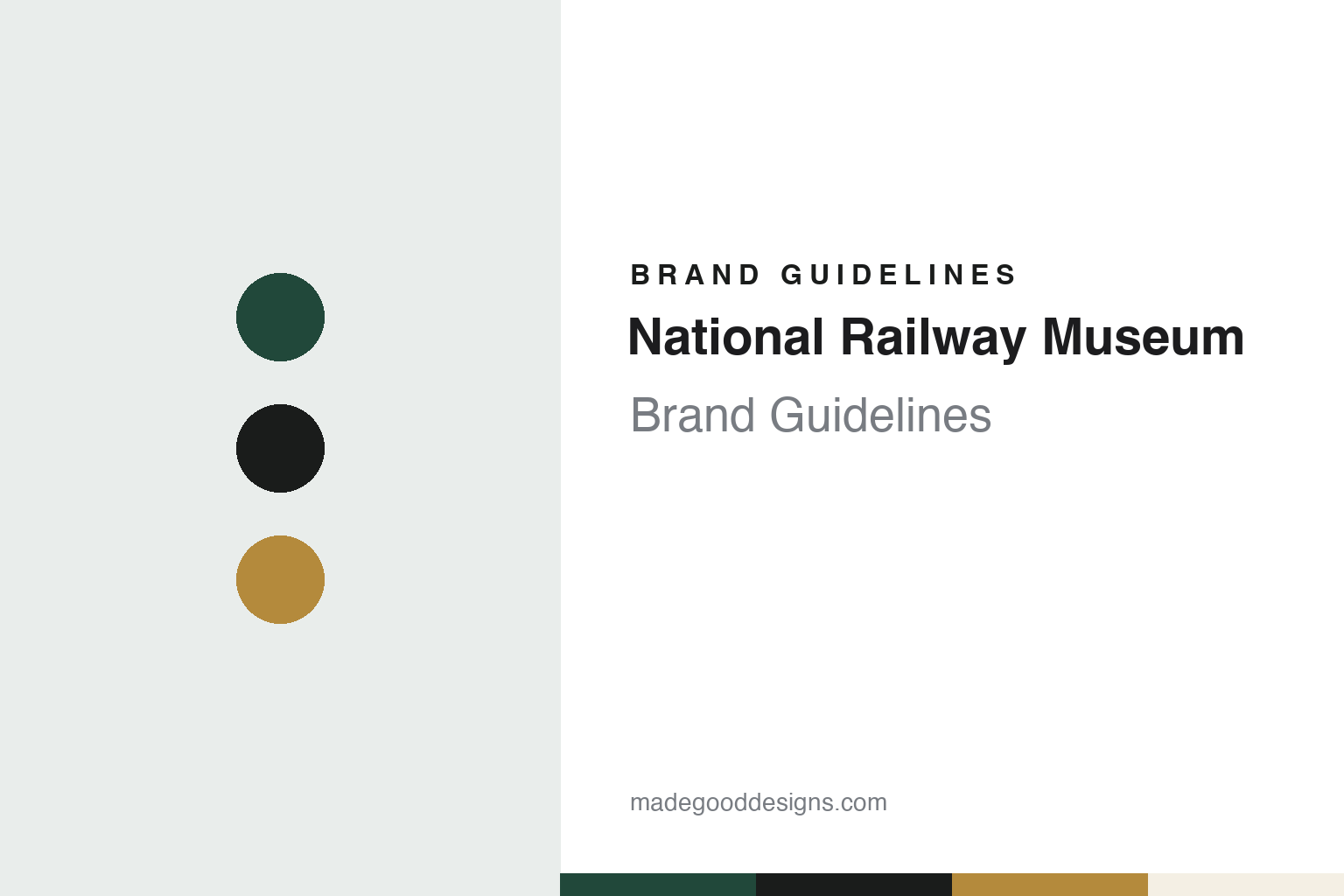
National Railway Museum Brand Guidelines
A national railway collection around a York turntable.
Aa
Two constants: a locomotive green, turntable black and brass palette and a transitional serif register. Abstract homage — not a National Railway Museum asset; no locomotive, livery, logo or nameplate is reproduced.
From two collections to York
An LNER museum, a Clapham garage and a 1968 Act.
The National Railway Museum stands on Leeman Road in York, beside the East Coast Main Line and a short walk from York station. It opened in 1975 on the site of the former York North locomotive depot, a roundhouse rebuilt in the 1950s, and it is part of the Science Museum Group, which also runs the Science Museum in London, the National Science and Media Museum in Bradford, the Science and Industry Museum in Manchester and Locomotion in Shildon, according to the museum’s website (2026). English Wikipedia describes it as the home of the national collection of historically significant railway vehicles.
Its roots lie in two older collections. English Wikipedia says the London and North Eastern Railway opened a railway museum in York in 1928, building on material gathered by the North Eastern Railway and shown at the centenary of the Stockton and Darlington Railway in 1925; small objects were kept in old station buildings and the locomotives in former repair shops. After nationalisation, British Railways opened the Museum of British Transport in a former bus garage at Clapham, in south London, in the early 1960s. Under the Transport Act 1968, British Rail agreed to provide premises for a national railway museum run as a branch of the National Museum of Science and Industry; English Wikipedia calls it the first English national museum outside London. The York and Clapham museums closed in the early 1970s, and their exhibits moved to the new site, joined by vehicles restored from storage.
The Duke of Edinburgh opened the museum in 1975, the year of the Stockton and Darlington Railway’s 150th anniversary. English Wikipedia says it received more than a million visitors in its first year. In the early 1990s the main building was re-roofed and reconstructed, keeping one of its two 1954 turntables, and it reopened on 16 April 1992 as the Great Hall. The former goods depot across Leeman Road, first used as a store and then to show trains as if in a station, was kept as the Station Hall.
Colour
Engines, carriages, archives and a second site.
English Wikipedia says the national collection numbers about 280 rail vehicles, around 100 of them at York at any one time, with the earliest wagonway vehicles dating from about 1815. Four locomotives and vehicles stand out in its account: the streamlined LNER A4 locomotive Mallard; Flying Scotsman, the LNER A3 locomotive bought for the collection in 2004 with support from the National Heritage Memorial Fund; the LMS Princess Coronation locomotive Duchess of Hamilton; and a Japanese 0 Series Shinkansen vehicle given by the West Japan Railway Company in 2001. Royal saloons used from Queen Victoria’s reign to the 1970s, signalling equipment, posters, nameplates, uniforms, clocks and models fill out the collection.
The Great Hall, the former engine shed, arranges locomotives around a turntable, as the museum’s own photographs of the depot in about 1950 and of the new museum in 1975 show. In 1999 the museum added The Works, with a workshop where rolling stock is maintained in view of a gallery above, and the Warehouse, an open store. Its library and archive, opened as Search Engine at the end of 2007, holds engineering drawings from railway works, more than 20,000 books and some 1.75 million photographs, according to English Wikipedia. In 1995 the museum and the University of York set up the Institute of Railway Studies.
The Station Hall is a Grade II listed building of the 1870s that served as York’s main goods station and became part of the museum in 1975, blooloop reported in September 2025. It closed from January 2023 and reopened in September 2025 after a restoration led by the conservation architects Buttress with the contractor John Graham Construction. The work replaced the roof and repaired glazing, brickwork and walls; Place Yorkshire reported that 632 solar panels went onto the new roof and that the gear for the original sliding shutter doors, through which locomotives and horse-drawn vans once moved, was restored. The hall reopened with a new permanent display and with six royal carriages.
Beyond York, Locomotion at Shildon in County Durham opened in October 2004 and is run by the museum with Durham County Council, English Wikipedia says; it houses more of the collection in a new building and on a historic site around former railway workshops. English Wikipedia gives 656,205 visitors at York in 2025.
Typography
Transport museums and their buildings.
A transport, railway or maritime museum usually has an organisation behind its name: a charitable trust, a city service, a state or national agency, or a museum group that runs several sites under one umbrella. Some began as collections kept by railway companies or transport operators, which set aside old buses, locomotives or carriages as they left service, and only later passed into public hands. The founding date of a collection and the opening date of its present building are often decades apart.
The buildings are often second-hand. Former flower markets, locomotive depots, goods yards, goods stations and railway stations have been turned into galleries, and many keep the features of their first use: a turntable at the centre of an engine shed, long roofs over former platforms, rail links that still let large vehicles in and out. Other museums commission purpose-built halls, sometimes with dramatic roofs, and a few are built around a single ship that sits at the heart of the museum.
Collections are usually described in general terms: locomotives and rolling stock, buses, trams, cars, aircraft and vessels, together with signals, tickets, uniforms, models, posters, photographs and engineering drawings. Many museums keep a separate store or depot for objects not on show, open to visitors on set days, and run programmes for schools, families and researchers, from libraries and archives to guided tours.
Visual identity in this category tends to borrow from transport design itself. Museums linked to a transport operator may use that operator’s symbols, lettering and colours, and the liveries, nameplates and posters in the collection give designers a ready vocabulary of their own. Refurbishments and reopenings, each with its own dates and architects, often bring a refreshed identity with them.
Aa
A transitional serif for a national collection. (Specimen set in Libre Baskerville, a serif STAND-IN; NOT the National Railway Museum logo.)
Shed, station and group
An identity carried by buildings and objects.
The museum’s look comes from its buildings and its objects as much as from any single mark. The Great Hall keeps the plan of a locomotive depot, with engines arranged around a turntable, while the Station Hall keeps the long roof and platforms of a goods station. Its public identity sits inside the Science Museum Group: the museum’s website places it alongside the group’s other museums, and the group presents one shared collection across science, technology, engineering and medicine.
Railway design is a large part of the collection itself. English Wikipedia lists posters, drawings and other artwork, tickets, nameplates, staff uniforms, clocks, and furniture and equipment from railway hotels and refreshment rooms; many of the posters and artworks are shown in temporary displays in an art gallery that opened in 2011. Copies of the engineering drawings are also supplied to heritage railways restoring or building locomotives, and to modellers.
The museum also documents working life. In 1999–2000 it began recording former railway staff for a National Archive of Railway Oral History, English Wikipedia says, and the reopened Station Hall, blooloop reported in September 2025, tells the stories of the people working on, using and passing through stations.
For a design guide, the National Railway Museum shows how a former engine shed and a goods station can carry a national collection’s identity through their plan and their roofs. Compare the Science Museum, its sister museum in the Science Museum Group, and London Transport Museum, which grew from London items kept back when the Clapham museum closed. For this guide we use a deep locomotive green, a turntable black and a brass yellow on warm paper with a serif, an unofficial interpretation; no product or logo is reproduced.
Explore & save
Keep National Railway Museum’s identity on hand — save it to a board in the Made Good inspiration library.
National Railway Museum identity set
Pin the locomotive green, turntable black and brass palette and the transitional serif register to your own board.
Source & notes
Frequently Asked Questions
What font can I use to match the National Railway Museum look?
This guide describes National Railway Museum’s type as “A transitional serif for a national collection”. Its type specimen is set in Libre Baskerville from Google Fonts as a stand-in; Libre Baskerville is not National Railway Museum’s own lettering.
What colours are in the National Railway Museum palette?
This guide’s National Railway Museum palette is Locomotive green #21483A, Turntable black #1A1C1B, Brass #B48A3C, Goods-shed brick #8A4B36 and Warm paper #F4EFE4. The tones are the guide’s own unofficial interpretation, not official National Railway Museum hex codes.
When did National Railway Museum open?
National Railway Museum opened in 1975, in Leeman Road, York.
Who owns National Railway Museum?
National Railway Museum is part of the Science Museum Group.