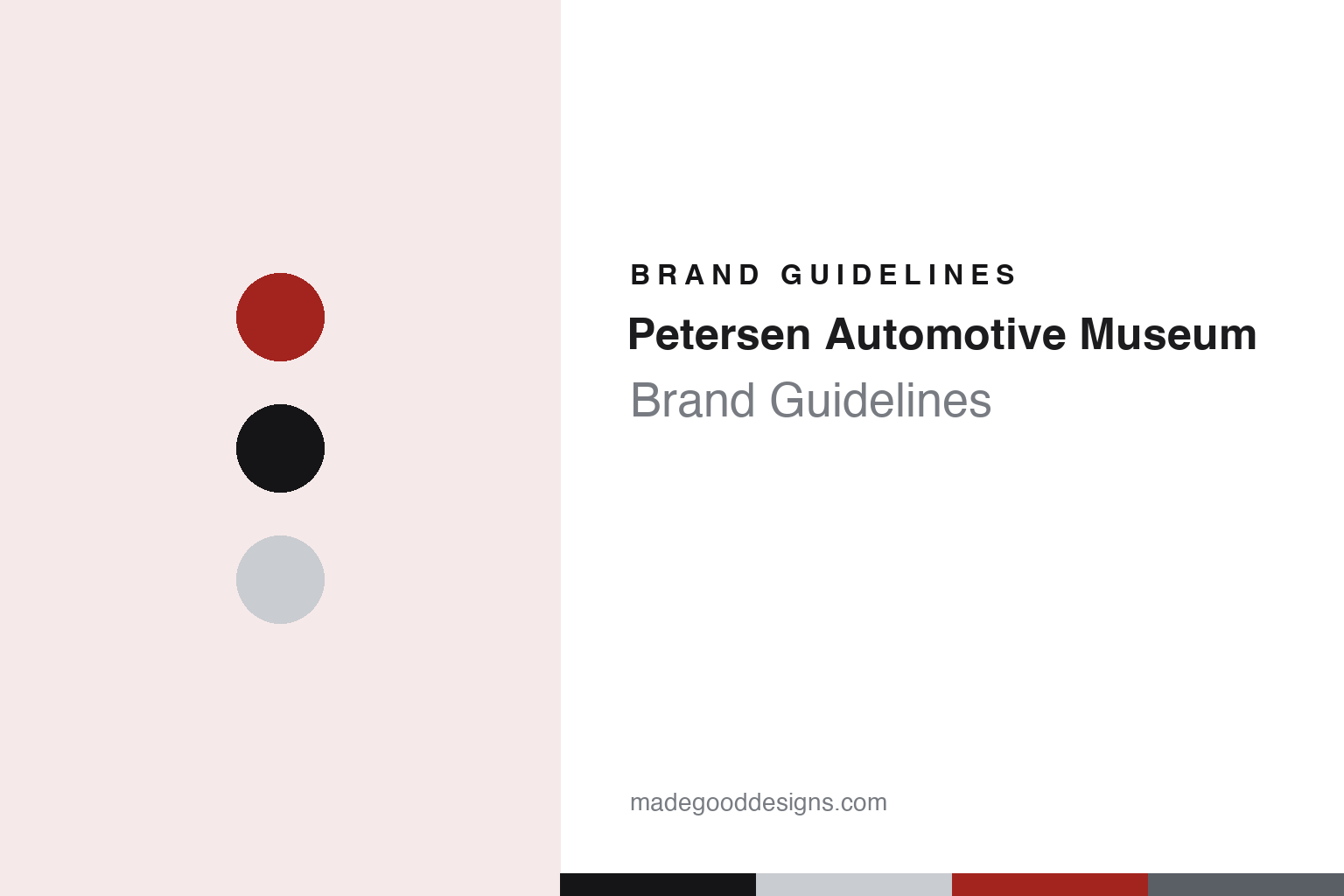
Petersen Automotive Museum Brand Guidelines
A Wilshire Boulevard car museum wrapped in steel ribbons.
Aa
Two constants: a ribbon red, asphalt and brushed steel palette and a wide grotesque register. Abstract homage — not a Petersen Automotive Museum asset; no vehicle, logo or facade is reproduced.
A publisher’s museum
A department store on Museum Row.
The Petersen Automotive Museum stands on Wilshire Boulevard along Museum Row, in the Miracle Mile district of Los Angeles. English Wikipedia says it was founded on 11 June 1994 by the magazine publisher Robert E. Petersen and his wife Margie Petersen, and that it is owned and operated by the Petersen Automotive Museum Foundation, a non-profit organisation specialising in automobile history and education. Dezeen, reporting in December 2015, also gives 1994 as the year the museum was established.
The museum did not start with a new building. English Wikipedia says it was first housed within the Natural History Museum of Los Angeles County before moving to a former department store designed by the Los Angeles architect Welton Becket. Dezeen dates that store to 1962. English Wikipedia says it first served as a short-lived American branch of the Japanese retailer Seibu and then as an Ohrbach’s store from 1965 to 1986, and that its largely windowless walls made it suitable for showing vehicles away from direct sunlight.
In 2014 and 2015 the museum closed for an extensive rebuilding, English Wikipedia says, and reopened to the public on 7 December 2015. Dezeen’s report of 8 December 2015 described the reopening that week and the two firms behind it: the global architecture practice Kohn Pedersen Fox for the exterior, and the Los Angeles studio The Scenic Route for the interior.
Colour
Ribbons, screws and red paint.
According to Dezeen, the building is wrapped in 308 metal ribbons, each individually designed. Their front and underside surfaces are stainless steel, while the back and top surfaces are textured aluminium coated in a paint described as “hot-rod red.” The ribbons are carried on 25 vertical tubular steel supports and horizontal beams, and some 140,000 custom stainless-steel screws were made for the project to imitate the look of early 20th-century car fasteners. Dezeen counted 866 individually controlled LED fixtures lighting the exterior at night.
Architect magazine, writing about the design before construction, described the ribbons as “angel-hair” stainless steel laid over a corrugated aluminium rain screen added to the existing facade, and quoted the firm’s description of the old building as “a chassis without a body.” English Wikipedia gives the steel as about 100 tons of type 304 stainless in 308 sections.
Inside, the reopened museum has about 95,000 square feet of exhibition space over three storeys and 25 galleries, linked by a three-storey spiral staircase, Dezeen reported. The route begins at the top. The third floor covers the history of the automobile, with an emphasis on Southern California’s car culture; the second, the Industry Floor, deals with design, technology and production; and the ground floor shows cars as “rolling sculpture,” including coach-built cars of the Art Deco era.
English Wikipedia fills in the floor plan. It says the second floor gives space to racing, motorcycles, hot rods and custom cars alongside a set of interactive teaching exhibits, and that the ground floor showcases an array of extravagant automobiles. Dezeen described a 166-foot display wall on the ground floor, part of an exhibition called Artistry of the Automobile, showing motion graphics inspired by the golden ratio, and noted that the same level holds a shop, a restaurant and the museum’s offices. The arrangement works as a sequence: history at the top, the making of cars in the middle and the car as an object of design at street level.
Among the vehicles Dezeen named at the reopening were concept cars of the 1950s and 1960s, a Batmobile, the red Ferrari from the 1980s television series Magnum, P.I. and a life-size Lightning McQueen from the animated film Cars. English Wikipedia also lists the camera-ready DeLorean time machine from Back to the Future.
Typography
The category.
A transport, railway or maritime museum usually has an organisation behind its name: a charitable trust, a city service, a state or national agency, or a museum group that runs several sites under one umbrella. Some began as collections kept by railway companies or transport operators, which set aside old buses, locomotives or carriages as they left service, and only later passed into public hands. The founding date of a collection and the opening date of its present building are often decades apart.
The buildings are often second-hand. Former flower markets, locomotive depots, goods yards, goods stations and railway stations have been turned into galleries, and many keep the features of their first use: a turntable at the centre of an engine shed, long roofs over former platforms, rail links that still let large vehicles in and out. Other museums commission purpose-built halls, sometimes with dramatic roofs, and a few are built around a single ship that sits at the heart of the museum.
Collections are usually described in general terms: locomotives and rolling stock, buses, trams, cars, aircraft and vessels, together with signals, tickets, uniforms, models, posters, photographs and engineering drawings. Many museums keep a separate store or depot for objects not on show, open to visitors on set days, and run programmes for schools, families and researchers, from libraries and archives to guided tours.
Visual identity in this category tends to borrow from transport design itself. Museums linked to a transport operator may use that operator’s symbols, lettering and colours, and the liveries, nameplates and posters in the collection give designers a ready vocabulary of their own. Refurbishments and reopenings, each with its own dates and architects, often bring a refreshed identity with them.
Aa
A wide, confident grotesque in the spirit of speed lettering and showroom signs. (Specimen set in Archivo Expanded, a sans STAND-IN; NOT the Petersen Automotive Museum logo.)
Petersen Automotive Museum
Three floors above, a Vault below.
Not all of the collection fits on the gallery floors. English Wikipedia says more than 100 vehicles are on display, with the rest kept in a vault on the basement level. The museum calls that space the Vault and describes it as holding more than 300 cars, trucks, concept vehicles, hot rods, vintage motorcycles and muscle cars spanning about 120 years; it is seen separately from the three main gallery floors, the museum’s visitor information says, and visitors under 18 must be accompanied there by an adult.
Education sits alongside the galleries. The museum’s website lists a Discovery Center for younger visitors, school tours, education programmes, resources for educators, an internship programme and online vehicle spotlights and digital archives. It describes itself as a 501(c)(3) non-profit organisation.
The building and the collection were reworked together. Dezeen reported that the 2015 interior included a Southern California gallery on how Los Angeles “grew out, instead of up,” an Alternative Power exhibit on the history of alternative-fuel vehicles, and a motorsports area with a 134-foot, 180-degree projection wall. Architect magazine wrote in September 2013 that the museum was adding exhibition space and widening its focus to include motorcycles and classic French cars. The building therefore serves as its own sign: the red and steel ribbons announce the museum on Wilshire Boulevard before any lettering is read.
For a design guide, the Petersen Automotive Museum shows how a single architectural gesture can become a museum’s signature, with motion, polished metal and a hot-rod red carried from facade to galleries. Compare LACMA, which Dezeen in 2015 placed on the same stretch of Museum Row, and the California State Railroad Museum, another California transport museum. For this guide we use a ribbon red, an asphalt black and a brushed steel grey with a wide sans, an unofficial interpretation; no product or logo is reproduced.
Explore & save
Keep Petersen Automotive Museum’s identity on hand — save it to a board in the Made Good inspiration library.
Petersen Automotive Museum identity set
Pin the ribbon red, asphalt and brushed steel palette and the wide grotesque register to your own board.
Source & notes
Frequently Asked Questions
What font can I use to match the Petersen Automotive Museum look?
This guide describes Petersen Automotive Museum’s type as “A wide, confident grotesque in the spirit of speed lettering and showroom signs”. Its type specimen is set in Archivo from Google Fonts as a stand-in; Archivo is not Petersen Automotive Museum’s own lettering.
What colours are in the Petersen Automotive Museum palette?
This guide’s Petersen Automotive Museum palette is Ribbon red #A3241F, Asphalt #151517, Brushed steel #C9CCD0, Gunmetal #5A5F66 and Showroom white #F4F4F2. The tones are the guide’s own unofficial interpretation, not official Petersen Automotive Museum hex codes.
When was Petersen Automotive Museum founded?
Petersen Automotive Museum was founded on 11 June 1994, in Los Angeles, California.
Who founded Petersen Automotive Museum?
Petersen Automotive Museum was founded by Robert E. Petersen and Margie Petersen on 11 June 1994.