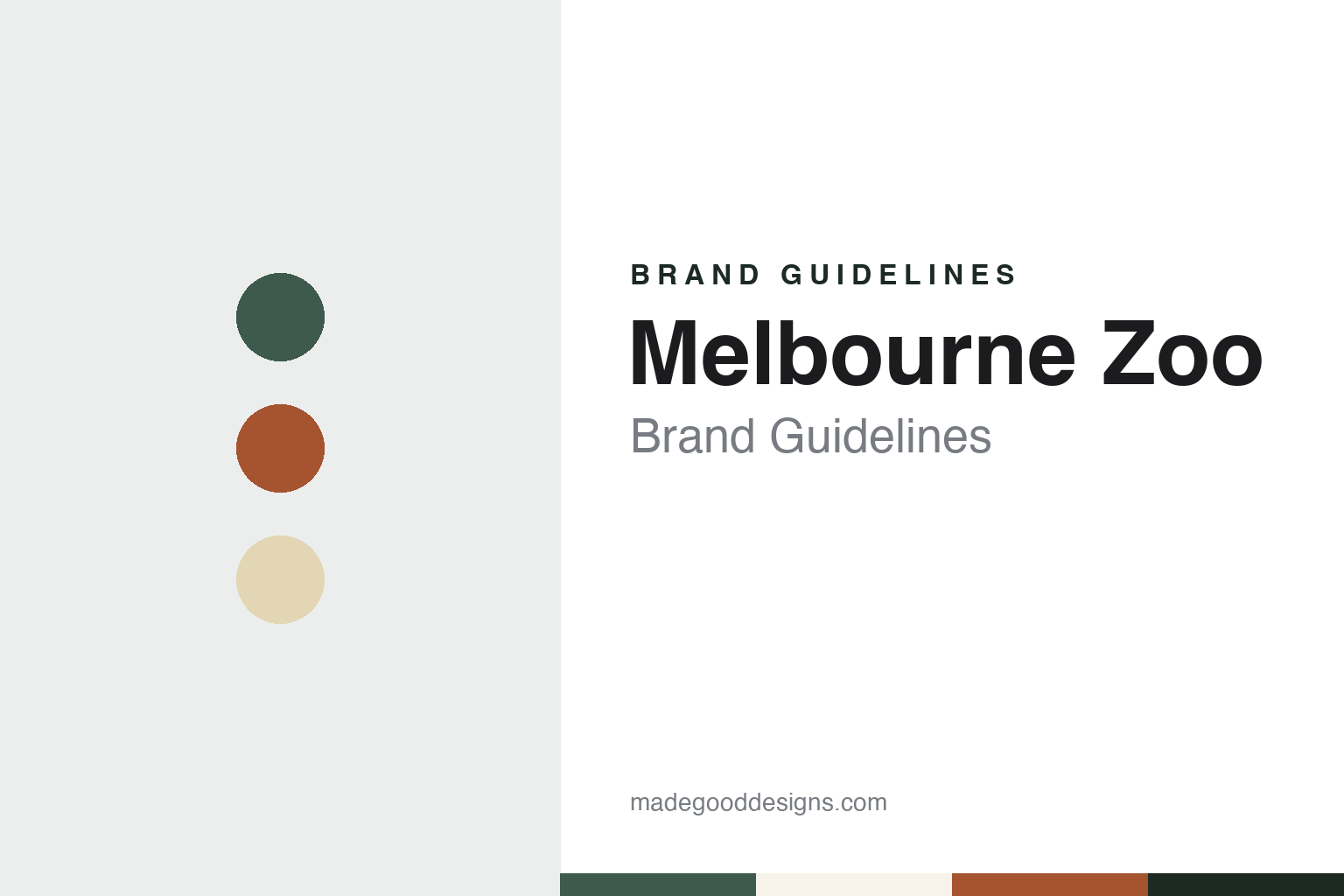
Melbourne Zoo Brand Guidelines
A Victorian acclimatisation garden in Royal Park that became a zoo of bioclimatic zones.
Aa
Two constants: a gum green, brick and dry grass palette and a Victorian garden serif register. Abstract homage — not a Melbourne Zoo asset or mark; no logo, sign, photograph or wordmark is reproduced.
From acclimatisation to zoo
A society of 1857 and a park site of 1862.
Melbourne Zoo lies in Royal Park, in the suburb of Parkville, about four kilometres north of the centre of Melbourne. Its roots go back to the Zoological Society of Victoria, founded in 1857. The Encyclopedia of Melbourne, published by the University of Melbourne in July 2008, says the society gathered a small collection of birds, native animals and monkeys in temporary enclosures in the Royal Botanic Gardens, with the intention of a permanent home at Richmond Paddock on the north side of the Yarra; the Encyclopedia of Australian Science and Innovation says a zoo was first set up at Richmond, on the bank of the river, before it moved to Royal Park.
A new society and a new site followed. The Encyclopedia of Melbourne says Edward Wilson, a former editor of The Argus, arranged a change of name to the Acclimatisation Society of Victoria in 1861, and a permanent location in Royal Park. Its aim was to import animals with economic, game or recreational value. The Royal Park ground was laid out in 1861 to a classical design by Albert Lynch, and English Wikipedia dates the opening of the zoo there to 6 October 1862, on 55 acres of land given by the City of Melbourne. The Encyclopedia of Melbourne says the zoo was one of many zoological gardens founded to follow the example of London Zoo, and calls it the oldest surviving Australian zoo.
The emphasis soon changed. When Albert Le Souef became secretary of the society in 1870, the Encyclopedia of Melbourne says, he began to develop the gardens for visitors and bought exotic animals, and the society was renamed the Zoological and Acclimatisation Society of Victoria; English Wikipedia dates the new name to 1870 and the encyclopedia to 1872. The prefix “Royal” was added in 1910. The 1880s, the encyclopedia says, made the zoo a popular place for recreation in the city.
Colour
A state board, a walk of 1861 and a register listing.
The society did not keep the zoo. The Encyclopedia of Melbourne says the depression of the 1930s left it short of funds, and that it gave up control to the newly created Zoological Board of Victoria in 1937; English Wikipedia names the law as the Zoological Gardens Act 1936. The encyclopedia says there was little development until the 1960s, when the board began to modernise the enclosures and the zoo’s educational role. English Wikipedia records a Lion Park with an elevated walkway that opened in 1964 and was replaced in 2014.
The modern zoo is arranged in what both sources call bioclimatic zones, enclosures grouped by habitat. English Wikipedia lists an African rainforest area, an Asian rainforest area and an area of Australian bush, together with named houses and precincts such as the Butterfly House, the Reptile House, the Great Flight Aviary, Wild Sea and Lion Gorge, set among flower gardens and picnic lawns and a Japanese garden with a pond and an island.
Older layers remain in the grounds. The Encyclopedia of Melbourne names the main walk of 1861 and a bar-and-brick orang-utan enclosure of 1928 as historical reminders preserved on the site. English Wikipedia says the Royal Melbourne Zoological Gardens were entered on the Victorian Heritage Register on 23 May 1996, and that the heritage-listed Elephant House has been adapted for overnight camping events. The zoo’s carousel, English Wikipedia says, was made in England, came to Australia in 1886 with a touring carnival, arrived at the zoo’s fun fair in 1952, was bought by the zoo in 1997, restored off site with Heritage Victoria funding and reopened in August 2005; it is listed by Heritage Victoria as a heritage place.
Typography
Zoos in Europe, North America and Australia.
A zoo usually presents itself through the body that stands behind its name. Some are run by a zoological society founded for the purpose, some by a charity, a company or a city, and some by a state agency that took over from an older society; the Encyclopedia of Melbourne, for example, describes how Melbourne’s acclimatisation society handed its zoo to a state board in 1937. The founding date matters as much as the owner, and many zoos give it a prominent place, whether it falls in the 18th or 19th century or in the decades of the modern site.
The grounds tell the same story in buildings. Older zoos keep historic gates, animal houses and pavilions, some of them on a heritage register, next to large landscaped habitat areas built much later. English Wikipedia describes how Chester Zoo’s founder followed Carl Hagenbeck’s use of moats and ditches in place of bars, an approach that shaped many 20th-century layouts, while the Encyclopedia of Melbourne notes that many 19th-century zoological gardens followed the example of London Zoo.
A large site also needs to be read on the move. Maps, signposts and named areas or zones guide visitors between houses and habitats, and several zoos group their animals by region or climate, so that a path leads from one landscape to the next. Education is part of the offer too, with programmes for schools and families described in general terms on the zoos’ own websites.
Visual identities draw on these layers. Logos often use an animal silhouette or a simple wordmark, signage follows the paths and zones of the site, and the buildings themselves, old and new, carry much of the character. This guide describes each zoo through what dated sources say about its founders, operators, buildings and grounds, and uses colours and type of its own choosing.
Aa
A Victorian garden serif, for a zoo laid out on a classical plan in 1861. (Specimen set in Fraunces, a serif STAND-IN; NOT the Melbourne Zoo logo.)
Melbourne Zoo today
One of four zoos under one name.
Since 1996 the zoo has been managed by the Zoological Parks and Gardens Board, the Encyclopedia of Melbourne says, and English Wikipedia says the board works under the Zoological Parks and Gardens Act 1995 and that its zoos have traded together as Zoos Victoria since 1973. Zoos Victoria’s website names four zoos in 2026: Healesville Sanctuary, Kyabram Fauna Park, Melbourne Zoo and Werribee Open Range Zoo; English Wikipedia says Kyabram Fauna Park joined in July 2022. English Wikipedia lists the zoo as a member of the Zoo and Aquarium Association and the World Association of Zoos and Aquariums.
The site has changed again in recent years. Time Out Melbourne reported in April 2025 that the zoo’s Asian elephants, six adults and three calves, had been moved in February 2025 from Parkville to a 21-hectare habitat at Werribee Open Range Zoo, a journey of 40 kilometres over five days; English Wikipedia says the former Trail of the Elephants precinct at Melbourne Zoo, opened in 2003, was renamed Forest of Wonder. In 2012 the zoo marked 150 years at Royal Park, and Australia Post issued a collector’s edition of zoo stamps that September, English Wikipedia says.
The zoo’s education work is aimed largely at schools, with a large schools section, according to English Wikipedia, and Zoos Victoria’s website lists excursion programs, digital programs and teacher training across its zoos. Visitors reach the grounds from Royal Park station on the Upfield line, by tram or along the Capital City Trail, and the Rail Gate entrance sits at the north end near the station.
For a design guide, Melbourne Zoo shows how a 19th-century garden plan, a main walk and old enclosures can carry a modern site arranged by habitat. Compare State Library Victoria, another Melbourne institution of the same era, and Taronga Zoo in Sydney. For this guide we use a gum green, a brick red and a dry-grass tone with a serif, an unofficial interpretation; no product or logo is reproduced.
Explore & save
Keep Melbourne Zoo’s identity on hand — save it to a board in the Made Good inspiration library.
Melbourne Zoo identity set
Pin the Melbourne Zoo gum green, brick and dry grass palette and the Victorian garden serif register to your own board.
Source & notes
Frequently Asked Questions
What font can I use to match the Melbourne Zoo look?
This guide describes Melbourne Zoo’s type as “A Victorian garden serif, for a zoo laid out on a classical plan in 1861”. Its type specimen is set in Fraunces from Google Fonts as a stand-in; Fraunces is not Melbourne Zoo’s own lettering.
What colours are in the Melbourne Zoo palette?
This guide’s Melbourne Zoo palette is Gum Leaf Green #3D5A4C, Parkville Brick #A6532F, Dry Grass #E3D6B4, Royal Park Shade #1C2A23 and Paper #F7F3EA. The tones are the guide’s own unofficial interpretation, not official Melbourne Zoo hex codes.
When did Melbourne Zoo open?
Melbourne Zoo opened on 6 October 1862, in Royal Park, Parkville, Melbourne.