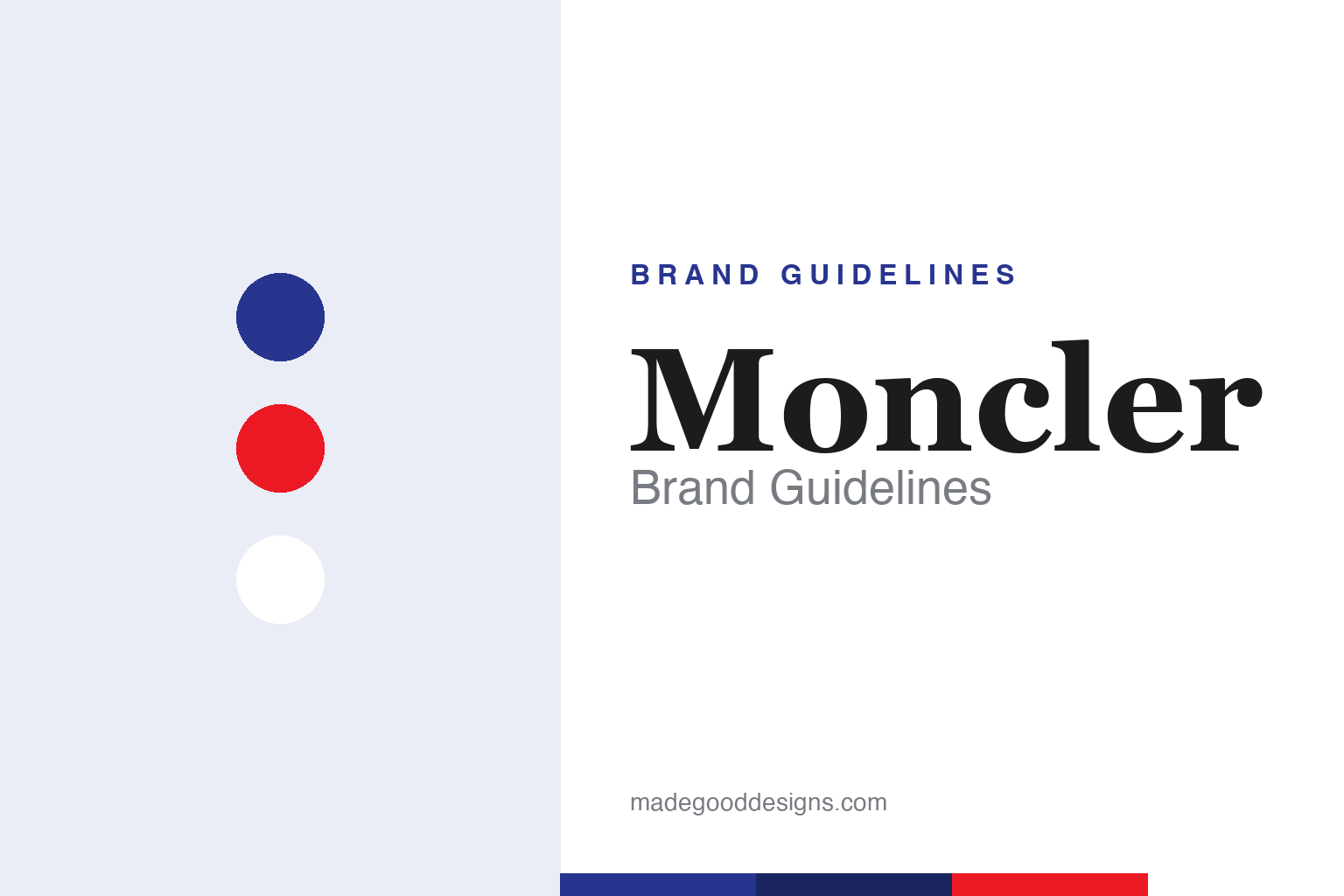
Moncler Brand Guidelines
A rooster that’s also a mountain, in French tricolour — Alpine gear reborn as luxury outerwear.
Aa
Two constants: a French tricolour and a glyphic serif. Abstract homage — not the Moncler rooster or wordmark.
A name hidden in a village
‘Moncler’ isn’t a founder or a word — it’s a French mountain village, abbreviated.
Moncler’s name is a small puzzle solved: it’s a contraction of MONestier-de-CLERmont, the French village near Grenoble where the company was founded on 1 April 1952 by René Ramillon and André Vincent. It began with quilted sleeping bags and tents, then the first down jackets in 1954 — genuine mountaineering gear. Its heritage is proven: Moncler equipped the Italian 1954 K2 expedition and the French 1968 Grenoble Olympic ski team. The emblem is a clever piece of design: a stylised rooster (le coq) — the Gallic rooster, a French national symbol of courage — rendered so its angular forms also read as alpine mountain peaks (and a pointed “M”), tying the French origin to the mountain purpose in one mark.
The modern twist is ownership and positioning. Though French in origin, Moncler is now Italian-owned: Remo Ruffini bought it in 2003 and reengineered the technical Alpine brand into global luxury outerwear — the puffer jacket as status symbol. So the rooster-on-mountain heritage is real, but the luxury Moncler you see today is a 21st-century Italian reinvention of a mid-century French mountaineering label.
Colour
Moncler wears the French tricolour. Click a swatch to copy the hex.
The palette is the tricolour of the French flag — blue, white and red — the logo colours since founding (blue for the rooster’s body/head, red for the comb). Moncler publishes no official brand hex, so treat cited values (blue around #28358F, red around #EB1923) as third-party approximations. The tricolour is doing clear heritage work: it signals the brand’s French origin and its national-symbol rooster, grounding a now-Italian luxury label in its Alpine, Gallic roots.
The lesson is a palette that encodes origin. Moncler’s blue-white-red instantly reads as French, reinforcing the rooster and the Monestier-de-Clermont story even as the brand operates as Italian luxury. It’s a reminder that colour can carry provenance: a national tricolour tied to a national-symbol emblem communicates “where we’re from” without a word. For designers, the takeaway is that when a brand’s heritage is a genuine asset (here, French Alpine mountaineering), letting the palette and emblem speak that heritage — tricolour, rooster, peaks — keeps the story legible even after the brand’s ownership and market have moved on.
Typography
The wordmark is a bold glyphic serif — sturdy and outdoorsy.
The “MONCLER” wordmark is a bold glyphic serif with flared, angular serifs, widely identified as Friz Quadrata (or a close custom variant) — a design-community attribution rather than a Moncler-confirmed spec. Glyphic serifs read as sturdy, established and a little rugged, which suits a mountaineering-heritage brand — they feel carved and durable rather than delicate. The type pairs with the rooster-on-mountain emblem to signal both French heritage and Alpine capability, giving even a fashion puffer a whiff of genuine outdoor pedigree.
Aa 1952
Bold, flared glyphic serifs — sturdy and outdoorsy. (Specimen set in Cinzel, a glyphic Roman face in the spirit of Moncler’s Friz-Quadrata-style wordmark.)
From K2 to the catwalk
Moncler’s story is technical heritage reengineered into luxury.
Moncler’s modern brand runs on authentic technical heritage, luxuriously repackaged. The mountaineering credentials are real (K2 1954, Grenoble 1968, decades of down expertise), and Remo Ruffini’s post-2003 repositioning turned that pedigree into aspirational, high-priced outerwear — the puffer as luxury item. The Moncler Genius platform (2018) replaced the seasonal runway with rotating designer and culture collaborations, keeping the brand culturally current. Throughout, the rooster-on-mountain emblem and the tricolour anchor everything in the founding Alpine story.
For designers, Moncler is a lesson in mining real heritage for modern luxury. A genuine technical past (mountaineering, Olympic teams) gives a brand authenticity that pure fashion can’t buy; the job of the identity is to keep that heritage visible — through the rooster-that-is-a-mountain, the French tricolour, the sturdy glyphic type — even as the product becomes a status symbol far from any peak. The takeaways: encode origin and purpose into the emblem and palette; protect those anchors through every repositioning; and remember that authentic heritage, clearly signalled, is what lets a £1,000 puffer feel earned rather than arbitrary. A rooster on a mountain still says “made for the cold,” even on a city street.
Explore & save
Keep Moncler’s identity on hand — save it to a board in the Made Good inspiration library.
Moncler identity set
Pin the tricolour palette and the type spirit to your own board.