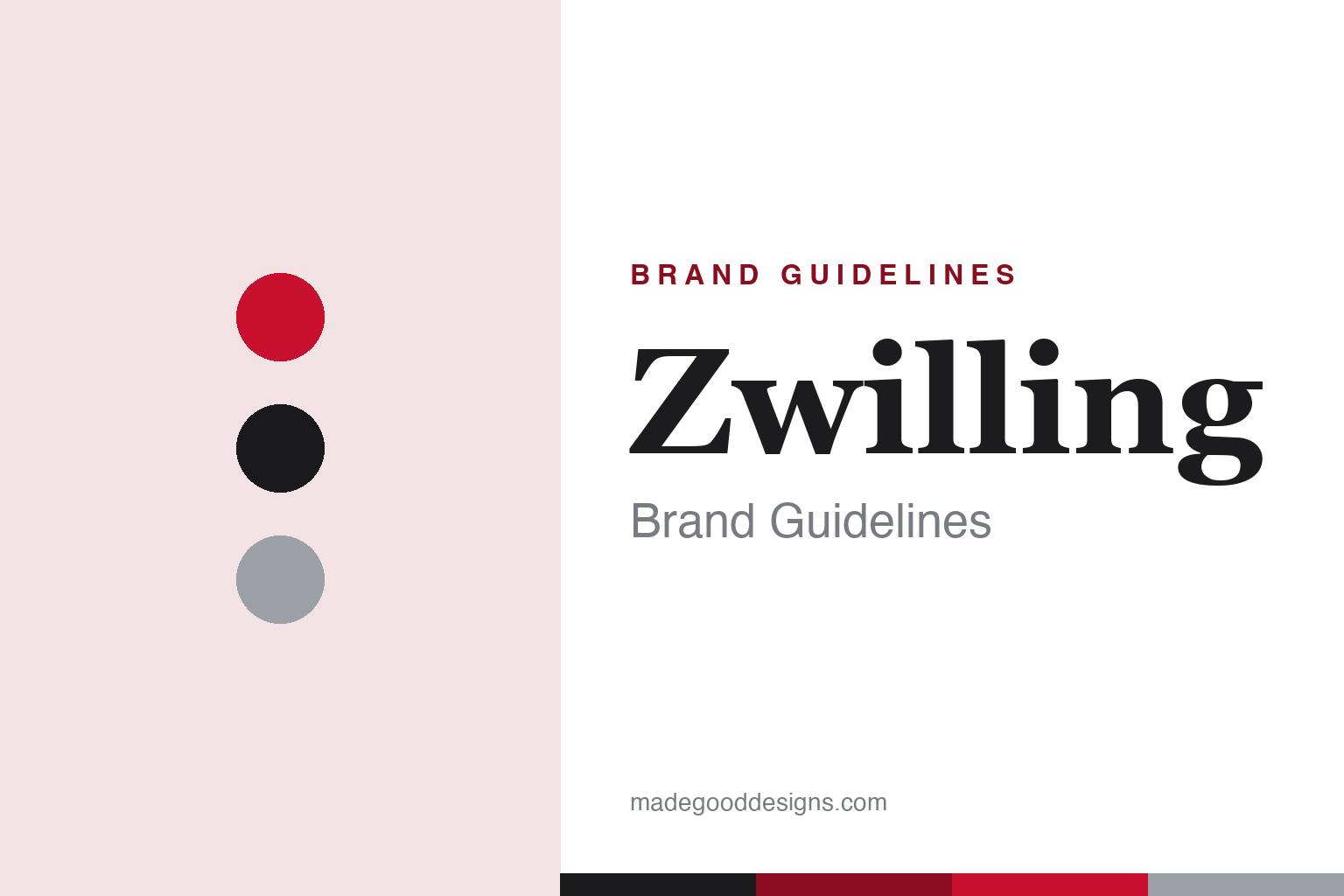
Zwilling Brand Guidelines
The twin mark since 1731 — Solingen steel, forged knives, and a logo whose number of twins signals the tier.
Aa
Two constants: a heritage red mark colour on near-black and an elegant heritage serif. Abstract homage — no twins, not the Zwilling mark.
The twin mark of 1731
Zwilling’s mark dates to 1731.
Zwilling is a lesson in a mark that has outlasted empires. On 13 June 1731 in Solingen, Germany — the “City of Blades” — Peter Henckels registered the “Zwilling” (twin) mark with the city’s Cutlers’ Guild. (An honest correction to a common error: the 1731 founder was Peter Henckels; Johann Abraham Henckels came later and gave the brand its “J.A.” name — so don’t call J.A. the founder. And it’s best described as “one of the oldest brand marks still in use,” registered with a guild in 1731, rather than a “registered trademark” in the modern legal sense, which didn’t exist yet.)
The name and mark are the identity. “Zwilling” means “twin,” and the logo depicts twin figures (a Gemini motif). There’s a clever two-tier system worth getting right: the premium Zwilling line uses the two-twins logo, while the value line, Henckels International, uses a single-figure logo — a rare case where a logo variant literally signals the price tier. (In the US the brand was long marketed simply as “J.A. Henckels” or “Henckels.”) The familiar red-background logo shape, incidentally, dates only to 1969 — far younger than the mark itself. (Two honest notes: no official brand hex is published, and the wordmark typeface is undocumented.)
Zwilling is famous for forged premium kitchen knives and its trademarked FRIODUR ice-hardened (cryogenically treated) blades. Beyond knives, the Zwilling Group owns a portfolio of respected brands: Staub (French cast iron), Ballarini (Italian), Miyabi (Japanese knives) and Demeyere (Belgian — not French). It’s owned by the Werhahn Group, a German family conglomerate, and has been fully so since 1970. (One myth-corrector, tying to the reusable-bottle world: despite a persistent rumour, Zwilling does not own Chilly’s.) A twin mark that has endured nearly three centuries.
Colour
Zwilling lives in a heritage red on near-black. Click a swatch to copy the hex.
Zwilling’s identity is anchored by its red mark (the red-background logo dating to 1969), usually set against black or near-black, with steel and white supporting tones. The red reads as heritage, confident and authoritative — a mark colour carried across generations of blade-making — while the near-black and metallics signal precision, forged steel and craft. It’s a restrained, grown-up palette befitting a near-300-year-old cutlery house: it says trusted craftsmanship, not fashion novelty. The honest caveat: Zwilling publishes no official brand hex, so the red and near-black here are observed approximations, not first-party values — and no twin figures are reproduced.
The lesson is a single heritage mark-colour can carry centuries of trust. Zwilling’s red-on-black world reads as precise, authoritative and enduring. For designers, it’s a reminder that a restrained, consistent heritage palette can signal reliability better than novelty. The takeaways: anchor on a confident heritage mark-colour (the red); support it with precise, forged-steel neutrals (near-black, steel); and treat specific hexes as approximate when no official spec is published.
Typography
The wordmark is an elegant heritage serif spirit — precise and enduring.
Zwilling’s identity carries a refined, heritage, precise spirit — a dignified feel befitting a cutlery house whose mark dates to 1731. An elegant serif captures it well: the classical letterforms read as crafted, authoritative and enduring, matching a brand built on forged steel and centuries of blade-making, and the restraint lets the mark and the steel speak. Set with a heritage red on near-black, the type feels trustworthy and timeless — exactly the precision-craft personality Zwilling cultivates. It’s refined and heritage rather than loud, mirroring the forged products. Because the exact wordmark face is undocumented, the honest description is “an elegant heritage serif spirit,” not a named font. The type behaves like the brand: precise, heritage and enduring.
Aa
An elegant heritage serif spirit — precise and enduring. (Specimen set in Playfair Display, an elegant heritage serif in the spirit of the Zwilling identity; the real wordmark is undocumented.)
A mark that endures
Zwilling sells centuries of trust.
Zwilling is a lesson in heritage as the brand. Its most valuable asset isn’t a single product — it’s a mark registered in 1731 and carried, almost unbroken, ever since. That continuity is a genuine, near-impossible-to-copy differentiator: nearly three centuries of forged-steel craft, condensed into a twin symbol that instantly signals authority in the kitchen. Zwilling manages that heritage smartly — extending it into a group of respected specialist brands (Staub, Miyabi, Ballarini, Demeyere) so each category has a credible name, and using a clever two-tier logo (two twins for premium Zwilling, one figure for value Henckels) to stretch across price points without diluting the top mark. The lesson is that a long, authentic heritage — protected, consistently marked, and thoughtfully extended — can be one of the most durable brands of all, because trust compounds over time. Guard the mark, and the centuries do the selling.
For designers and brand-builders, Zwilling offers a clear takeaway: a long, authentic heritage, consistently marked, can be a brand’s deepest moat. The lessons: protect and centre a heritage mark (the 1731 twins); extend into categories with credible specialist brands rather than stretching one name thin (the Zwilling Group); and use clear visual tiers to span price points (two twins vs one figure). It’s also a reminder to keep the facts precise — Zwilling’s twin mark was registered by Peter Henckels in Solingen in 1731, the red logo dates to 1969, the group owns Staub, Miyabi, Ballarini and Demeyere, and it’s owned by the Werhahn Group. Zwilling sells centuries of trust — proof that heritage can be the brand.
Explore & save
Keep Zwilling’s identity on hand — save it to a board in the Made Good inspiration library.
Zwilling identity set
Pin the heritage red-on-black palette and the heritage-serif spirit to your own board.