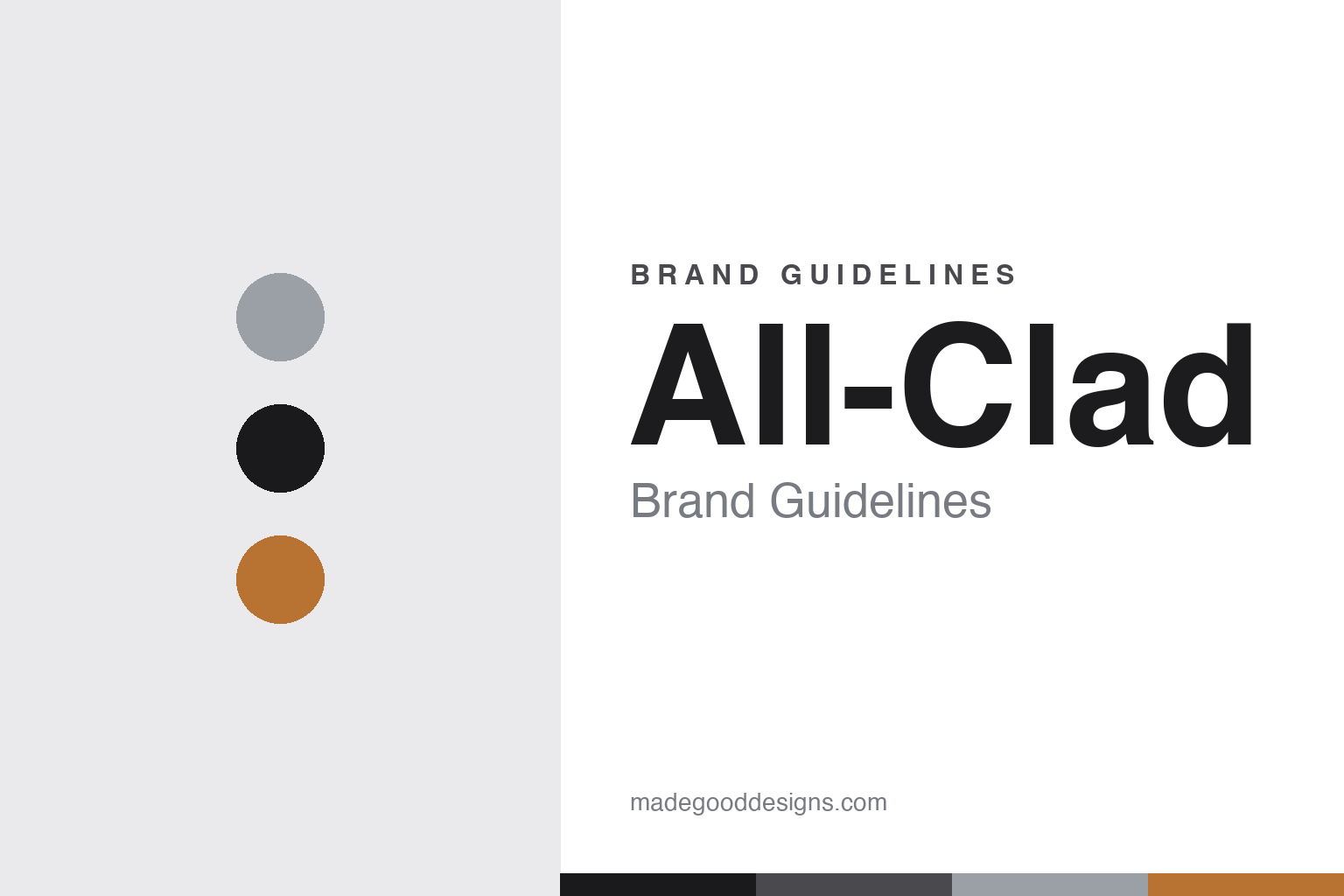
All-Clad Brand Guidelines
The name is the spec — bonded multi-ply metal, all the way up the sides, engineered for professional kitchens.
Aa
Two constants: a stainless-steel-and-black palette with a copper-core nod and an industrial sans. Abstract homage — not the All-Clad wordmark.
The name is the spec
All-Clad bonded metal into cookware.
All-Clad is a lesson in a brand name that is an engineering spec. It was founded in 1971 by John Ulam, a metallurgist, in Canonsburg, Pennsylvania (the Pittsburgh area). Ulam pioneered the roll-bonding of dissimilar metals — bonding layers of stainless steel with aluminium and/or copper into a single sheet — and his earlier bonded-metals work supplied industries from US Mint coinage to avionics. (An honest note: 1971 is when the cookware company, All-Clad Metalcrafters, was founded — Ulam’s bonded-metals business predates it, around 1967 — so don’t say he “invented bonded metal in 1971.” Two more: no official brand hex is published, and the wordmark typeface is undocumented.)
The name says it all: “clad” refers to the bonded multi-ply construction, and “All-Clad” means the bonded layers run all the way up the sides of the pan (not just a disc on the base) — a rare case of a premium brand name being a literal engineering description. That construction is the whole product: premium, professional-grade bonded stainless cookware, made in the USA at Canonsburg, and a favourite of professional chefs and serious home cooks. The signature lines are D3 (3-ply), D5 (5-ply) and Copper Core (with a newer G5 Graphite Core), typically with a Type 304 stainless cooking surface.
An honest note on origins and claims: All-Clad is an American company that is French-owned — since 2004 it has been owned by Groupe SEB (the French group behind T-fal/Tefal, Krups, Rowenta and WMF), so the premium American icon and the mass-market non-stick brand share a corporate roof. Its bonded lines are marketed as “Made in the USA with global components” (not 100% American materials). A 2022 class-action settlement (over “dishwasher-safe” labelling and a rough rim) was resolved without admission of wrongdoing. The identity is engineered and restrained — stainless steel, black handles. The name is the spec.
Colour
All-Clad lives in stainless steel and black. Click a swatch to copy the hex.
All-Clad’s identity reads through stainless-steel silver and black, with a copper nod to its Copper Core line. The palette is the honest colour of the product itself — polished bonded metal and black handles — and reads as engineered, professional and premium: restrained and serious rather than decorative, the look of pro-grade equipment. The metallic tones signal the bonded-metal craftsmanship at the brand’s core, while the black adds a clean, professional contrast. The honest caveat: All-Clad publishes no official brand hex, so the steel, black and copper here are an original, unofficial interpretation, not first-party values.
The lesson is the product’s own material can be the palette. All-Clad’s stainless-and-black world literally looks like its pans — engineered and premium. For designers, it’s a reminder that an honest, material-led palette can communicate quality and seriousness. The takeaways: let the material lead for an engineered brand (stainless, black); nod to a signature feature (the copper core); and treat specific hexes as unofficial when no brand spec is published.
Typography
The wordmark is a restrained industrial sans — engineered and professional.
All-Clad’s identity carries a restrained, industrial, professional spirit — a clean sans-serif wordmark whose engineered, even letterforms read as precise, premium and serious. The restrained type matches a brand built on metallurgy and professional-grade construction, and the plainness signals substance and engineering over decoration. Set against a stainless-and-black palette, the type feels like pro equipment — exactly the engineered, chef’s-tool personality All-Clad cultivates. It’s industrial and precise rather than decorative, mirroring the bonded cookware. Because the exact wordmark face isn’t publicly documented, the honest description is “a restrained industrial sans spirit,” not a named font. The type behaves like the brand: engineered, professional and precise.
Aa
A restrained industrial sans spirit — engineered and professional. (Specimen set in Chivo, an industrial grotesque in the spirit of the All-Clad wordmark; the real face is undocumented.)
Engineering as the brand
All-Clad sells the metallurgy.
All-Clad is a lesson in engineering credibility as the brand. Where others sell cookware on colour, celebrity or convenience, All-Clad sells metallurgy: a genuinely superior construction (fully bonded multi-ply metal, cladding the whole vessel) invented by a metallurgist whose bonding tech was serious enough for coinage and avionics. That engineering story is the entire brand — it’s why professional chefs trust it, why serious home cooks pay a premium, and why the name itself is a spec (“All-Clad” = clad all the way up). The lesson is that in a category full of marketing gloss, a real, demonstrable engineering advantage — communicated plainly and honestly — can build a durable premium brand and a devoted following. The honest discipline matters too: being precise about “Made in USA with global components,” about French ownership (Groupe SEB), and about a settled labelling lawsuit keeps the credibility intact. Sell the engineering, and the reputation follows.
For designers and brand-builders, All-Clad offers a clear takeaway: a real, demonstrable engineering advantage can be a durable premium brand. The lessons: build on genuine technical substance (bonded multi-ply metallurgy); make the name and identity express it (the “clad” spec, the material-led palette); and keep the claims precise and honest (US-made with global components, French-owned). It’s also a reminder to keep the facts precise — All-Clad Metalcrafters was founded in 1971 by metallurgist John Ulam in Canonsburg, PA, pioneered roll-bonded cookware, is owned by Groupe SEB since 2004, and is American-made with global components. All-Clad sells the metallurgy — proof that engineering can be the brand.
Explore & save
Keep All-Clad’s identity on hand — save it to a board in the Made Good inspiration library.
All-Clad identity set
Pin the stainless-and-black palette and the industrial-sans spirit to your own board.