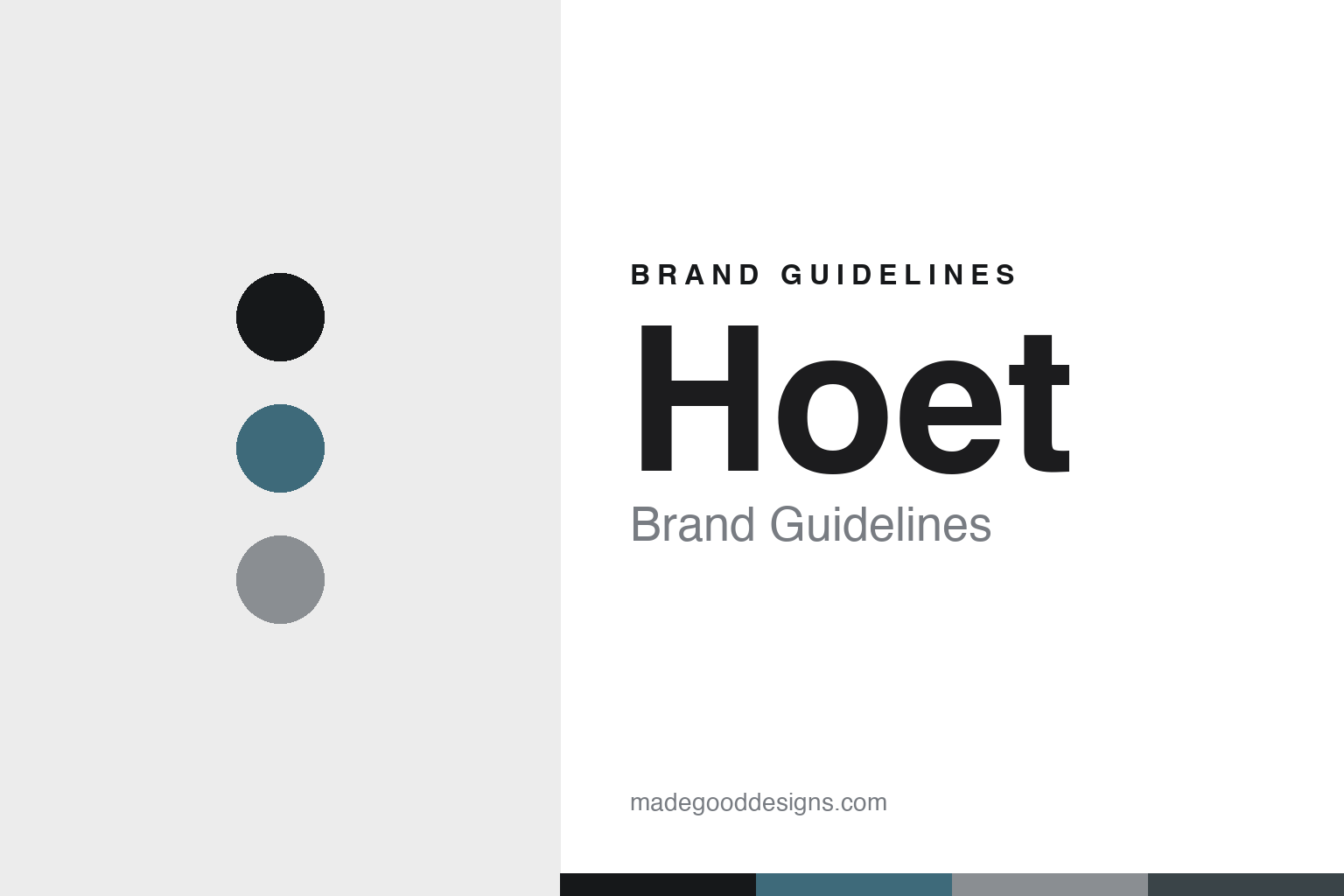
Hoet Brand Guidelines
The 3D-printed titanium frame.
Aa
Two constants: a titanium palette and a technical sans register. Abstract homage — not the Hoet frame or wordmark.
The 3D-printed titanium frame
Hoet 3D-prints eyewear in titanium.
Hoet is a lesson in additive titanium craft as the identity. A Belgian eyewear brand from a six-generation Bruges optician family, it makes frames by 3D-printing titanium.
Its identity is the 3D-printed titanium frame. Hoet’s Couture line — laser-printed titanium, made to order and engravable — is the work it is known for, having been the first in the world to bring 3D-printed titanium eyewear to market. Avant-garde, engineered by printer. Titanium, grown layer by layer.
(Honest notes: Hoet is a Belgian eyewear brand from an optician-and-jeweller family in Bruges, established in 1884 and now in its sixth generation (Patrick Hoet founded the separate Theo brand; his daughter Bieke Hoet has led the company since 2020). The independent Hoet eyewear brand launched in 2014. Its signature is Hoet Couture — luxury 3D-laser-printed (laser-sintered) titanium frames, made to order and engravable, across Couture, Couture² and Costume; in 2014 Hoet was the first in the world to bring 3D-printed titanium eyewear to market, and that is the real signature story. One important correction: “Cabrio” is a separate brand — a sunglasses-and-cap-visor hybrid in polypropylene/synthetics, not a titanium frame — so we don’t conflate it with Couture. On production, it is made in Belgium, 3D-printed on demand (with additive partners such as Materialise and EOS). It is an independent, family-owned business. We don’t attribute a Silmo d’Or to Couture (that award was for the separate Seiko Xchanger collaboration). There’s no official brand hex, and we reproduce no frame or logo — these tones are an unofficial interpretation. This is design commentary and does not promote any product.)
Colour
Hoet lives in a titanium palette. Click a swatch to copy the hex.
Hoet’s identity is engineered, sculptural and cool — a titanium teal, an ink, a titanium, a graphite, and a chalk. The palette leans titanium — the register of laser-printed metal and additive manufacturing. It signals technology and craft rather than novelty. The honest caveat: with no published brand hex, these tones are an original, unofficial interpretation, not first-party values.
The lesson is a titanium palette signals additive craft. Hoet’s world is an engineered, sculptural, cool-metal object. For designers, it is a reminder that a manufacturing technology — 3D-printed titanium — can be the whole identity, and that a titanium palette signals that engineering. Because a titanium teal can fail as small text, keep type dark and let the colour live in the accents, palette and band. The takeaways: print the titanium; make to order; keep it sculptural; and treat any single hex as unofficial.
Typography
The register is a technical sans — precise, modern, engineered.
Hoet’s identity carries a precise, modern, engineered spirit — a 3D-printed, titanium object. A geometric technical sans captures the mood: it is exact and current, the register of additive engineering. Set in a titanium palette, the technical sans feels precise and modern — exactly the personality Hoet carries. It is engineered rather than decorative, mirroring printed titanium. (Hoet’s real frame and wordmark are works we describe but do not reproduce, and the exact typeface is not ours to use.) Because it is not ours to use, the honest description is “a technical sans spirit,” shown here in a stand-in. The type behaves like the brand: precise, modern and engineered.
Aa
A technical sans spirit — precise and modern. (Specimen set in Sora, a geometric technical sans STAND-IN; NOT the Hoet wordmark.)
Additive titanium craft as identity
Hoet stands for the 3D-printed titanium frame.
Hoet is a lesson in making a technology the identity. A titanium palette, a technical sans and a printed frame make additive titanium craft the whole brand — engineered, sculptural, precise. The technology is the differentiator. The differentiator is 3D-printing titanium into eyewear — made to order, engravable, grown rather than cut.
Put to work, the identity is manufacturing as design. A designer building in this spirit would let a distinctive process define the product — here, laser-sintered titanium — so the object could not be made any other way, and the technology becomes the aesthetic. The lesson Hoet teaches is that being first with a technology can be a durable identity: bringing 3D-printed titanium eyewear to market in 2014 gives the brand genuine authority, and a precise, technical design language keeps that engineering legible.
For designers and brand-builders, Hoet offers a clear takeaway: let a distinctive process define the object. The lessons: print the titanium; make to order; keep it sculptural; and be honest about the story. It is also a reminder to keep brands separate: Hoet Couture is the 3D-printed titanium line, distinct from the Cabrio synthetics brand and from Theo — the palette here is an unofficial interpretation. And it is a reminder that made-where honesty can be a genuine boast: Hoet is 3D-printed in Belgium, on demand. It is a reminder, too, that awards should be attributed correctly, so we don’t claim a Silmo d’Or for Couture. Hoet made the 3D-printed titanium frame the brand — proof that additive craft can be the difference.
Explore & save
Keep Hoet’s identity on hand — save it to a board in the Made Good inspiration library.
Hoet identity set
Pin the titanium palette and the technical-sans register to your own board.