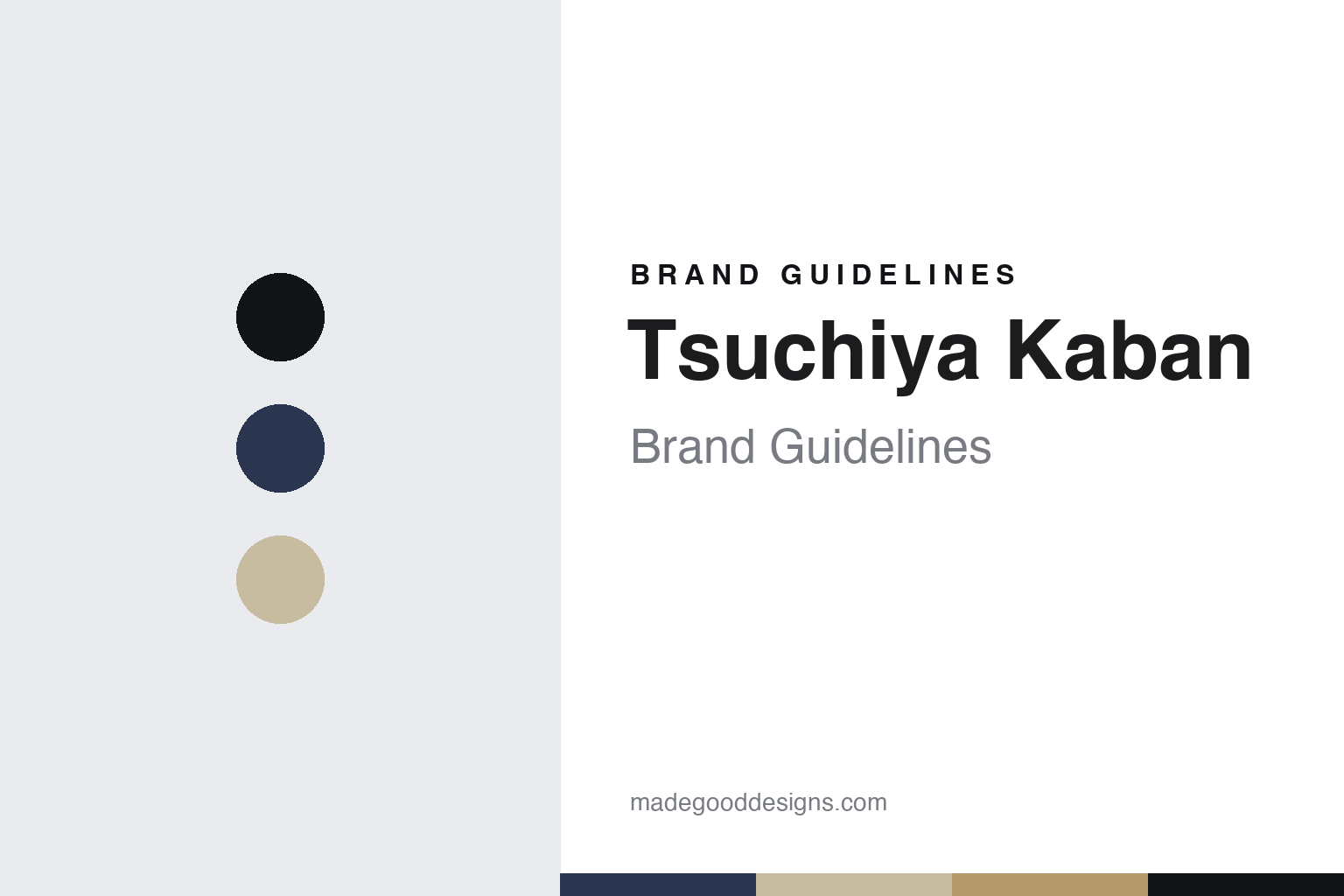
Tsuchiya Kaban Brand Guidelines
The satchel craft.
Aa
Two constants: an ai-indigo palette and a minimal sans register. Abstract homage — not a Tsuchiya Kaban design or wordmark.
The satchel craft
Tsuchiya Kaban began with the Japanese school satchel and grew into hand-crafted leather bags, made in Tokyo.
Tsuchiya Kaban is a lesson in a craft heritage as the identity. A Tokyo maker, it began in 1965 crafting the randoseru — the durable leather school satchel that is a Japanese institution — and grew that same meticulous hand-craft into understated adult leather bags and wallets. A bag, made with a satchel-maker’s care.
Its identity is the satchel craft. Tsuchiya Kaban’s hand-crafted, made-in-Japan leather goods, rooted in the randoseru, are the work it is known for. A craft, made a signature. A workshop that scaled a schoolchild’s satchel into a life’s bag.
(Honest notes, so the story stays precise. Tsuchiya Kaban was founded in 1965 in Tokyo by the craftsman Kunio Tsuchiya, making randoseru; it is family-operated and independent, based in Tokyo’s Nishiarai district, with around a hundred and eighty artisans, and it expanded into adult leather goods over the years. It is genuinely made in Japan, hand-crafted in-house — a bag can involve a hundred and fifty components across three hundred processes. Its designs are its IP, described but never reproduced, and there is no official brand hex — these tones are an unofficial interpretation. This is design commentary and does not promote any product.)
Colour
Tsuchiya Kaban lives in an ai-indigo palette. Click a swatch to copy the hex.
Tsuchiya Kaban’s identity is understated, precise and Japanese — an ai indigo, an ink, a natural leather, a tan, and a chalk. The palette leans ai indigo and leather: the register of a quiet Japanese craft in deep indigo and natural hide. It signals craft and restraint over show. The honest caveat: with no published brand hex, these values are an original, unofficial interpretation, not first-party colours.
The lesson is an ai-indigo palette signals an understated, precise identity. Tsuchiya Kaban’s world is a hand-crafted, made-in-Tokyo, durable object. For designers, it is a reminder that a deep indigo and a natural leather tan can carry a brand built on a craft — the indigo of a Japanese dye and the tan of worked hide. Because these tones can fail as small text, keep type dark and let the colour live in the accents, palette and band. The takeaways: honour the craft; keep it in Japan; make it to last; and treat any single hex as unofficial.
Typography
The register is a minimal sans — clean, quiet, precise.
Tsuchiya Kaban’s identity carries a clean, quiet, precise spirit — a considered object, not a loud one. A minimal sans captures the mood: even, spare and calm, the register of a hand-crafted Japanese leather bag. Set in an ai-indigo palette, the minimal sans feels clean and quiet — exactly the personality Tsuchiya Kaban carries. It is precise rather than showy, mirroring a bag built from many careful steps. (Tsuchiya Kaban’s real designs and wordmark are things we describe but do not reproduce, and the exact typeface is not ours to use.) Because it is not ours to use, the honest description is “a minimal-sans spirit,” shown here in a stand-in. The type behaves like the maker: clean, quiet and precise.
Aa
A minimal-sans spirit — clean and quiet. (Specimen set in Jost, a minimal-sans STAND-IN; NOT the Tsuchiya Kaban wordmark or any bag design.)
A craft heritage as identity
Tsuchiya Kaban stands for the satchel craft.
Tsuchiya Kaban is a lesson in making a craft heritage the identity. An ai-indigo palette, a minimal sans and hand-crafted leather bags make a satchel-maker’s craft the whole maker — understated, precise and Japanese. The craft is the differentiator. The differentiator is a genuine root — beginning with the randoseru, a bag built to survive six years of a Japanese childhood, and carrying that durability into adult goods.
Put to work, the identity is a craft heritage as design. A maker building in this spirit would let a founding craft define everything after it, keep the making in-house, and prize durability over fashion, so the customer buys into a bag made to last a lifetime. It would treat the randoseru heritage as its DNA. It would keep the many careful steps rather than cut them. The lesson Tsuchiya Kaban teaches is that a craft heritage can build a brand: the satchel gives it roots, and the Japanese making gives it authenticity. The craft is the personality, and the making is the proof.
For designers and brand-builders, Tsuchiya Kaban offers a clear takeaway: let a founding craft define the whole line. The lessons: honour the root; make it in Japan; build it to last; and keep the careful steps. It is also a reminder to stay precise: Tsuchiya Kaban is a family-operated Tokyo maker founded in 1965 by Kunio Tsuchiya, hand-crafting leather goods rooted in the randoseru — with the palette here an unofficial interpretation. Tsuchiya Kaban made the satchel craft the maker — proof that a craft heritage can be the difference.
Explore & save
Keep Tsuchiya Kaban’s identity on hand — save it to a board in the Made Good inspiration library.
Tsuchiya Kaban identity set
Pin the ai-indigo palette and the minimal-sans register to your own board.