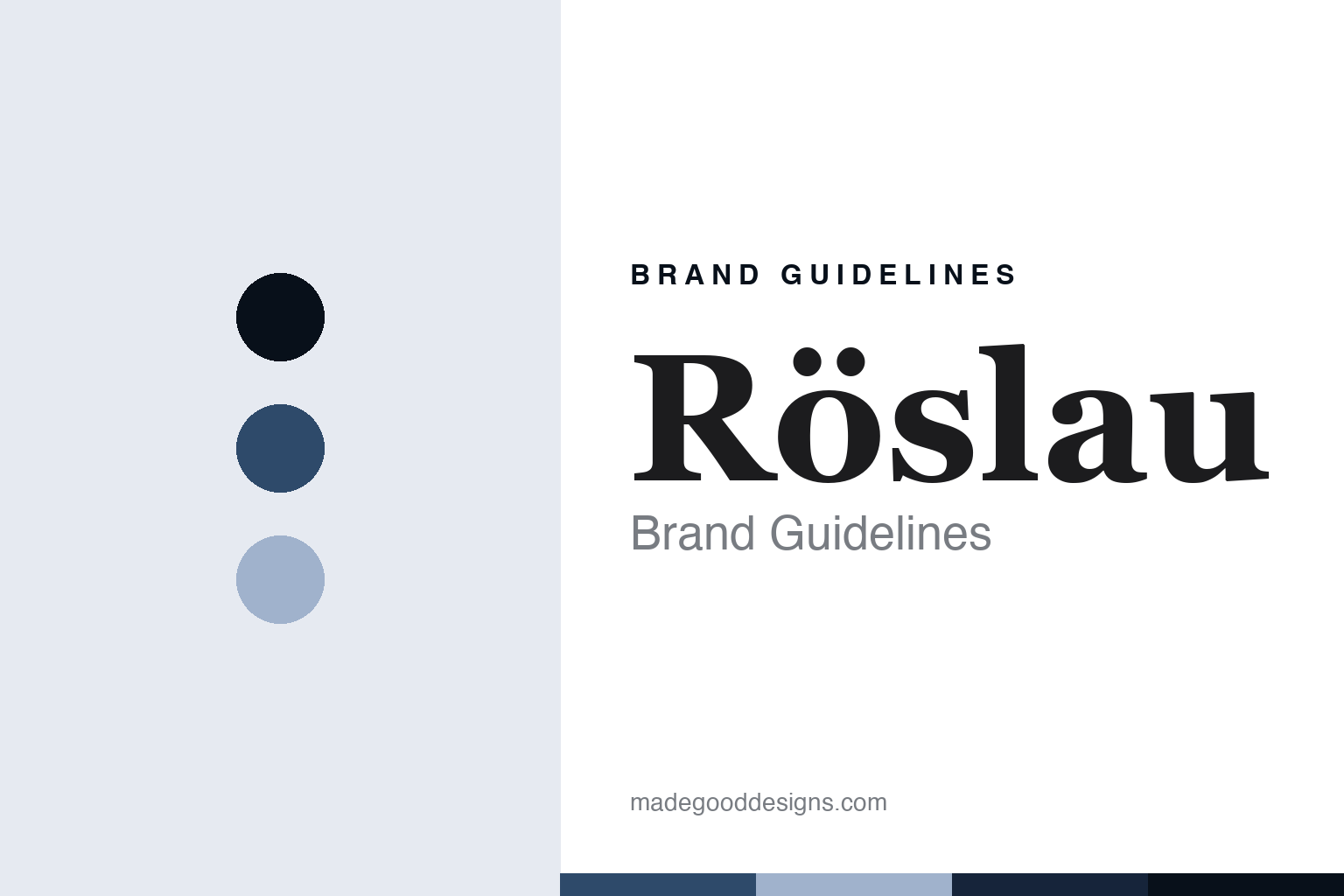
Röslau Brand Guidelines
The piano-wire maker.
Aa
Two constants: a wire-steel palette and a wire-serif register. Abstract homage — not a Röslau wire, string or mark.
The piano-wire maker
Röslau is the German maker of piano and music wire founded in 1882, the precision steel wire that becomes the strings inside pianos, made in Röslau, Bavaria.
Röslau is the round’s most invisible part and its deepest heritage — the steel wire that becomes a piano’s strings. From the Bavarian town of Röslau, the company draws high-tensile precision steel wire, including the music wire that piano makers turn into strings. Its answer to how a maker becomes a name is a material so good the trade named itself after it: draw piano wire so consistently that “Röslau” becomes a byword for it. A German wire, inside pianos everywhere.
Its identity is the piano-wire maker. Röslau’s piano and music wire, its 1882 heritage and its German making are the work it is known for. A wire, made in Germany. The invisible part inside a piano.
(Honest notes, so the story stays precise. Röslau — Stahl- und Drahtwerk Röslau GmbH — was founded in 1882 by the Bongardt brothers, and is based in the town of Röslau, in Bavaria; its live official presence is at roeslau-draht.com. On what it makes, it is precision steel wire: piano string wire (in a range of diameters), finer steel string wire for violins, guitars and other stringed instruments, plus spring steel and industrial wire. On where it is made — a theme of this round — it is made in Germany, at its single Bavarian site. On ownership, it is an independent private GmbH; we do not name a parent group (none is stated) and do not confuse it with a separate company of a similar name in the same town. On its reputation, German-language sources describe it as a market leader in piano-string wire, and note that “Röslau” became a byword for it, which we attribute as reported; the company’s own pages name no specific piano brand as a customer, so we claim none. Its name and marks are IP, described but never reproduced, and there is no official brand hex; these tones are an unofficial interpretation. This is design commentary and does not promote any product.)
Colour
Röslau lives in a wire-steel palette. Click a swatch to copy the hex.
Röslau’s identity is precise, German and hidden — a wire steel, an ink, a silver, a deep steel, and a paper. The palette leans wire steel and silver: the register of drawn steel wire and a polished string. It signals precision at the heart of the instrument. The honest caveat: with no published brand hex, these values are an original, unofficial interpretation, not first-party colours.
The lesson is a wire-steel palette signals a precise, hidden-component identity. Röslau’s world is a precise, steel, German object. For designers, it is a reminder that a wire steel and a soft silver can carry a maker built on drawn wire — the blue-grey of steel and the sheen of a polished string. Because these tones can fail as small text, keep type dark and let the colour live in the accents, palette and band. The takeaways: make the hidden part best; make it in-country; claim only the customers you can; and treat any single hex as unofficial.
Typography
The register is a wire serif — precise, heritage, made.
Röslau’s identity carries a precise, heritage, made spirit — a component maker with a century and a half behind it, not a fashion label. A wire serif captures the mood: classic, exact and industrial, the register of a wire works since 1882. Set in a wire-steel palette, the wire serif feels precise and heritage — exactly the personality Röslau carries. It is a hidden material rather than a marketing wall, mirroring a piano string. (Röslau’s real logo and wordmark are things we describe but do not reproduce, and the exact typeface is not ours to use.) Because it is not ours to use, the honest description is “a wire-serif spirit,” shown here in a stand-in. The type behaves like the maker: precise, heritage and made.
Aa
A wire-serif spirit — precise and heritage. (Specimen set in Playfair Display, a wire-serif STAND-IN; NOT the Röslau logo or any mark.)
The parts players choose
Röslau stands for the wire that becomes a piano’s strings.
Röslau is a lesson in how a hidden material can be an identity. A wire-steel palette, a wire serif and drawn steel wire make one thing — the piano-wire maker — the whole identity: precise, German and hidden. The precision wire is the differentiator, and the heritage since 1882 is the meaning. The point is a maker of the part no player thinks about — the steel wire that becomes a piano’s strings — drawn so consistently that the piano trade adopted the town’s name as a term for the wire itself.
Put to work, the identity is a hidden material, honestly told, as design. A maker in this spirit would perfect the wire, make it in-country, and claim only what it can — piano and music wire, made in Bavaria, an independent works since 1882. A brand learning from it would see that a hidden material can be a durable identity — that the maker of the wire inside a piano holds a place the piano brand cannot always claim — and that being precise, founded 1882 by the Bongardt brothers in Röslau, made in Germany, keeps the story honest. Röslau closes a loop the last components round opened: with the piano-action maker there and the piano-wire maker here, two of the most invisible parts of a piano — the mechanism and the strings — turn out to be the deep-heritage specialties of makers most players have never heard of. It also holds this round’s deepest roots (1882) among mostly-modern specialists, and its “byword” reputation is the strongest form of the invisible-maker story. The discipline is in the restraint: attributing the market-leader and byword claims as reported, naming no specific piano-brand customer, and not confusing the firm with a similarly-named neighbour. The lesson Röslau teaches is that the unseen can hold an identity: the wire gives it substance, and the honesty about the claims keeps it credible. The material is the personality, and the piano wire is the proof.
For designers and brand-builders, Röslau holds the hidden-material pole in the parts players choose, from Germany: perfect the unseen material, and claim only what you can. The lessons: make the invisible part best; keep it in-country; attribute your reputation honestly; name no customer you can’t verify; and never reproduce a logo. It is also a reminder to stay precise: Röslau is the German maker of piano and music wire founded in 1882, the precision steel wire that becomes the strings inside pianos, made in Röslau, Bavaria — with the palette here an unofficial interpretation. Röslau made a hidden material the identity — proof that the wire inside a piano, honestly told, can be the difference.
Explore & save
Keep Röslau’s identity on hand — save it to a board in the Made Good inspiration library.
Röslau identity set
Pin the wire-steel palette and the wire-serif register to your own board.


