Nisaku Brand Guidelines
The hori-hori.
Aa
Two constants: an indigo palette and a blade-serif register. Abstract homage — not a Nisaku product or mark.
The hori-hori
Nisaku is the Tsubame, Japan blade maker behind the stainless hori-hori soil knife, made in Niigata since 1959.
Nisaku is the round’s Japanese blade — the maker behind a soil knife that has become a gardener’s favourite worldwide. Nisaku makes digging and weeding tools led by the hori-hori, the stainless soil knife, along with hoes, sickles and transplanting tools. Its answer to how a maker becomes a name is a single trusted blade: make a stainless hori-hori sharp and rust-resistant enough to dig, weed, transplant and cut roots, in the Tsubame blade district. A knife, for the soil.
Its identity is the hori-hori. Nisaku’s stainless hori-hori, its Tsubame making and its Japanese heritage are the work it is known for. A tool, made in Japan. The hori-hori.
(Honest notes, so the story stays precise. Nisaku is the brand of Tomita Cutlery Co., at nisaku.co.jp, whose signature is the hori-hori — a stainless soil/weeding knife, best known in gardens as the NJP650 — alongside hoes, sickles and transplanting tools. It was founded in 1959, in Tsubame City, Niigata, in the Tsubame-Sanjo metalworking region, and is run by the Tomita family. On where it is made — a theme of this round — Nisaku’s tools are made in Tsubame, Niigata, a genuine Japanese making region, not a name-only import. On ownership, it is an independent, family-run maker that also does contract manufacturing. Two details to get right: it is Tomita Cutlery, with no connection to other cutlery houses; and “Nisaku steel” is a trade name for its stainless, not a published alloy spec. Importantly, the hori-hori is a traditional Japanese tool, not a Nisaku invention — Nisaku is a maker of the form, told respectfully. Its name and marks are IP, described but never reproduced, and there is no official brand hex; these tones are an unofficial interpretation. This is design commentary and does not promote any product.)
Colour
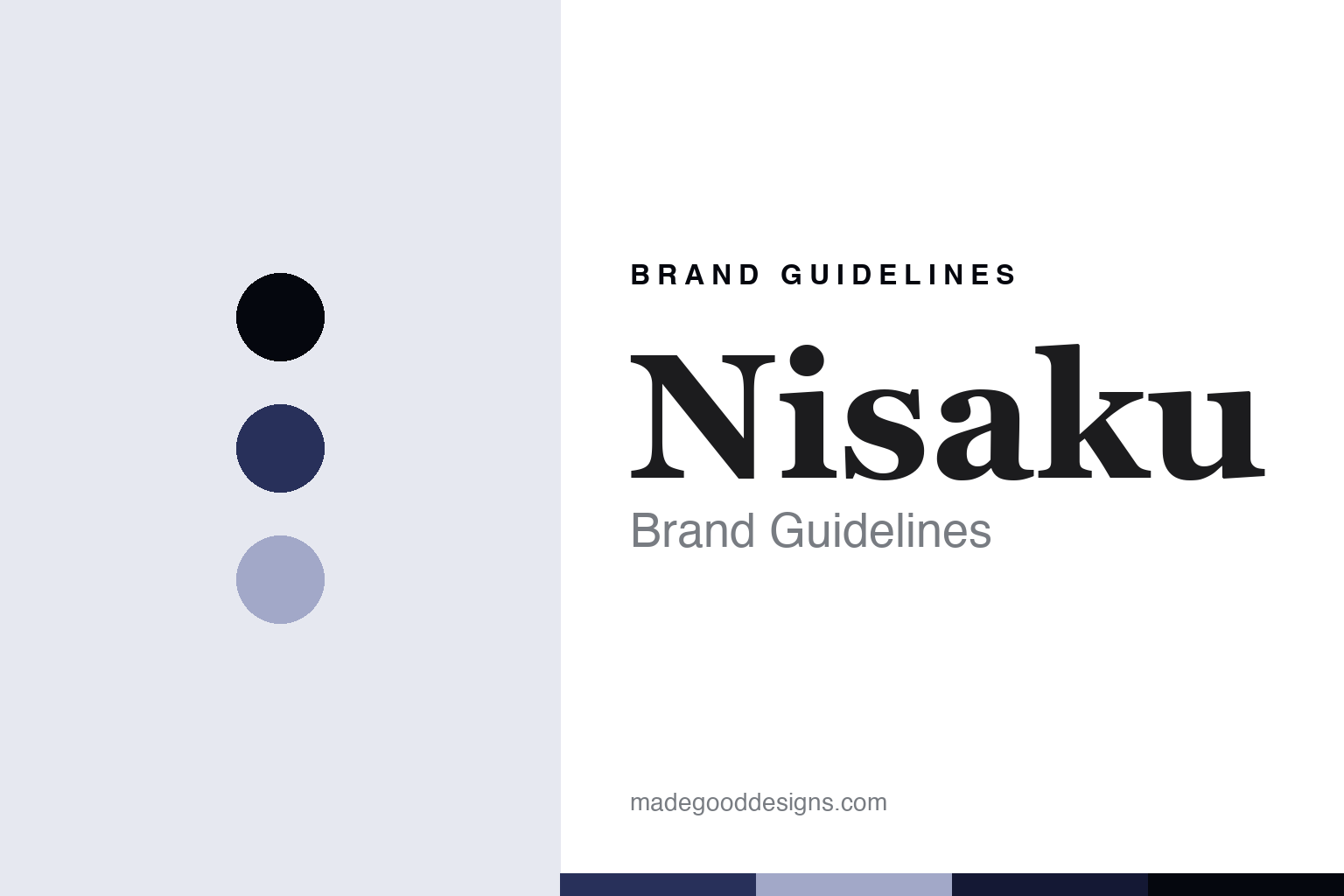
Nisaku lives in an indigo palette. Click a swatch to copy the hex.
Nisaku’s identity is made, precise and honest — an indigo, an ink, a mist blue, a deep indigo, and a paper. The palette leans indigo and mist blue: a quiet Japanese register drawn from indigo tradition rather than any blade or mark. It signals a Japanese blade maker. The honest caveat: with no published brand hex, these values are an original, unofficial interpretation, not first-party colours, and the indigo is a respectful nod, not a Nisaku asset.
The lesson is an indigo palette signals a made-in-Japan, precise identity. Nisaku’s world is a made, precise object. For designers, it is a reminder that a deep indigo and a soft mist blue can carry a blade maker — the calm of a Japanese craft region — without lifting a motif. Because these tones can fail as small text, keep type dark and let the colour live in the accents, palette and band. The takeaways: make one blade well; make it at home; credit the traditional form; and treat any single hex as unofficial.
Typography
The register is a blade serif — fine, precise, made.
Nisaku’s identity carries a fine, precise, made spirit — a blade house, not a broad brand. A blade serif captures the mood: exact, quiet and Japanese, the register of a soil knife ground for the garden. Set in an indigo palette, the blade serif feels fine and precise — exactly the personality Nisaku carries. It is one trusted blade rather than a logo, mirroring a sharp, rust-resistant edge. (Nisaku’s real wordmark, and the hori-hori’s shape, are things we describe but do not reproduce, and the exact typeface is not ours to use.) Because it is not ours to use, the honest description is “a blade-serif spirit,” shown here in a stand-in. The type behaves like the tool: fine, precise and made.
Aa
A blade-serif spirit — fine and made. (Specimen set in Playfair Display, a blade-serif STAND-IN; NOT the Nisaku logo or a blade.)
The digging & cultivating tools
Nisaku stands for the hori-hori, made in Japan.
Nisaku is a lesson in how one trusted blade can be an identity. An indigo palette, a blade serif and a soil knife make one thing — the hori-hori — the whole identity: made, precise and honest. The stainless hori-hori is the differentiator, and the Tsubame making is the meaning. The point is a Japanese family blade house that makes a soil knife trusted by gardeners far beyond Japan.
Put to work, the identity is one blade, told straight, as design. A maker in this spirit would make one tool well and make it at home — the hori-hori, in Tsubame. A reader in this spirit would keep the details right: it is Tomita Cutlery with no other-house connection, “Nisaku steel” is a trade name rather than an alloy spec, and the hori-hori is a traditional Japanese tool that Nisaku makes rather than invented. Nisaku holds the round’s three-jobs thread on the cultivating and weeding side with Wolf-Garten, and its where-made thread at the made-at-home end with Red Pig, Garant and Meadow Creature. The honest editorial moves are to credit Tomita Cutlery, to treat “Nisaku steel” as a trade name, and to frame the hori-hori as a traditional form. The lesson Nisaku teaches is that one trusted blade can hold an identity: the Tsubame making gives it substance, and the soil knife keeps it credible.
For designers and brand-builders, Nisaku holds a Japan pole in the digging & cultivating tools: make one blade well — and credit the tradition. The lessons: perfect one tool; make it in its craft region; name the real company; treat a marketing term as one; respect a traditional form; and never reproduce a logo. It is also a reminder to stay precise: Nisaku is the Tsubame, Japan blade maker behind the stainless hori-hori soil knife, made in Niigata since 1959 — with the palette here an unofficial interpretation. Read that way, Nisaku is less a knife than a craft region distilled into one blade: a Tsubame-Sanjo maker taking a traditional Japanese soil knife and grinding it sharp and rust-resistant enough to become a gardener’s single most-reached-for tool, from Kyoto to California. Nisaku made the-hori-hori the identity — proof that a tool, honestly made, can be the difference.
Explore & save
Keep Nisaku’s identity on hand — save it to a board in the Made Good inspiration library.
Nisaku identity set
Pin the indigo palette and the blade-serif register to your own board.