Allstar Brand Guidelines
Two houses, one managing director, one blade code.
Aa
Two constants: an Allstar-crimson palette and a lowercase-sans register. Abstract homage — not an Allstar product or mark; no weapon, guard, mask or kit livery is reproduced.
Two houses, one managing director, one blade code
Allstar and its nearest German rival are separate companies in separate towns — but they share a managing director, and the FIE lists their blades as one entry.
Allstar follows Uhlmann, and the two of them together are the most interesting structural fact in this round. On paper they are competitors: different towns, different register courts, different tax numbers, different supplier codes, and neither company’s website acknowledges the other anywhere. In practice the same man is managing director of both. And the international federation, when it publishes the list of blades approved for competition, does not give them a row each. It gives them one shared row and one shared code. Its answer to a round about who owns and where-makes the fencing house is a relationship the paperwork denies and the rulebook records: two houses, one managing director, one blade code.
Its identity is two houses, one managing director, one blade code. The 1964 founding, the red lowercase mark and a shared blade entry are the story here. The fencing house. Two houses, one managing director, one blade code.
(Honest notes, so the founding, the ownership, the relationship and the making are framed accurately — and so the claim we cannot support is left out. On founding: Allstar was founded in 1964 by Johanna Messemer and her son Roland, per the company’s own account; it does not state a founding town, and its present home is Kusterdingen near Tübingen, so we do not assume the two are the same. It describes itself as family-run in a fourth generation, which we report as its own claim, because the specific line of succession is nowhere stated and we will not reconstruct it. On the relationship, carefully: the two German houses are legally separate and no merger or acquisition between them is documented anywhere. What is documented is a shared managing director, and a single combined entry on the federation’s approved-blades list — the version effective September 2025 — where every other maker has its own. That list was published in September 2025, and the international federation restructured its supplier registration during 2026, separating supplier registration from product homologation, with the framework still being implemented through that year. Federation statuses here are therefore reported as the published record at their date rather than as live certifications. That is the honest way to put it — not that they merged, which we could not support, but that the sport’s own governing body treats them as one manufacturing house for blades. The ultimate shareholders of both are undisclosed. On the making: the company states it produces predominantly at its Kusterdingen headquarters, and specifically its safety equipment — clothing and masks — rather than the whole range; its Made-in-Germany page carries images and no substantive text, so there is no detailed sourcing disclosure to lean on. On its claims: a long list of world firsts, a share-of-finalists statistic from 1978, and a description of itself as an official federation partner are all the company’s own, and the federation’s own site lists it among suppliers rather than sponsors. We attribute each. Its marks are IP we describe but do not reproduce; there is no official brand hex.)
Colour
Allstar lives in an Allstar crimson. Click a swatch to copy the hex.
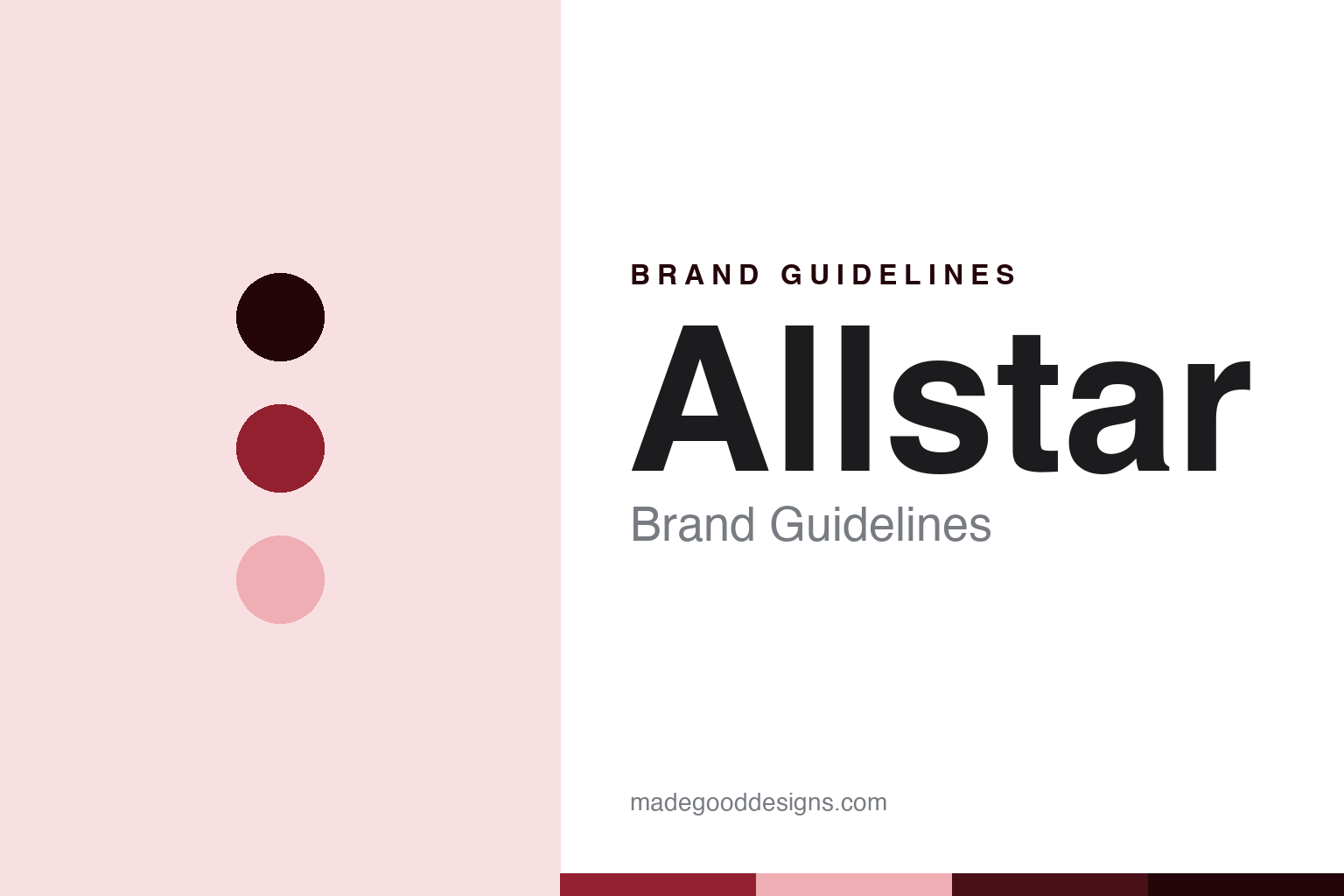
Allstar’s identity is German, family-run and unmistakably red — an Allstar crimson, an ink, a pale rose, a deep claret, and a paper. The palette leans Allstar crimson and deep claret: a piste-side register that stands in for a kit-and-scoring house rather than a loud logo colour. It signals two houses, one managing director — German, family-run and red. The honest caveat: red genuinely is this company’s own identity colour, described in its own words as its unmistakable red logo, and the crimson here is an unofficial interpretation for this series rather than that value.
The lesson is two brands can share an owner and still be designed as opposites, and this pair is the cleanest example you will find. One sets its name in lowercase, builds its identity on a single vivid red, and codes its products as short alphanumeric SKUs. The other capitalises, works in a muted slate-blue, and names its products in compressed technical German. Same managing director, same sport, same country, adjacent towns — and two completely different answers to how a fencing brand should look and read. For anyone running a multi-brand group, that is the instructive part: the separation is doing real work. A buyer choosing between them is not choosing between a house brand and a sub-brand; they are choosing between two distinct propositions that happen to share a boardroom. The design difference is what makes that possible. Because a strong hue can fail as small text, keep type dark and let the colour live in the accents, palette and band. The takeaways: date the founding to 1964; keep the lowercase; attribute the fourth-generation and first-in-the-world claims; and describe the relationship with its rival precisely.
Typography
The register is a lowercase sans — German, family-run, direct.
Allstar’s identity carries a German, direct spirit — a house that equips a hall and a tournament and says so plainly. A lowercase sans captures the mood: modern, unpretentious and legible, the register of a brand that writes its own name without a capital. Set in an Allstar-crimson palette, the lowercase sans feels contemporary rather than heritage — exactly the personality Allstar projects, and a deliberate contrast with its stablemate. It behaves like a moulded, stitched thing rather than a loud logo, mirroring a guard arc and a piste line. (Allstar’s real products, its red mark and the name itself are things we describe but do not reproduce, and the exact typeface is not ours to use.) Because it is not ours to use, the honest description is “a lowercase-sans brand,” shown here in a stand-in. The type behaves like the brand: German, family-run and direct.
Aa
A lowercase-sans brand — modern and legible. (Specimen set in Manrope, a lowercase-sans STAND-IN; NOT the Allstar logo or products.)
The shared-code node
Allstar stands for two houses, one managing director, one blade code.
Allstar holds the round’s shared-code node. An Allstar-crimson palette, a lowercase sans and a 1964 founding make one thing — two houses, one managing director, one blade code — the whole identity: German, family-run and direct. The founding is the frame, the shared leadership is the substance, and the federation’s combined blade entry is the proof. The point is a relationship that corporate filings present as separation and a rulebook presents as unity, which is a more interesting arrangement than a merger would have been.
Put to work, the identity is the relationship described precisely and the claims attributed. A brand in this spirit would date the founding to 1964 and name the mother and son who started it, decline to state a founding town the company does not give, report the fourth-generation description as the company’s own without inventing the line of succession, describe the German pair as legally separate companies sharing a managing director and a single federation blade entry rather than as a merger, bound the manufacturing claim to what is actually said — predominantly, and specifically safety equipment — and attribute every world-first. A reader in this spirit would keep the facts right: Allstar makes fencing kit and scoring equipment; it dates to 1964; it is family-run; and it produces predominantly at Kusterdingen. Allstar follows Uhlmann, before Negrini. The honest editorial moves are to date the founding, to describe the relationship, to bound the making, and to attribute the claims.
For designers and brand-builders, Allstar holds the shared-code node: design difference is what lets two brands share an owner without collapsing into one. The lessons: a category can contain two houses that are separate on paper and joined in practice, here two German companies in different Swabian towns with different register courts, tax numbers and supplier codes, neither website mentioning the other, sharing a managing director and appearing on the federation’s approved-blades list as a single combined entry under one code while every other maker has its own; a founding is dated to 1964 to a mother and son, with the town left unstated because the company leaves it unstated; an ownership claim is attributed rather than reconstructed, because a fourth generation is asserted while the succession is not; a making is bounded to the company’s own wording, predominantly at Kusterdingen and specifically the safety equipment, with no detailed sourcing disclosure available; and an identity is read as a deliberate opposite — lowercase where the other capitalises, one vivid red where the other is slate-blue, short alphanumeric SKUs where the other writes compressed technical German. Two further disciplines. A string of world-first claims — an elastic fencing suit, a rollbag, a universal scoring box, a touchscreen scoring box — are the company’s own with no patents located, and are reported as claims. And its description of itself as a long-standing official federation partner sits against that federation’s own site, which lists it among suppliers rather than sponsors; we report both and adjudicate neither. The hook is that duality: Allstar is two houses, one managing director, one blade code. Read that way, Allstar is less a single product than the red half of a pair that is separate where it counts commercially and joined where it counts technically: German, family-run, direct. The lesson for a brand is that shared ownership is survivable when the brands are genuinely designed apart. Allstar made the-two-houses the identity — proof that separation can be a design decision.
Explore & save
Keep Allstar’s identity on hand — save it to a board in the Made Good inspiration library.
Allstar identity set
Pin the Allstar-crimson palette and the lowercase-sans register to your own board.