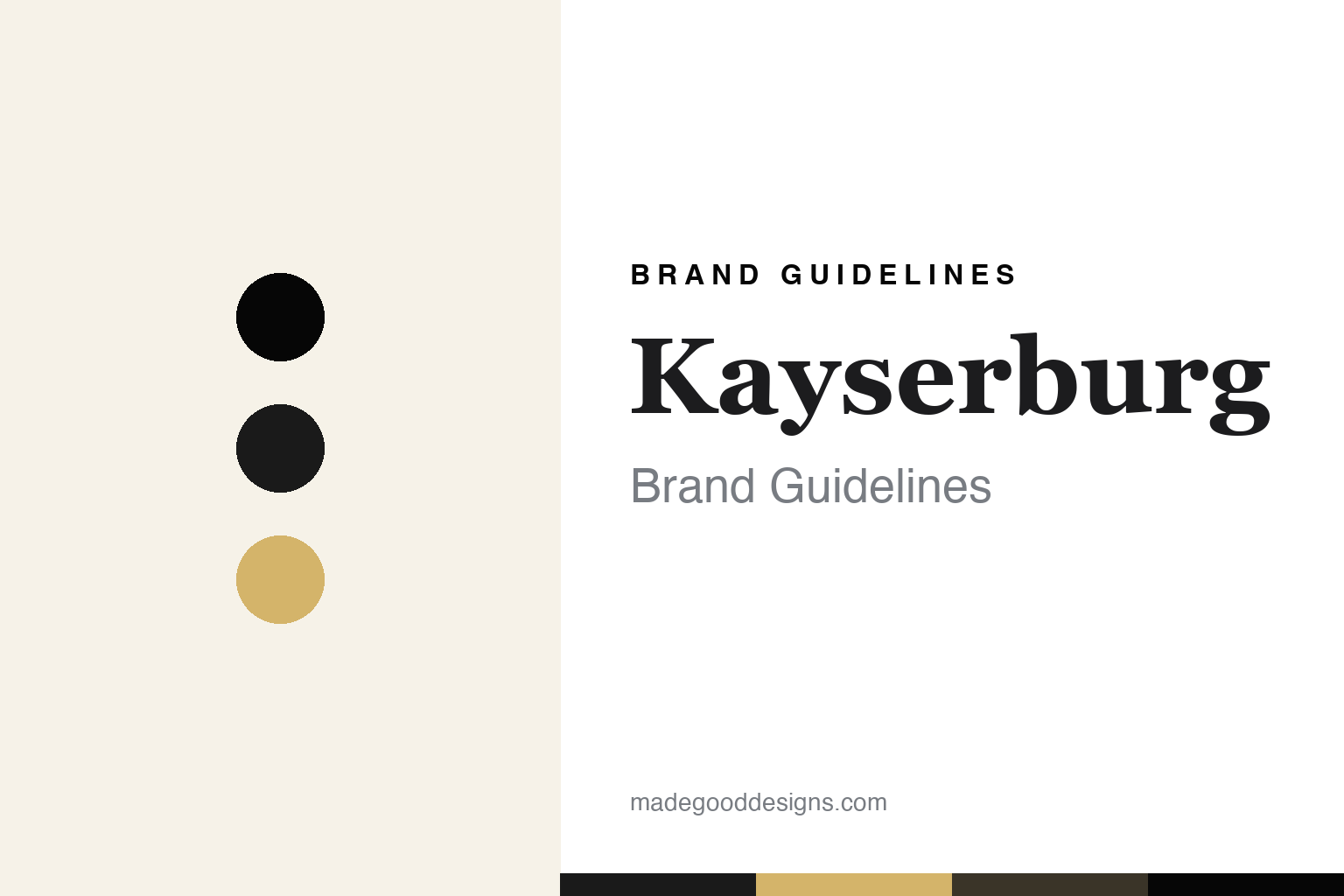
Kayserburg Brand Guidelines
Built for artists, in a factory within a factory.
Aa
Two constants: a concert-black palette and an imperial-serif register. Abstract homage — not a Kayserburg or Pearl River product or mark; no piano or logo is reproduced.
A premium name for a Chinese maker
Kayserburg was invented to fill a gap.
Pearl River had volume; what it lacked was a premium name. The Guangzhou Daily, in a 2024 history of the company, wrote that in 2007 Pearl River launched “珠江·恺撒堡” — Pearl River Kayserburg — as a professional, high-end line, to fill the gap left by the absence of a domestic premium brand. Piano Buyer gives the same year: “Research for the Kayserburg line was completed in 2007, and these pianos were first introduced in China and the Asia Pacific regional market shortly thereafter.” North America followed in 2013.
The name sounds German — an emperor’s castle, to an English ear — and the brand’s marketing leans into that. We found no explanation of its origin in English or Chinese sources, and we do not invent one. Its Chinese form is 恺撒堡, and at home the line is sold as “Pearl River Kayserburg,” with the parent’s name in front.
Kayserburg came out of collaboration. In 2016 Piano Buyer reported that the Bayreuth maker Steingraeber had partnered with Pearl River to build concert grands for China under the Kayserburg name; Steingraeber’s owner said the partnership came to nothing when he declined to sell Pearl River a stake in his company — his account. Pearl River went on to buy a 90 per cent stake in Schimmel instead.
Colour
A separate facility, a Swiss engineer, an unnamed designer.
Kayserburg’s claim to be different from the rest of Pearl River rests on where and how it is built. Piano Buyer says: “Kayserburg pianos are manufactured in a separate facility from the rest of Pearl River’s extensive product lines,” and gives the maker’s address: Guangzhou Pearl River Piano Group, Xiangshan Avenue, Zengcheng, Guangzhou, China. Piano Buyer’s Chinese edition describes the top Artists and Master series as hand-built in a “factory within a factory,” supervised by the Swiss master Stephan Mohler, who, Pearl River says, “oversees the entire manufacturing process and final assembly for all Pearl River brands.”
The brand’s own page is coy about its designer: “the master designer responsible was trained and excelled in building pianos for famous German brands before accepting the challenge to develop the Kayserburg Artists AND Master Series.” Chinese sources name the European designer Lothar Thomma; we report that without the further claims dealers make about his career. Piano Buyer’s 2022 survey of the American market observed, drily, that makers have long sought “Periodic redesigns by German engineers, or American engineers with Germanic names”; Kayserburg’s page makes the German training of its designer the point, rather than his name.
The parts list is European. The site cites “Röslau strings and premium hammers with parts and felt imported from Germany,” and “Over 8,000 precision components, more than 300 meticulous processes.” Its current range runs through Master, Artists, Heritage, Excellent and School series, with a K70 model for Pearl River’s seventieth anniversary; Piano Buyer has reviewed the Excellent, Heritage, Nuovo, Artists and Master series under codes from KX to KAM.
The separate facility matters because of what surrounds it. Pearl River’s American site describes “over 150,000 pianos annually in our new 3.2 million-square-foot, state-of-the-art factory – the largest in the world” — its claim. A premium line that wants to be judged differently has to be seen to be built differently, and the “factory within a factory” is Kayserburg’s answer: the brand is defined by its distance from the mass-production line beside it.
Typography
“The ultimate expression of German craftsmanship” — made in Guangzhou.
Kayserburg’s marketing uses Germany as a quality standard. Its page speaks of “the ultimate expression of German craftsmanship” and “European Performance.” Like Pearl River’s Ritmüller pages, the Kayserburg page we read does not mention China or Guangzhou in its body text. Piano Buyer does, plainly.
That gap between a quality idiom and a place of manufacture is what the law on origin claims polices. The US Federal Trade Commission’s guidance accepts “Designed in USA — Made in Finland” as a fair specific claim, and calls “Created in USA” deceptive because buyers read “created” as “made.” US customs rules require imports to show “the English name of the country of origin,” with the true origin “in close proximity” to any misleading foreign place name. The EU’s Unfair Commercial Practices Directive treats as misleading a practice that deceives about “geographical or commercial origin,” judged on its “overall presentation… even if the information is factually correct.” We found no regulator action against Kayserburg, and we have not inspected its labels; “German craftsmanship” describes a standard, not a place, and the rules turn on place.
Kayserburg’s more distinctive claim is that it is a Chinese premium brand at all. China made about 376,000 pianos in 2013, “almost 80 percent of the world’s total,” the Chinese government’s English-language site reported; the gap the Guangzhou Daily described was not output but a domestic premium name. Pearl River, which completed its first piano in Guangzhou in July 1956 and listed in Shenzhen in 2012 as “China’s first musical-instrument stock,” built Kayserburg to address it. Pearl River runs a “珠江·恺撒堡” International Youth Piano Competition, and its 2025 annual report records that a Kayserburg model won a best-new-product award at Music China in Shanghai that year.
Aa
A tall imperial serif — a name meant to sound like a castle. (Specimen set in Cormorant Garamond, a serif STAND-IN; NOT the Kayserburg logo.)
Built For Artists, By Artists
A tagline about people, not places.
Kayserburg’s tagline is “Kayserburg ~ Built For Artists, By Artists,” with a secondary line, “The Quest For Perfection.” In 2024 Pearl River named the pianist Ed Bazel the brand’s “Worldwide Brand Ambassador,” a title that puts a performer, not a place, at the front of the brand’s American marketing. The emphasis on artists rather than places is the brand’s cleverest move: it lets a Chinese premium piano make its case on performance and craftsmanship, which travel, rather than on origin, which does not.
For a design guide, Kayserburg is the reverse of Ritmüller. Ritmüller bought an old German name; Kayserburg invented a German-sounding new one. Both sit in the same Guangzhou company, majority-held by the state-owned Guangzhou City Construction Investment Group. Together they show two ways a maker that dominates on volume can try to win on prestige.
For this guide we use a concert black and a crown gold with a tall serif. These are an unofficial interpretation, not Pearl River’s colour values, and nothing of the Kayserburg logo is reproduced.
Explore & save
Keep Kayserburg’s identity on hand — save it to a board in the Made Good inspiration library.
Kayserburg identity set
Pin the concert-black palette and the imperial-serif register to your own board.