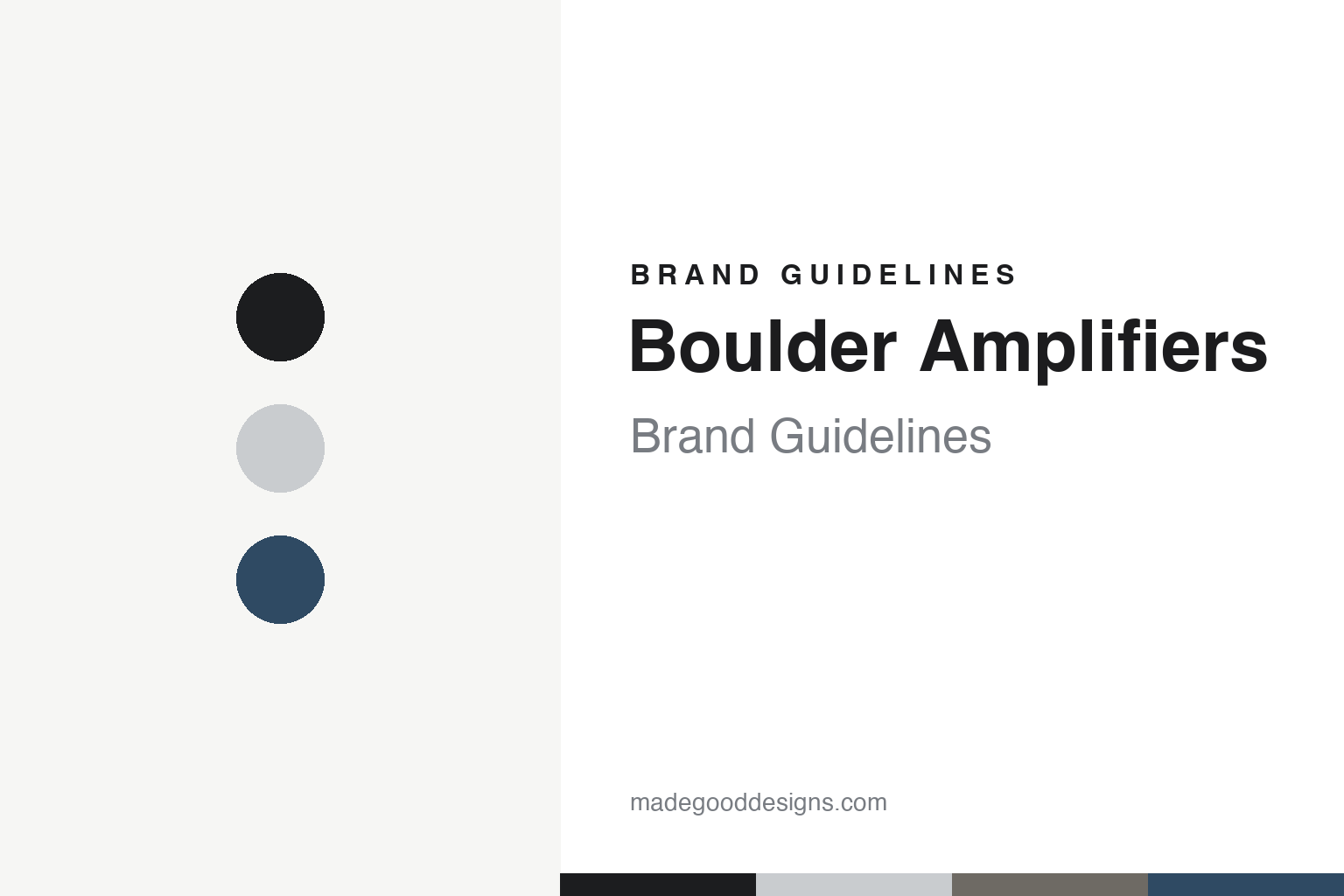
Boulder Amplifiers Brand Guidelines
The Colorado amplifier maker that machines its own metal.
Aa
Two constants: a Boulder black, silver and Front Range blue palette and a Machined sans register. Abstract homage — not a Boulder product or mark; no amplifier, logo or nameplate is reproduced.
From the studio
A recording engineer’s amplifier company.
Boulder Amplifiers began in the recording studio, not the living room. The company says that in the 1970s its founder, Jeff Nelson, was “a largely self-taught electronics savant who owned a recording studio and built mixing boards for other studios.” It adds that he later worked as an engineer at Pacific Recorders, a California maker of broadcast equipment, where he was responsible for its Tomcat cart machine — the tape-cartridge player radio stations used for commercials and jingles. PS Audio’s Copper magazine told a similar story in 2016, saying Nelson moved to Colorado in 1984; its further statement that the firm itself was then renamed Boulder Amplifiers does not appear in the company’s own history, and we could not confirm it.
Sources differ on the founding year. English Wikipedia gives 1983, in Boulder; the German magazine FIDELITY, after a factory visit in 2018, gave 1984, which is also the year the company gives for its first product, the 500 power amplifier. Either way, the company now says it has been building audio components “near Boulder, Colorado” for more than 40 years. Its first workshop was not in the city itself: the company says production began in Superior, a small town just south-east of Boulder, and Copper described the premises as an old farmhouse.
The 500 was built for professional use. The company says many went to recording studios, loudspeaker manufacturers and broadcast facilities; a home version, the 500 AE — for “Audiophile Edition” — dropped the professional meters and controls, leaving, Copper wrote, only a power switch. Over the following years, the company says, it made “the gradual transition from professional to home audio.”
Colour
Cost out of the equation.
The company’s reputation rests on large, expensive amplifiers and on metalwork. Its 2000 Series, introduced in 1995 by its own timeline — the 2010 preamplifier, the 2020 converter and the 2050 mono and 2060 stereo power amplifiers — was designed, it says, so that “cost did not figure into the equation before the design and optimal performance criteria were achieved.” A smaller 1000 Series followed in 1999, FIDELITY reported. In 2002 came the 2008 phono preamplifier, which Stereophile’s Michael Fremer reviewed with the 2010 preamplifier that July, English Wikipedia notes; the company says the magazine called it “one of the 100 most important products in the history of audio,” a description we have not traced to the magazine itself.
Its flagship arrived in 2011. The 3050 mono amplifiers, shown at the Consumer Electronics Show in Las Vegas that January, were rated at 1,500 watts into 8 ohms and weighed roughly 400 to 450 pounds each, according to show and review reports, which put the price at about $180,000 to $195,000 a pair; Enjoy the Music gave $195,000 in October 2011. Boulder’s own timeline calls the 3000 Series its “all-out endeavor.”
Behind those products is a factory that does its own metalwork, which is unusual in hi-fi. After moving from Superior into Boulder — in 1998 by the company’s account, in the mid-1990s according to Hi-Fi News — it added a machine shop and its first Haas CNC milling machine, noting that “a successful family machining business was in Jeff’s history.” Later it installed its own surface-mount line for circuit boards, after which, it says, “every aspect of manufacturing was now under Boulder’s control.” In 2011 Rich Maez, then its director of sales and marketing for the Americas, told Enjoy the Music: “We’re the last high-end electronics manufacturer that cuts and finishes our own metal and makes our own circuit boards.” Copper wrote in 2016 that its heavily machined casework was all done in-house, and FIDELITY described CNC and pick-and-place machines on its 2018 visit.
Typography
The American high end.
Colorado’s Front Range, around the city of Boulder, is home to several of America’s high-end audio makers. Avalon Acoustics builds loudspeakers in Boulder; Ayre, founded in Boulder in 1993 according to English Wikipedia, now gives its address at Niwot, just north-east of the city; Boulder Amplifiers moved to Louisville, east of Boulder, in 2016; and YG Acoustics gives its headquarters and machining plant as Denver.
The others are spread more widely: MartinLogan in Lawrence, Kansas, where it was founded — in 1979 according to English Wikipedia, in 1983 according to the company — and where it still has its design centre; Rockport Technologies in South Thomaston, Maine, where SoundStage! found it in 2012; and Constellation Audio in California, which Hi-Fi News called a “Californian amplifier specialist” in 2025.
The shows have changed too. For years the Consumer Electronics Show in Las Vegas gave high-end audio rooms of its own, latterly at the Venetian hotel, and Boulder showed its 3050 amplifiers there in January 2011; at CES 2019, Stereophile wrote that the curtain had closed on the show as the place for high-end launches. Denver had its own event, the Rocky Mountain Audio Fest, first held in 2004; its organisers cancelled the 2021 show and all future ones. AXPONA, held at Schaumburg near Chicago, now describes itself as North America’s largest high-end audio show.
Prices at this level can be startling: Boulder’s 3050 mono amplifiers cost about $195,000 a pair in 2011, Enjoy the Music reported. Several of these makers remain small and privately held.
This guide sets out what can be checked about each brand — who founded it, who owns it, and what it says about where its products are made — and marks clearly what rests only on the company’s own word.
Aa
A machined sans — brushed metal and heavy heatsinks. (Specimen set in Archivo, a sans STAND-IN; NOT the Boulder logo.)
Boulder
A mountain on the faceplate.
In August 2016 the company moved again, to a purpose-built factory in Louisville, Colorado, on a three-acre plot it says is about 15 minutes east of Boulder. It gives the building as 23,000 square feet, more than twice the size of the previous one, with three listening rooms and a new machining area. It says “all aspects of design, manufacturing, and assembly” now take place there, and that “every board and chassis” of its 812 converter-preamplifier is crafted “entirely in Boulder’s Colorado facility”; we give those as the company’s claims, supported in part by the factory visits described above. Its “independent ownership has also remained the same since its founding,” it says; we found no record of a sale, and its history still describes the company as growing “under Jeff Nelson’s leadership.” It says it is distributed in more than 40 countries.
The brand’s look is the look of its metal. The 1100 Series, launched in 2017 after the move, added curved edges to its heatsinks and front panels carrying three-dimensional topographical maps of Flagstaff Mountain, “located just west of Boulder,” the company says. The range has since grown downward, with the compact 800 Series, including the 866 integrated amplifier and the 812, which the company calls its first dedicated headphone amplifier. In 2026, when the High End show moved from Munich to Vienna, Boulder used it to launch the 808 phono stage and the 851 mono amplifiers, the company announced in June. We found no published brand guidelines, and no official colours or typeface.
For a design guide, Boulder shows how machining can become an identity: brushed metal, heavy heatsinks and a local mountain cut into the faceplate. Compare Ayre, another electronics maker from the Boulder area, and Pass Labs, an American solid-state amplifier maker. For this guide we use an anodised black, a machined silver and a Front Range blue with a sans, an unofficial interpretation; no product or logo is reproduced.
Explore & save
Keep Boulder Amplifiers’s identity on hand — save it to a board in the Made Good inspiration library.
Boulder identity set
Pin the Boulder black, silver and Front Range blue palette and the Machined sans register to your own board.