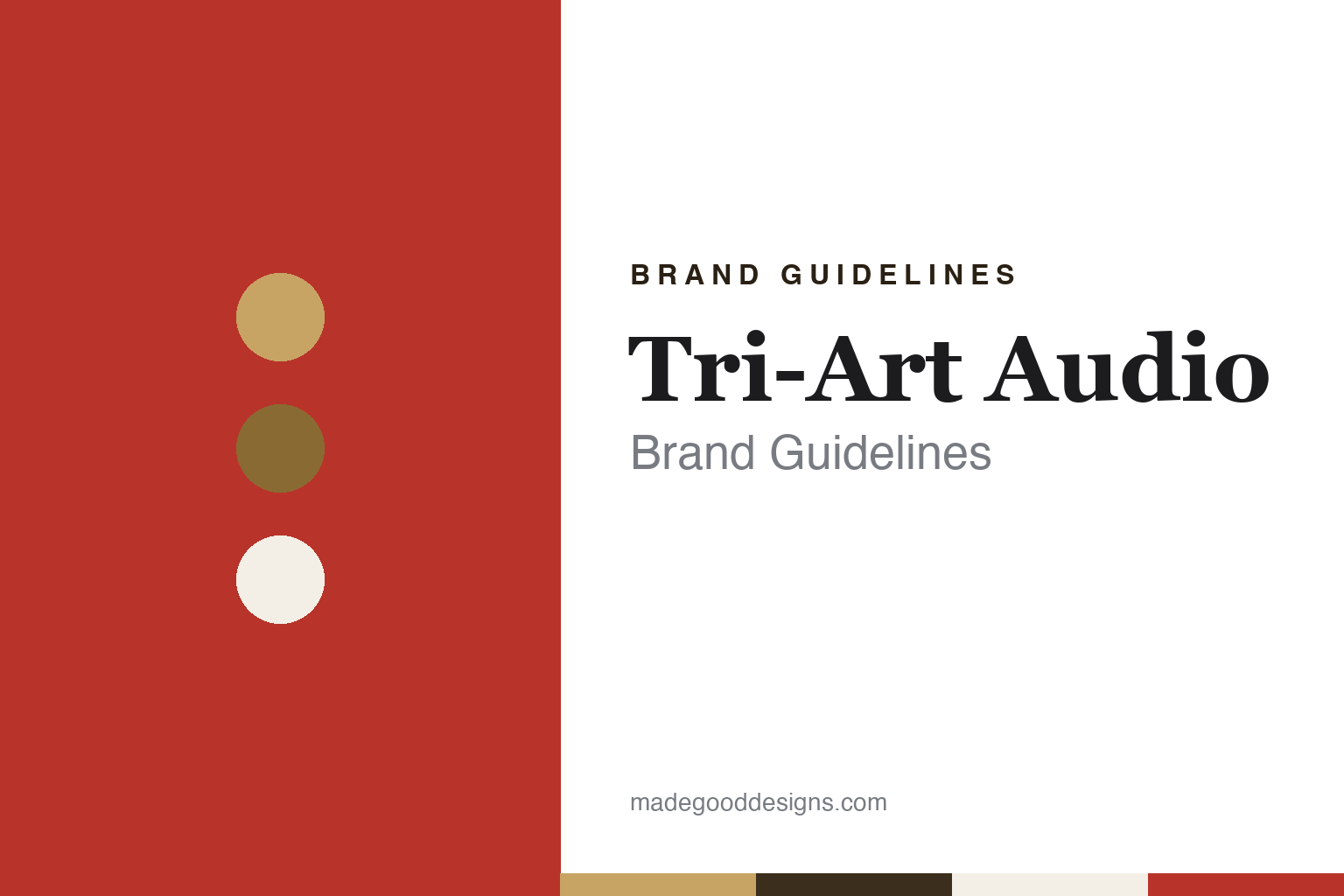
Tri-Art Audio Brand Guidelines
The Kingston paint maker that builds hi-fi in bamboo.
Aa
Two constants: a bamboo, walnut and gesso palette with a cadmium-red accent and a warm serif register. Abstract homage — not a Tri-Art product or mark; no product, logo or nameplate is reproduced.
Art Noise
A paint factory with a hi-fi line.
Tri-Art Audio is the hi-fi arm of a paint company. Its parent, Tri-Art Manufacturing of Kingston, Ontario, began making artists’ acrylics as an offshoot of Art Noise, an art-supply store and gallery in the city. Sustainable Kingston, a local sustainability network, dates the formation of Tri-Art Manufacturing Inc. to 1994, and in September 2019 the Queen’s University student paper, the Queen’s Journal, marked the company’s 25 years in business, recalling that it had started as a small project at the back of the Art Noise shop.
The founder of the audio business is Steve Ginsberg — Stephen Ginsberg in some reviews, and in a 2016 trade report that named him as Tri-Art’s president. The company’s website credits him with the aim of building “audio systems of the highest possible quality and value” for three levels of listener, which it calls entry, enthusiast and experienced. Audiophilia, reviewing a Tri-Art loudspeaker in August 2020, described him as an artist and painter who had once worked as a technician at House of Sound, a stereo shop it says was popular with Queen’s students in the 1970s and 1980s.
It is a family business. Audiophilia named Ginsberg’s sons Simon and Evan as part of the family venture, and Kingston’s downtown business association describes Evan Ginsberg, who holds a fine-arts degree, as a co-owner of Art Noise, which now trades on Princess Street selling art supplies alongside hardware. The family’s businesses make three quite different things: artist paints, a specialty paint that turns a wall into a projection screen — sold under the Goo Systems name, according to Audiophilia — and audio equipment. The Queen’s Journal described the same three-way split in 2019 as paint products, audio and optical coating.
Colour
Bamboo, oil and wax.
What sets Tri-Art’s equipment apart is the material. Its amplifiers, turntables and loudspeakers are housed in bamboo, which the company soaks in hemp oil; a 2017 product announcement relayed by the British site The Audiophile Man added that the bamboo parts were sealed in beeswax. Ginsberg has explained the choice in terms of sound rather than ecology. “Bamboo was chosen first and foremost for its sound properties,” he told Dagogo in 2020, calling it a very fast material with “an incredible isolation to both airborne and structural vibrations.” In a 2021 interview with AudioKey Reviews he called it “nature’s carbon fiber,” but without the dry sound he associates with carbon fibre; the same review reported that the company uses sheep’s wool for internal damping.
The range is organised in tiers. The earliest review we found, in Dagogo in December 2014, covered the Pebbles TA-1, a belt-drive turntable priced at $1,295. The 2017 announcement listed three turntables — the Sprout TA-0.5, the Pebbles TA-1 and the twin-motor, twin-plinth Bam Bam — with matching bamboo tonearms. Today the website groups its turntables, amplifiers and preamplifiers into S-, P- and B-Series, describing the B-Series as its “reference level,” alongside Mini Monitor loudspeakers, open-baffle speakers, cables, stands and isolation platforms.
Reviewers have tended to remark on the prices. AudioKey Reviews tested the P-Series integrated amplifier, a 35-watt class-D design with an external 24-volt supply, at $995 in September 2021. Audiophilia reviewed the B-Series 60-watt integrated, with its tube-buffered outboard power supply, at $3,799 in March 2021, and in 2020 the B Series 4 Open loudspeaker — a 15-inch bass driver with full-range, dome and super-tweeter drivers on a bamboo baffle — at $3,840. Ginsberg told AudioKey that the aim was to put the products within reach of people who work with their hands, naming construction workers, painters and artists.
Typography
Canada’s audio industry.
Canada’s loudspeaker industry owes an unusual debt to a government laboratory. The engineer Floyd Toole joined the National Research Council (NRC) in Ottawa in 1965 and, SoundStage! Hi-Fi wrote in 2024, carried out “seminal research in acoustics and psychoacoustics” there in the 1970s, before leaving in 1991 to join Harman International.
The same magazine called that work “pivotal to the remarkable growth of the Canadian loudspeaker industry in the 1980s.” Paul Barton, who founded PSB in 1972, began research at the NRC under Toole in 1974, and Axiom’s founder, Ian Colquhoun, said learning Toole’s methods “changed everything.” Axiom says that Canadian makers including itself, Paradigm and PSB jointly funded a further NRC research project, called Athena, from 1988.
The industry clusters in two provinces. In Ontario, Paradigm says it builds its speakers at its headquarters just outside Toronto, Axiom and Bryston share a plant at Dwight, in Muskoka, and Tri-Art Audio works in Kingston. In Quebec, Totem Acoustic is based in Montreal, Classé gives Montréal as its home, according to their own websites; Verity Audio, which announced in 2024 that it was ceasing operations, was based in Quebec City.
Ownership has moved, too. In 2019 Paradigm’s co-founder Scott Bagby and John Bagby bought Paradigm, Anthem and MartinLogan back from the private-equity firm Shoreview Industries. In 2021 Bryston was sold to its vice-president, James Tanner, in partnership with Colquhoun, and moved most of its manufacturing from Peterborough to Axiom’s plant, Global News reported. Classé’s website now carries a Harman International copyright.
This guide sets out what can be checked about each brand — who founded it, who owns it, and what it says about where its products are made — and marks clearly what rests only on the company’s own word.
Aa
A warm serif for a maker that calls its sound an artist’s perspective. (Specimen set in Fraunces, a serif STAND-IN; NOT the Tri-Art Audio logo.)
Tri-Art Audio
Made in Kingston — and an old name revived.
Where it is made is the company’s central claim. Tri-Art Audio says it “designs, manufactures and assembles” its products in Kingston, on the north shore of Lake Ontario, and that its finishes are “hand-rubbed and meticulously applied in-house.” Part of that has independent support. In August 2016 Canadian Manufacturing reported that Tri-Art Manufacturing ran a 30,000-square-foot plant not far from downtown Kingston and planned an expansion of nearly $1 million to push further into turntables and speakers, with $140,000 from the Ontario government and ten new jobs; Ginsberg, quoted as president, said the support would help it “expand further into the audiovisual entertainment market.” The same report said the projection-screen paint was in use at Disney and Universal theme parks. Ginsberg has also told Dagogo that the B-Series circuit boards are “uniquely designed and assembled by Tri-Art in house”; where bought-in parts such as drive units come from, we could not establish.
In 2021 Tri-Art took on an old name. Hartley Loudspeakers, whose website traces it to England in 1927 and the United States in 1953, now gives Canada as its home from 2021 and says the brand has “returned to production under the stewardship of Tri-Art Audio,” with all “milling, fabrication, and finishing” done in-house in Kingston. In an interview on the Hartley site, Ginsberg describes approaching the previous owner, Richard Schmetterer, who had stopped making complete speakers and drivers and was doing repairs and consulting, and reaching a deal after about two years of talks. Hartley calls itself “renowned for coining the term ‘High Fidelity’”; that is the company’s claim, which we have not verified.
For a design guide, Tri-Art Audio shows how a material can carry an identity: bamboo, oil and wax doing the work a logo usually does, from a company that started out mixing paint. Compare Bryston, another Ontario maker that builds in the province, and PSB, whose founder trained in Ottawa’s acoustics research. For this guide we use bamboo, walnut and gesso tones with a cadmium red and a serif, an unofficial interpretation; no product or logo is reproduced.
Explore & save
Keep Tri-Art Audio’s identity on hand — save it to a board in the Made Good inspiration library.
Tri-Art Audio identity set
Pin the Tri-Art Audio bamboo, walnut and gesso palette and the warm serif register to your own board.