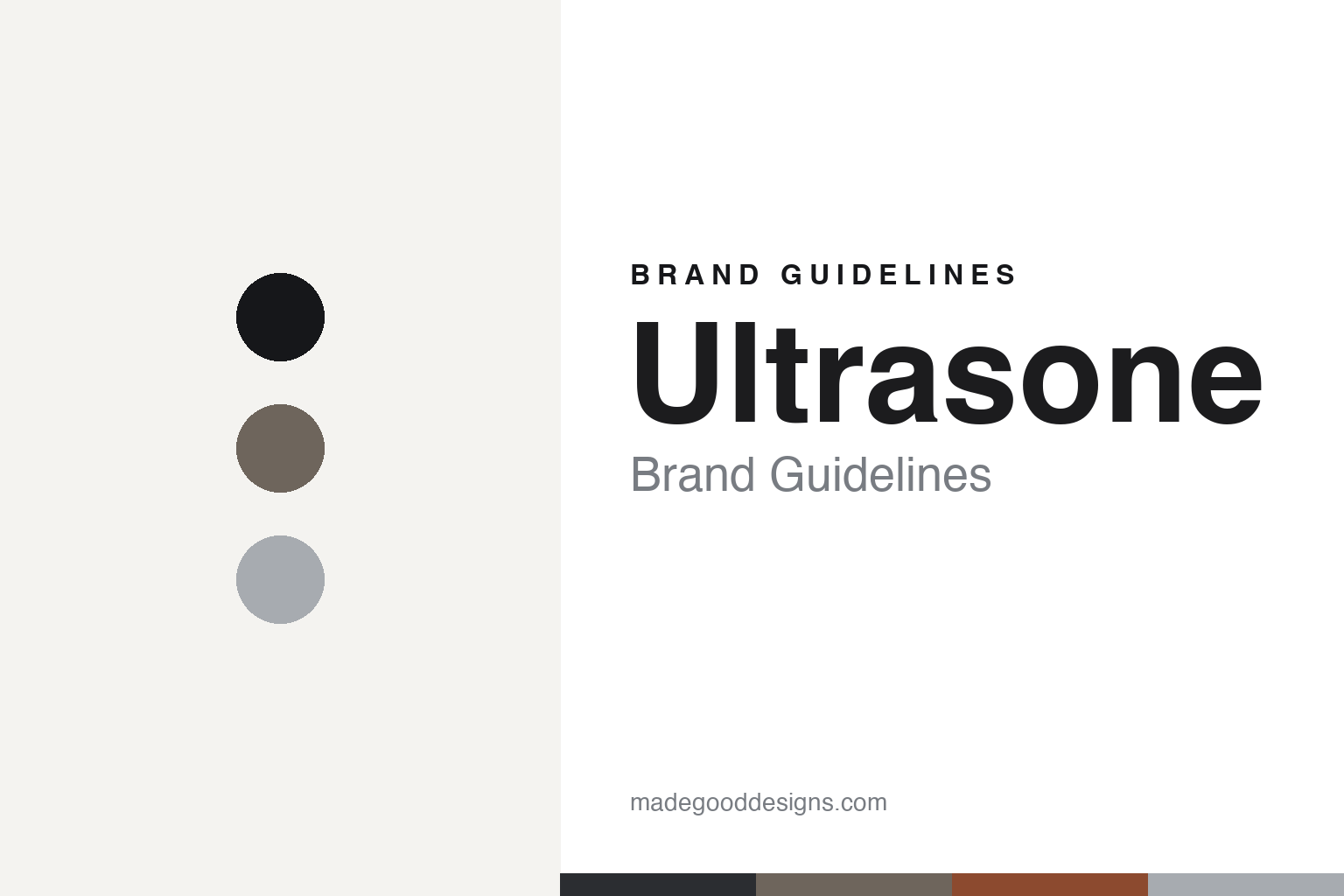
Ultrasone Brand Guidelines
The Bavarian headphone maker that moved the driver off-centre.
Aa
Two constants: an Ultrasone graphite, ruthenium and cherry palette and a technical sans register. Abstract homage — not an Ultrasone product or mark; no headphone, logo or nameplate is reproduced.
Penzberg to Wielenbach
An engineer’s idea about the outer ear.
Ultrasone is a Bavarian headphone maker whose founding date depends on which record you read. English Wikipedia says it was set up as a German GmbH in December 1990 by Florian M. König, with the aim of making advanced headphones for professional audio. The company’s own press releases from 2008 to 2012 said it was founded in 1991, while a 2004 version of its website said 1990. A later company page reached back further still, saying “it all began in 1985 with a quest for the perfect headphones.” We treat 1990–91 as the founding and 1985 as the company’s own origin story.
Who founded it also needs stating carefully. In 2004 the website listed König, an engineer working on acoustics and electromagnetic fields, as chief technology officer, and Michael Willberg, an industrial engineer, as chief executive. English Wikipedia names König as the founder; the current website calls Willberg “Founder and CEO.” We give both rather than choose between them.
The company has moved around the lakes south-west of Munich. The North Data register digest shows Ultrasone AG entered in the Munich commercial register in November 2001 with its seat in Penzberg, where the 2004 website also placed the business. By 2008 its press releases were datelined Tutzing, on Lake Starnberg, and the registered seat followed at the turn of 2013. In February 2023 the AG changed its legal form to a GmbH, Just Listen GmbH, and the website’s legal notice now gives “ULTRASONE Just listen GmbH” at Gut Raucherberg in Wielenbach, near Weilheim. English Wikipedia’s infobox, which still shows a public company in Tutzing, is out of date on both points.
Colour
S-Logic, ULE and the Editions.
Ultrasone’s signature idea is S-Logic. Instead of aiming the driver straight into the ear canal, it places the drivers off-centre in the earcup so that sound reflects off the outer ear first — “decentralized driver positioning,” as the 2004 website put it. The company says this gives a more speaker-like, three-dimensional image without any signal processing, and ProAudio Review described the approach in 2005. Ultrasone also says S-Logic lets listeners hear the same loudness at 3–4 dB lower sound pressure; that is its claim, repeated on today’s website. S-Logic was presented in 2000 as the successor to an earlier “FPS” system, and later versions were named S-Logic Plus, S-Logic EX and, on current models, S-Logic 3 and S-Logic 5. The company said in 2010 that S-Logic had won a Plus X Award for innovation.
The second idea is ULE, for “ultra low emission.” The 2004 website says the first ULE headphones were developed in 1997 and shown in 1999. Ultrasone uses mu-metal shielding and says it cuts the magnetic fields reaching the listener by up to 98 percent, which ProAudio Review reported as the company’s figure in 2004. The register shows the same concern: Ultrasone’s stated business includes devices to reduce “Elektrosmog.” We report this as a company claim, not a health finding.
The range runs from studio models — the PRO series and the HFI line — to DJ headphones and the limited Edition series, which made the brand’s name among enthusiasts. Company press releases describe the Edition 8 Limited of May 2010, 888 units with a matte ruthenium finish, walnut inlays and Ethiopian sheepskin pads, and the Edition 10 of October 2010, the first open-back Edition, limited to 2,010 units with zebrano wood inlays and titanium-plated 40 mm drivers. Headfonics reported that the open Edition 15 came out in late 2017, and in November 2020 reviewed its closed sibling, the Edition 15 Veritas, at $3,499.99, with American cherry cups and a 40 mm driver using a gold-titanium compound diaphragm. In 2018 ADAM Audio launched its Studio Pro SP-5 headphone, which Recording magazine said “was born out of a design and manufacturing collaboration” with Ultrasone, built around S-Logic Plus.
Typography
Design and documentation.
Beyond the best-known headphone names, a group of smaller specialists builds around less common designs: planar magnetic drivers, true ribbons and electrostatic panels. The seven makers here span the United States, Europe, Russia and China, and most have a thin public record.
Three make planar magnetic headphones. Abyss, a division of JPS Labs, gives its address as Lancaster, near Buffalo, New York, and says it machines and assembles its headphones there. Kennerton, which sells planar and dynamic models, gave its location as St Petersburg on its website as archived in 2025. Sivga, best known for wooden-cup dynamic headphones and the parent of the planar brand Sendy Audio, is in Dongguan, in China’s Guangdong province.
RAAL’s website described it in 2007 as a company based in Zaječar, in eastern Serbia; its ribbon headphones, first sold as RAAL-requisite, now carry the RAAL 1995 name, and its American distributor, Requisite Audio, says they are handmade in Serbia. Warwick Acoustics, which makes electrostatic headphones and car audio systems, gives its address as the MIRA Technology Park in Nuneaton, Warwickshire.
The other two work in central Europe. Ultrasone’s legal notice gives an address in Wielenbach, in Bavaria, and it speaks of “craftsmanship from Bavaria.” Erzetich, which makes the dynamic Mania and Thalia and the planar magnetic Phobos as well as amplifiers, gives an address in Nova Gorica, Slovenia, and says its workshop is “located in the Slovenian woods.”
This guide sets out what can be checked about each brand — who founded it, who owns it, and what it says about where its products are made — and marks clearly what rests only on the company’s own word.
Aa
A technical sans for an engineering-led brand. (Specimen set in Barlow Semi Condensed, a sans STAND-IN; NOT the Ultrasone logo.)
Ultrasone
Handmade in Bavaria — and elsewhere.
Where Ultrasone headphones are made is a question the company has answered differently over time. Its 2004 website said production was “separated at several locations in Germany, USA, Austria and Taiwan”; a 2012 version said “Germany and Taiwan.” In 2010 it said the Edition headphones bore the mark “Handmade in Bavaria” and were made “on the banks of Lake Starnberg.” In 2023 the website said all products were designed by Ultrasone engineers and that “a large part of our collections are made in Germany in our manufactory.” Today it promises “craftsmanship from Bavaria” and says Willberg assembles the 222-unit Founders Series himself, a reissue drawing on the Edition 8 and Edition 10. We give these as the company’s statements; we found no independent account of which models are built where.
The company has stayed close to its management. The register digest shows Michael Willberg leading it for most of its history, with Yvonne Willberg on the board between 2018 and 2022, and a partial profit-transfer agreement with BayBG, the Bavarian investment company, registered in 2008. We found no record of a sale to an outside group. In 2008 Ultrasone opened a US subsidiary, Ultrasone Inc., in Southern California, its press release said; by 2020 Headfonics credited Vitec USA as its American partner. In November 2010 the company said it had won the Bavarian Export Award in the industry category. Its website now says, “For years, we were only known in the Asian market. Now we want to change that.”
For a design guide, Ultrasone shows how a single acoustic idea can carry a brand for more than three decades. Compare beyerdynamic, the Heilbronn maker of studio headphones, and Sennheiser. For this guide we use graphite, ruthenium grey and cherry brown with a sans, an unofficial interpretation; no product or logo is reproduced.
Explore & save
Keep Ultrasone’s identity on hand — save it to a board in the Made Good inspiration library.
Ultrasone identity set
Pin the Ultrasone graphite, ruthenium and cherry palette and the technical sans register to your own board.