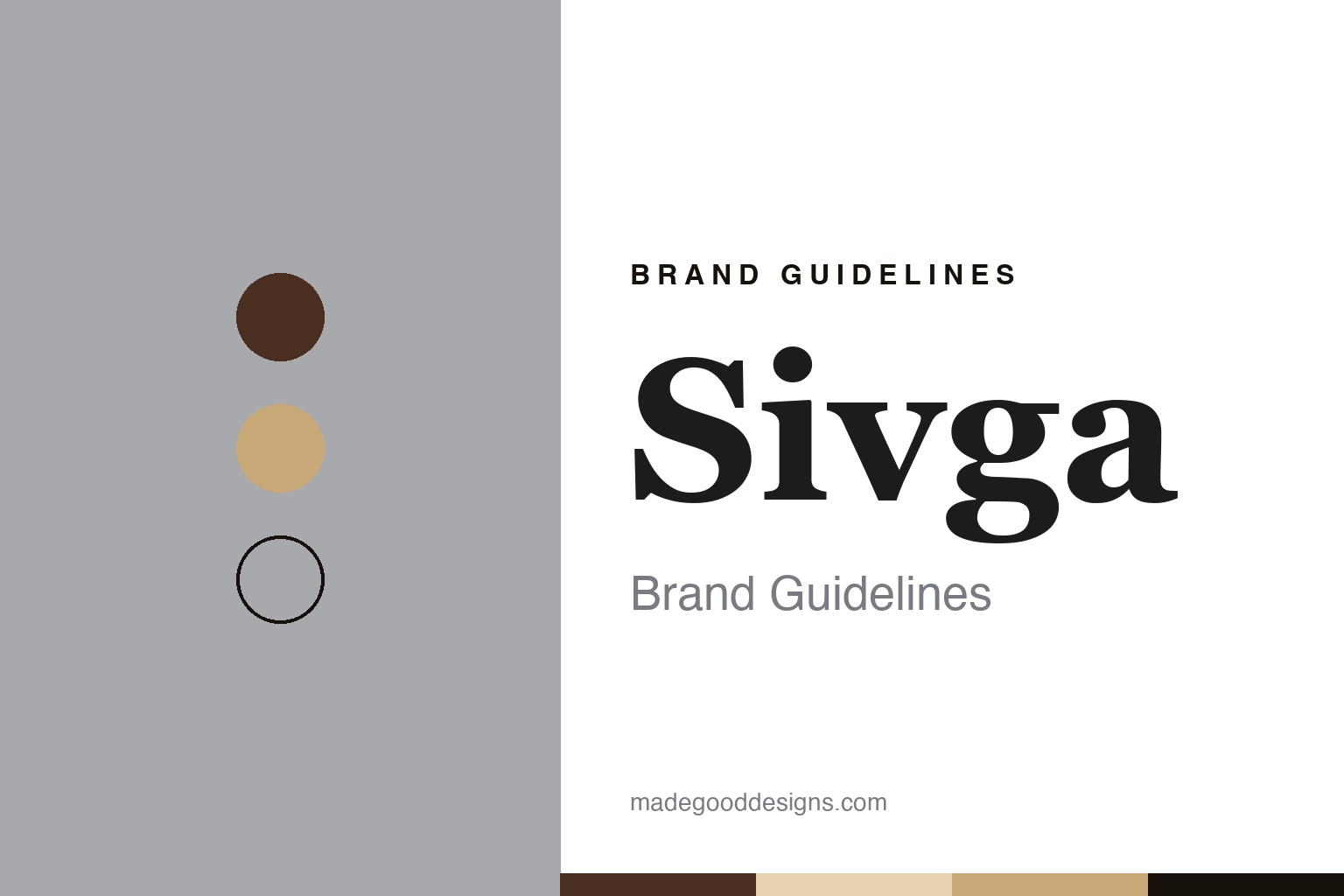
Sivga Brand Guidelines
The Dongguan headphone maker that builds in solid wood.
Aa
Two constants: a walnut, zebrawood and brushed-aluminium palette and a craft serif register. Abstract homage — not a Sivga product or mark; no headphone, logo or nameplate is reproduced.
Dongguan, 2016
A headphone company in China’s factory city.
Sivga is the headphone brand of Dongguan Sivga Electronic Technology Co., Ltd. (东莞市斯唯嘉电子科技有限公司), which says on its website that it was established in 2016 and is based in Dongguan, the manufacturing city in China’s Guangdong province. Its contact page gives an address in the Juhui E Valley high-tech industrial park in Liaobu, a town within Dongguan. The Chinese name on the site, 斯唯嘉 (Siweijia), renders the brand phonetically; the company does not explain the name, and we found no explanation elsewhere.
The company does not name a founder. Its English and Chinese “About” pages describe only a core engineering team drawn from “elites from the electronic and acoustic field,” and an archived 2018 version said that “the whole team has more than 10 year experiences in audio industry.” We found no founder’s name in the trade reviews we checked, and the Chinese business registers we tried could not be reached from our location, so this guide does not name one. Nor did we find any report of an outside owner or of the company changing hands.
The earliest copy of sivgaaudio.com in the Internet Archive dates from February 2018. It shows a small online shop with sections for wooden headphones, wooden in-ear earphones, multi-driver sports earphones and planar magnetic headphones, and three over-ear models: the SV005, a noise-cancelling headphone at $86, and the SV006 and SV007, both with wooden ear cups, at $99 and $98. The 2018 “About” page said the company “focuses on designing and producing high quality wood earphones and headphones,” that its products were then “mainly sold in Europe and United States,” and that “product designs are made by our own designer.” Its motto was “returning original sound to ear.”
Colour
Walnut cups, metal frames.
Wood is the thread through the range. Today’s website lists dynamic-driver headphones — the SV021 PRO, Peng, Anser, Luan, Oriole, SV023, Robin (SV021) and Phoenix — two planar magnetic headphones, the P-II and P2 PRO, and a line of in-ear monitors, earbuds and wireless earphones. The company names the SV007 as its representative Sivga product.
Reviewers have followed the range for several years. Ear Fidelity reviewed the Phoenix, an open-back dynamic headphone with wooden earcups priced at $255, in October 2020. In October 2022 eCoustics described the SV023, at $449.95, as having “walnut cups with a central stainless grille” on a steel and aluminium frame, and said it took over from the Phoenix as the flagship. The same site reviewed the open-back Luan, at $299, in 2023, noting its brushed aluminium, black leather and dark walnut cups, and in March 2026 the closed-back SV021 Pro, at $179, in beech or zebrawood.
Its reviewers have praised the building more consistently than the sound. The 2022 review said that, across the models it had tested, “the results have been inconsistent,” though “all of the products are built to a high standard”; the 2026 review found the SV021 Pro “less resolved in its final voicing decisions” than its woodwork suggested.
The in-ear range carries the same material into its faceplates. What Hi-Fi? reported in November 2025 that the Nightingale PRO, a planar magnetic in-ear and the successor to an original Nightingale of 2023, pairs an aluminium-magnesium alloy shell with “hand-polished solid-wood faceplates,” and in July 2026 that the four-driver Lyrebird uses a handcrafted wooden faceplate treated with resin. eCoustics reported the Lyrebird’s debut at CanJam London 2026 and gave its price as $149.
Typography
Beyond the big names.
Beyond the best-known headphone names, a group of smaller specialists builds around less common designs: planar magnetic drivers, true ribbons and electrostatic panels. The seven makers here span the United States, Europe, Russia and China, and most have a thin public record.
Three make planar magnetic headphones. Abyss, a division of JPS Labs, gives its address as Lancaster, near Buffalo, New York, and says it machines and assembles its headphones there. Kennerton, which sells planar and dynamic models, gave its location as St Petersburg on its website as archived in 2025. Sivga, best known for wooden-cup dynamic headphones and the parent of the planar brand Sendy Audio, is in Dongguan, in China’s Guangdong province.
RAAL’s website described it in 2007 as a company based in Zaječar, in eastern Serbia; its ribbon headphones, first sold as RAAL-requisite, now carry the RAAL 1995 name, and its American distributor, Requisite Audio, says they are handmade in Serbia. Warwick Acoustics, which makes electrostatic headphones and car audio systems, gives its address as the MIRA Technology Park in Nuneaton, Warwickshire.
The other two work in central Europe. Ultrasone’s legal notice gives an address in Wielenbach, in Bavaria, and it speaks of “craftsmanship from Bavaria.” Erzetich, which makes the dynamic Mania and Thalia and the planar magnetic Phobos as well as amplifiers, gives an address in Nova Gorica, Slovenia, and says its workshop is “located in the Slovenian woods.”
This guide sets out what can be checked about each brand — who founded it, who owns it, and what it says about where its products are made — and marks clearly what rests only on the company’s own word.
Aa
A craft serif — warm, carved, set against machined metal. (Specimen set in Fraunces, a serif STAND-IN; NOT the Sivga logo.)
Sivga and Sendy
Two brands, one Dongguan company.
Sivga has a sister brand, Sendy Audio. The Sendy website calls it “a sub-brand of SIVGA” and carries the Dongguan company’s name in its footer; the Internet Archive’s first copy of sendyaudio.com is from February 2021. Sendy says its housings are made from solid natural wood through “material selection, cutting, carving, polishing to repeated drying,” and that its Black Beauty planar magnetic series followed three and a half years of development; it says its Aiva headphone won a Japanese VGP award in 2019. eCoustics wrote in 2022 that the two brands “share R&D duties and the production side,” with Sivga then covering roughly $50 to $350 and Sendy $350 to $1,500.
Where the products are made rests mostly on the company’s own word. Sivga describes itself as an enterprise integrating research, design, production and service in Dongguan, and eCoustics wrote in 2026 that it runs its own R&D and manufacturing in-house; we found no independent account of the factory. The Chinese version of its website also says the SV007 was once named among the ten most influential brands in a foreign poll, which it does not identify and which we could not trace. In 2026 the company’s news page listed stands for Sivga and Sendy at CanJam New York, AXPONA near Chicago, CanJam Singapore, HIGH END in Vienna, the Portable Audio Festival in Tokyo’s Akihabara and CanJam London.
Two domain traps are worth noting: sivga.com leads to a domain-sale page, and sendy.com belongs to no one connected with the company. The official sites are sivgaaudio.com and sendyaudio.com, with sivgashop.com as the official store.
For a design guide, Sivga shows how a single material — solid wood set against machined metal — can carry a brand from budget earbuds to flagship headphones. Compare Meze Audio, which has also built headphones around wooden cups, and HiFiMAN, another maker of planar magnetic headphones. For this guide we use walnut, zebrawood and brushed-aluminium tones with a serif, an unofficial interpretation; no product or logo is reproduced.
Explore & save
Keep Sivga’s identity on hand — save it to a board in the Made Good inspiration library.
Sivga identity set
Pin the Sivga walnut, zebrawood and brushed-aluminium palette and the craft serif register to your own board.