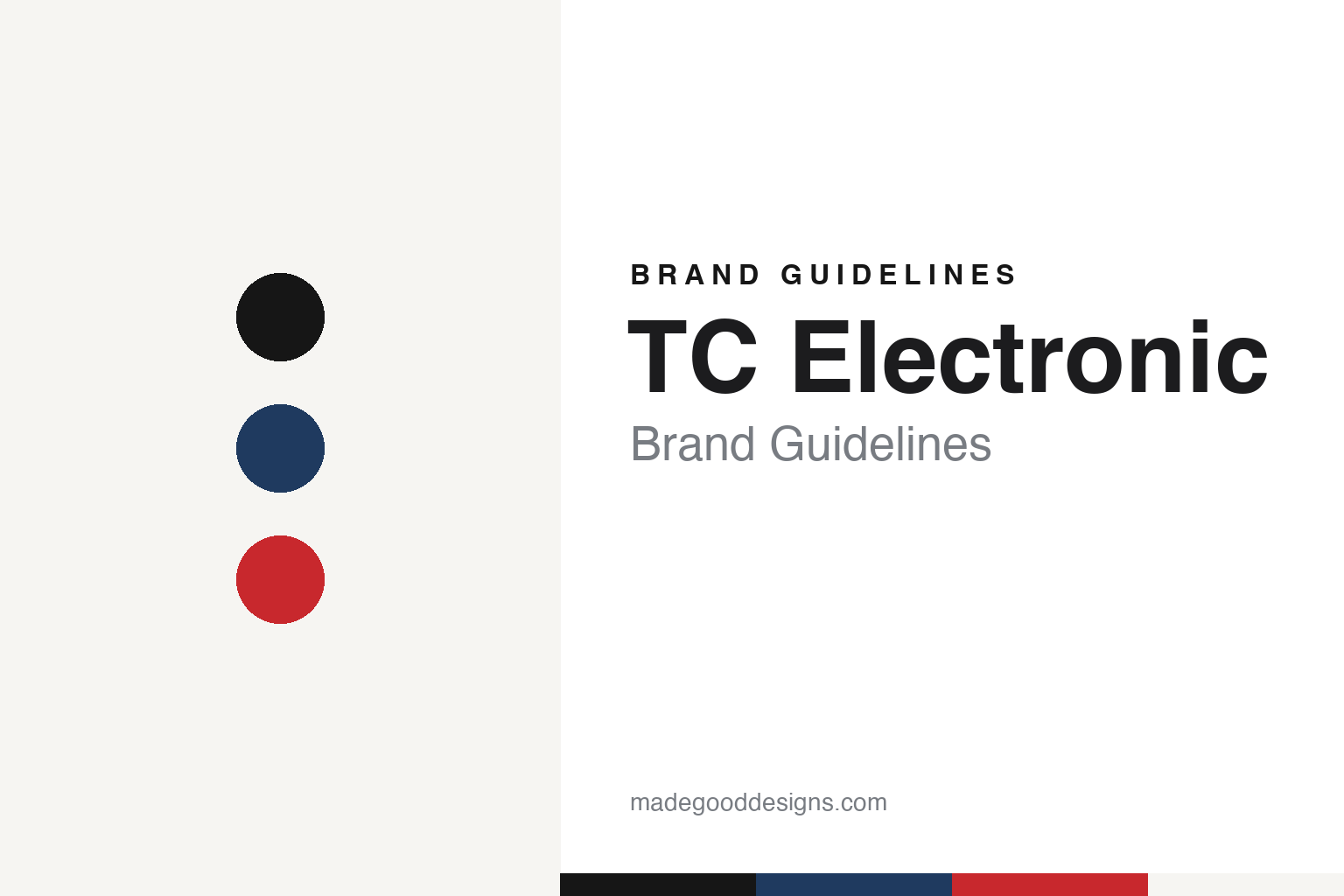
TC Electronic Brand Guidelines
The Aarhus pedal maker that became a studio name.
Aa
Two constants: a TC Electronic black, blue and red palette and an Engineered sans register. Abstract homage — not a TC Electronic product or mark; no pedal, logo or nameplate is reproduced.
Kim and John Rishøj
Two musician brothers and a kitchen in Aarhus.
TC Electronic began in Aarhus, Denmark’s second city, in 1976. Its founders were two musician brothers, Kim and John Rishøj. A 2006 anniversary article in Basunen, the trade paper of the Danish musicians’ union in Aarhus, says they built their first guitar effect pedals in their mother’s kitchen, using local musicians as test pilots. The company’s own history places the founding “in the suburbs of Aarhus.”
The same issue of Basunen carried a memoir by the guitarist Flemming Madsen, who says he was the brothers’ first customer. He recalls being shown a pedal that was flat, black and much smaller than the orange MXR units of the day; it sounded thin at first, he writes, until he realised that what he had taken for a weak effect was clarity. He says he bought it in 1975, and that “the year after, in 1976, TC Electronic was a reality.” He adds that he was never told what the letters TC stand for, and we found no explanation in the sources we checked.
That pedal line produced the SCF, the Stereo Chorus + Pitch Modulator & Flanger. The company says the SCF was praised for “a low noise level and transparent character” and stayed in production for 40 years. From pedals the firm moved into studio racks: its TC2290 digital delay arrived in 1985, and the company says the unit was inducted into the TEC Hall of Fame in 2015.
The business did not stay with its founders alone. Basunen says that at one point new owners installed a professional board, which hired the Harvard-educated Anders Fauerskov as chief executive while the brothers stayed active in the company. Under that management TC turned toward studio equipment, and through the 1990s it grew to about 120 staff in Denmark. By 2006, the article says, its headquarters had stood for a decade in low red buildings in an industrial district of Risskov, in the north of Aarhus.
Colour
Racks, mastering boxes and a tuner.
TC Electronic’s reputation in studios rests on digital processors. In August 1996 Sound On Sound reviewed the M2000, describing it as a cheaper repackaging of the “Danish manufacturer’s professional flagship, the M5000.” The Finalizer, a mastering box combining multiband compression, limiting and equalisation, followed; Sound On Sound reviewed the upgraded Finalizer 96K in March 2000. The company dates its System 6000 reverb and mastering platform to 2000 and says it won a TEC Award; English Wikipedia says the system was upgraded to MK2 in 2010. The FireworX multi-effects unit won a TEC Award for hardware signal processing in 1998, according to English Wikipedia, citing the TEC Foundation’s archive.
The guitar side returned to the front later. The company says the PolyTune was the world’s first polyphonic guitar tuner, reading all six strings strummed at once, and that it earned TC its 11th TEC Award. Its TonePrint pedals let players load presets made by well-known guitarists and bassists; English Wikipedia dates their launch to the NAMM Show of January 2010, while the company’s timeline puts the TonePrint debut and the PolyTune in 2011, so we give both. The Ditto Looper, a one-knob looper pedal, followed in 2013, and the company calls it a best-seller. Along the way TC made bass amplifiers, PowerCore DSP hardware for computers — discontinued in early 2011, Create Digital Music reported — and loudness meters and processors for broadcasters.
A group grew around the pedal maker. English Wikipedia’s TC Group article, citing Mix, says TC Group was incorporated on 10 October 1998. A joint venture with the Canadian firm IVL Technologies in 2000 produced TC-Helicon, the vocal-processor brand, whose remaining shares TC bought in 2005. In 2002 TC Group bought the British loudspeaker maker Tannoy together with Martin Audio, in a deal The Engineer put at £15 million; Martin Audio left through a management buyout in 2003. The Swedish amplifier maker Lab.gruppen also became part of the group. In 2006, Basunen reported, the cheaper product lines were made in Thailand, while a smaller production of high-end gear such as the System 6000 — and of the classic chorus pedal — remained in Risskov.
Typography
Design and documentation.
Studio outboard — the reverbs, delays, compressors, equalisers and preamps that sit in racks beside a mixing console — is a small trade, much of it started by engineers working for themselves. The seven makers in this guide span digital effects, valve processing and licensed recreations of vintage studio equipment.
Two are American digital pioneers of the early 1970s. Eventide began that year in New York City and now dates its press releases from Little Ferry, New Jersey; we found no record of a sale to a larger group. Lexicon began in 1969 as American Data Sciences, took the Lexicon name in 1971, was based in Waltham, Massachusetts, and was bought by Harman in 1993, Harman announced at the time; Samsung completed its purchase of Harman in March 2017.
TC Electronic was founded in Aarhus, Denmark, in 1976 by the brothers Kim and John Rishøj. In April 2015 MusicRadar reported that its parent, TC Group, had been bought by Music Group, the Behringer owner now called Music Tribe.
The analogue makers are smaller. Empirical Labs, founded by Dave Derr, who had helped design Eventide’s H3000, lists a New Jersey address and says all its products are made in the USA. Manley Laboratories builds valve equipment in Chino, California, and was bought in July 2025 by Rockforce Tech Holding, a company founded by Dirk Ulrich, Mix reported. Tube-Tech is the brand of Lydkraft, near Copenhagen. Chandler Limited, which Wade Goeke founded in 1999, is in Shell Rock, Iowa, and the company names him as its owner.
This guide sets out what can be checked about each brand — who founded it, who owns it, and what it says about where its products are made — and marks clearly what rests only on the company’s own word.
Aa
An engineered sans for a maker of racks and pedals. (Specimen set in Archivo, a sans STAND-IN; NOT the TC Electronic logo.)
TC Electronic
From Risskov to Music Tribe.
In 2015 TC Group was sold. MusicRadar reported on 30 April 2015 that the group, including TC Electronic and TC-Helicon, had been acquired by Music Group, the owner of Behringer. Its founder, Uli Behringer, said he would invest heavily in TC’s brands “as we have done with Midas, Klark Teknik and Turbosound,” and TC Group’s chief executive, Anders Fauerskov, said “some of the largest industry players were bidding for TC Group.” English Wikipedia’s TC Electronic article gives August 2015 for the purchase, but the dated report it cites is from April. Music Group renamed itself Music Tribe in December 2017, according to English Wikipedia, which gives its base as Makati, in Metro Manila, the Philippines.
Where the products are made today is documented at group level. In July 2018 Systems Integration Asia reported that Music Tribe had opened its own factory complex, Music Tribe City, in Zhongshan, China, and that it handled component manufacturing, assembly and packaging for the group’s 12 brands; the report named Midas, Turbosound and Behringer rather than TC, and we did not check individual TC product labels. TC Electronic’s current website says the brand was “Founded in Denmark in 1976,” describes it as “Part of Music Tribe,” and speaks of merging “our legendary Danish heritage” with “new Innovation Hubs in Manchester and Italy.” We could not establish from the sources we checked how much of the company still works in Risskov.
For a design guide, TC Electronic shows how a brand born from one well-made pedal can carry a single name across studio racks, broadcast meters and budget stompboxes, and through a change of owner. English Wikipedia notes that the name is sometimes styled in lower case as “t.c. electronic.” Compare Behringer, its owner’s founding brand, and Klark Teknik, another older maker that joined the same group. For this guide we use studio black, a rack blue and a signal red with a sans, an unofficial interpretation; no product or logo is reproduced.
Explore & save
Keep TC Electronic’s identity on hand — save it to a board in the Made Good inspiration library.
TC Electronic identity set
Pin the TC Electronic black, blue and red palette and the Engineered sans register to your own board.