Ronzoni Brand Guidelines
Emanuele Ronzoni’s New York macaroni brand.
Aa
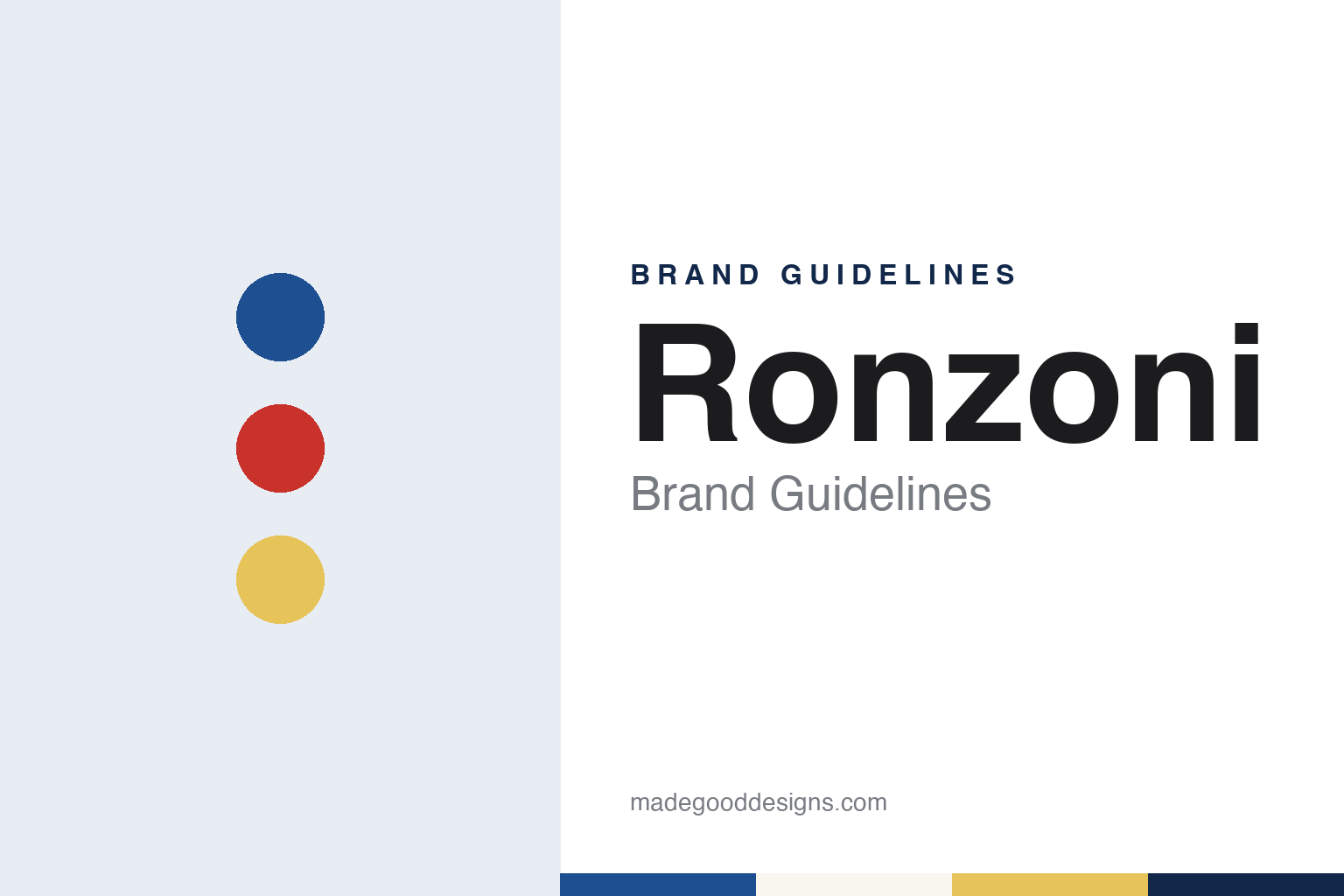
Two constants: a Ronzoni blue, tomato red and durum gold palette and a high-contrast serif register. Abstract homage — not a Ronzoni product or mark; no pack or logo is reproduced.
Ronzoni Macaroni Company
A Ligurian emigrant and the New York macaroni trade.
Ronzoni is a New York brand with Italian roots. The company’s own history says Emanuele Ronzoni emigrated in 1881 from San Fruttuoso, in Italy, and went into the macaroni trade in New York as a teenager. In 1892, the company says, he set up a small macaroni business of his own, and he later helped to create the Atlantic Macaroni Company in Queens. The business that carries his name, the Ronzoni Macaroni Company, dates from 1915 on the brand’s website; the English Wikipedia article on its later owner Ebro Foods gives 1918 instead, so the sources differ by three years.
The company says that after the First World War it became known for “Genoa-style,” or fancy-cut, pasta shapes, and that this made Ronzoni one of the best-known pasta names in the eastern United States. Its history says the business grew through the 1950s and 1960s, reaching both seaboards and Puerto Rico, and that it built its plants in Long Island City, Queens. A photograph used by English Wikipedia shows dry pasta lines at the Ronzoni Macaroni Co. factory in New York around 1960.
Ronzoni stayed a family name for a long time. In 1974 The New York Times profiled the company under the headline “A Label That’s All in the Family,” and the English Wikipedia article on Ebro Foods, citing that piece, says that by the 1970s Ronzoni was the number one pasta brand in New York.
Colour
General Foods, Hershey and New World Pasta.
The family did not keep it. The International Directory of Company Histories, in its 2003 history of New World Pasta, says General Foods bought Ronzoni in 1984, and that in 1990 the Hershey Pasta Group acquired Ronzoni from General Foods. The Hershey Story museum, in a 2016 history of the chocolate maker’s pasta business, lists the 1990 purchase of Ronzoni Foods Corporation of Long Island City, New York, alongside earlier Hershey pasta brands such as San Giorgio and Delmonico, bought in 1966. The museum notes that pasta customers tended to stay loyal to their regional brands, which is why Hershey kept buying established local names rather than building one national label. The same 2003 history says Hershey built a new pasta plant in Winchester, Virginia, in the 1990s.
In 1999 Hershey sold its whole pasta division, eight brands and six plants, the museum says, to the New World Pasta group, owned by private-equity investors; English Wikipedia says the new company was based in Harrisburg, Pennsylvania. New World Pasta went into bankruptcy in 2004, Progressive Grocer and USA Today reported, and in 2006 the Spanish group Ebro Puleva, now Ebro Foods, bought it, as Forbes and Ebro announced that June. Under Ebro the business was merged into its American rice company, Riviana Foods, on 1 January 2017, English Wikipedia says. In Canada, the same article notes, the Ronzoni name was replaced by Catelli from October 2013.
The brand also made the news for one small shape. In January 2023 CNN reported that Ronzoni had stopped selling its star-shaped pastina because a long-term supplier would no longer make it; the company said on Instagram in late 2024 that the stars were coming back, The Kitchn and Parade reported.
Typography
Design and documentation.
The seven brands in this group all make pasta, and they come from Italy, France, Spain and the United States: Buitoni, Panzani, Lustucru, Pastas Gallo, Ronzoni, Mueller’s and Felicetti. Pasta makers and brands in general sit at many different points in the trade, from family firms that still carry a founder’s surname to names that now belong to much larger food groups, and a single brand can be sold everywhere from a corner shop to a supermarket shelf.
A pasta brand’s identity is usually carried less by a single product than by a pack, a name and the meal it promises, because the company behind the name may have changed hands, moved its factory or grown far beyond the town where it started. That makes the questions behind each name worth asking plainly: who started it, who owns it now, and where its pasta is actually made and packed.
Each guide separates what independent sources record from what the company says about itself — its founding story, its owners over time, where its pasta is made and how its packaging has changed — and marks plainly what rests only on the company’s own word.
Aa
A high-contrast serif for an old New York grocery brand. (Specimen set in Playfair Display, a serif STAND-IN; NOT the Ronzoni logo.)
Ronzoni
From Ebro to Post Holdings to a Canadian miller.
Ronzoni left Ebro in 2021. Post Holdings announced in March that year that its subsidiary 8th Avenue Food & Provisions would buy Ronzoni from Ebro’s Riviana, and its June 2021 release said the deal closed on 31 May 2021, taking in the Ronzoni brand and the dry pasta plant in Winchester, Virginia; Post described Ronzoni as a 100-year-old brand. 8th Avenue had been formed in October 2018 and was then owned by Post and outside investors. In June 2025 Food Dive reported that Post would take full ownership of 8th Avenue, with the deal expected to close on 1 July 2025.
Post did not keep the pasta for long. On 29 August 2025 Richardson (U.S.) Holdings, part of Richardson International of Winnipeg, itself a subsidiary of James Richardson & Sons, announced that it would buy Ronzoni together with a durum mill and three pasta plants, at Carrington, North Dakota, New Hope, Minnesota, and Winchester, Virginia, with about 500 employees, according to the announcement on PR Newswire. Milling Middle East & Africa reported on 2 December 2025 that the deal had closed on 30 November. Richardson’s chief executive, Darwin Sobkow, linked the purchase to the company’s durum milling business. Ronzoni’s website now says the brand is part of Richardson Food & Ingredients.
Where is it made? The documented record is the plant transfers: the Winchester plant came with the brand in 2021, and the 2025 sale moved the Carrington mill and pasta plant, New Hope and Winchester to Richardson. The sources we checked do not say which of those plants makes each Ronzoni line.
For a design guide, Ronzoni shows how a brand can be built on one city’s loyalty and then carried through six owners without losing its name. Compare Mueller’s, another century-old American pasta brand from the New York area, and Banza, a newer American pasta label. For this guide we use a deep blue, a tomato red and a durum gold with a serif, an unofficial interpretation; no product or logo is reproduced.
Explore & save
Keep Ronzoni’s identity on hand — save it to a board in the Made Good inspiration library.
Ronzoni identity set
Pin the Ronzoni blue, red and gold palette and the high-contrast serif register to your own board.