Sokołów Brand Guidelines
Poland’s meat brand, owned by Danish Crown since 2014.
Aa
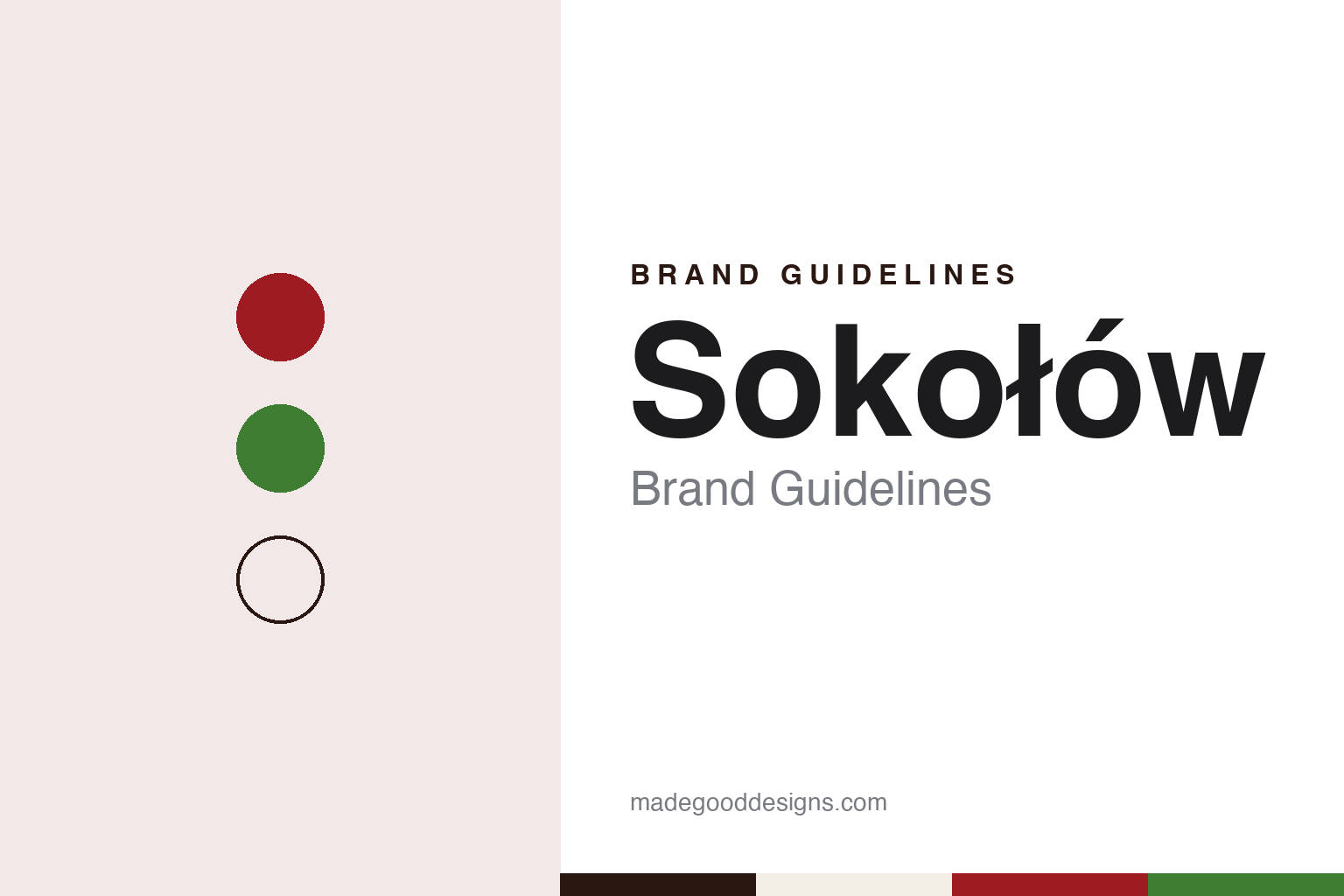
Two constants: a meat red, smoked brown and leaf green palette and a sturdy grotesque register. Abstract homage — not a Sokołów product or mark; no pack, logo or product is reproduced.
From Poznań to Podlasie
A slaughterhouse of 1899 and a plant of 1975.
Sokołów is one of the best-known names in Polish meat, and the company behind it is a group of plants with very different ages. The company traces its history to 1899, when a slaughterhouse opened in Poznań; that business, later known as Pozmeat, moved to a newly built plant at Robakowo, near Poznań, in 2000 and is now the company’s Robakowo branch, Polish Wikipedia and the company say. Other branches have their own starting dates: a bacon and canning factory in Jarosław in 1927, a municipal slaughterhouse in Tarnów in 1929, a cold store in Dębica in 1951 that later became part of the Igloopol combine, and the meat works in Koło in 1974.
The plant that gave the brand its name came last. The meat-industry enterprise in Sokołów Podlaski, a town in eastern Mazovia, was founded in 1975, according to the company timeline in Polish Wikipedia, and was reorganised as a commercial company in 1992. The company calls it its largest branch and one of the most modern in Central and Eastern Europe when it was built. The headquarters of „Sokołów” S.A. remain in Sokołów Podlaski, with an office in Warsaw.
In 1993 Sokołów S.A. was listed on the Warsaw Stock Exchange; the company says it was the first meat company to list there. The 1990s also produced a parallel group, Farm Food, which built a plant in Czyżew between 1991 and 1993, listed on the exchange in 1995 and took over the meat works in Jarosław and Tarnów in 1996 and 1997. In 1998 Sokołów took control of Igloomeat, the Dębica cured-meat business, which was renamed to include the word salami. Sokołów merged with Koło in 1999, and in 2000 the Farm Food and Sokołów groups merged, creating what Polish Wikipedia calls the largest meat-processing business in the country.
Colour
Finnish and Danish owners, then Danish alone.
Foreign owners arrived in the following decade. In 2003 the Finnish meat group HK Ruokatalo, later renamed HKScan, became a strategic investor, and in 2004 the Danish meat group Danish Crown joined it; the two set up a joint holding company, Saturn Nornic Holding AB, which bought all of Sokołów’s shares, Polish Wikipedia says. In mid-August 2006 Sokołów left the Warsaw Stock Exchange, a date the company also gives, and the same year it bought the Pozmeat plant at Robakowo.
The joint ownership lasted a decade. In 2014 Danish Crown bought HKScan’s half and became the sole owner of Saturn Nornic Holding, and so of Sokołów, Polish Wikipedia says, citing an HKScan stock-exchange release of June 2014. The company today names the Danish Crown group as its shareholder, and Danish Crown’s chief executive, Niels Duedahl, chairs Sokołów’s supervisory board, according to Polish Wikipedia. On 30 May 2018 the group took over the Gzella meat group, with a plant at Osie in the Tuchola Forest region of northern Poland, the company says.
Production stays in Poland. The company lists eight plants, at Sokołów Podlaski, Koło, Robakowo, Dębica, Czyżew, Jarosław, Tarnów and Osie, alongside subsidiaries for logistics, farming and its online business, and says its products are sold in around 40 countries. It also likes to point out each plant’s specialism: Dębica makes its mould-ripened products, matured for up to six weeks; Koło ages beef for between ten days and six weeks; Czyżew turns out frankfurters and pâtés; and Tarnów makes burgers. Its plants work to the IFS and BRC food-safety standards, the company says. Przemysław Gostkiewicz has been chief executive since November 2023, succeeding Bogusław Miszczuk, the trade site portalspozywczy.pl reported.
Typography
Design and documentation.
The seven brands in this group all make food, and they come from Poland, Ukraine, Russia, Austria and Hungary, Croatia, the Czech Republic and Serbia: Sokołów, Roshen, Krasny Oktyabr, Kotányi, Kraš, Hamé and Bambi. Food brands in general sit at many different points in the trade, from family firms that still carry a founder’s surname to names that now belong to much larger food groups, and a single brand can be sold everywhere from a corner shop to a supermarket shelf.
A food brand’s identity is usually carried less by a single product than by a pack, a name and the meal or treat it promises, because the company behind the name may have changed hands, moved its factory or grown far beyond the town where it started. That makes the questions behind each name worth asking plainly: who started it, who owns it now, and where its food is actually made and packed.
Each guide separates what independent sources record from what the company says about itself — its founding story, its owners over time, where its food is made and how its packaging has changed — and marks plainly what rests only on the company’s own word.
Aa
A sturdy grotesque for a working meat brand. (Specimen set in Archivo, a sans STAND-IN; NOT the Sokołów logo.)
Sokołów
One house name over several sub-lines.
The Sokołów name works as an umbrella over several product lines. Naturrino is a line of cold cuts marked with a green leaf, which the company says is seasoned only with natural spices; Sokoliki is a line aimed at children; Grill House covers meat for the barbecue; and Z Gruntu Dobre, roughly “good from the ground up,” is a plant-based range made from vegetables, grains, seeds and nuts. Polish Wikipedia also names Gold among the company’s strongest brands. The wider range runs from fresh pork and beef through hams, salami, smoked meats and frankfurters to ready meals, beef tartare and tinned meat.
Polish Wikipedia lists a run of awards, most of them Polish brand rankings: Superbrands titles in 2009, European Trusted Brands distinctions in 2013 and 2014, the “Teraz Polska” emblem, gold medals at the Poznań International Fair for the Naturrino and Uczta Qulinarna lines, and first place in the meat sector for both product quality and brand awareness in the 2015 ranking of Polish brands by the daily Rzeczpospolita. The company also puts its name on sport, sponsoring girls’ basketball in Sokołów Podlaski, a training camp for young players run by the basketball player Marcin Gortat, and the Sokoliki Cup, a football tournament for children under ten.
For a design guide, Sokołów shows how a town’s name became a national food brand through mergers and changes of owner, with sub-brands for children, the grill and plant-based eating gathered under it. Compare Campofrío, the Burgos charcuterie maker, and ElPozo, the Murcia meat brand. For this guide we use a deep meat red, a smoked brown and a leaf green with a sturdy sans, an unofficial interpretation; no product or logo is reproduced.
Explore & save
Keep Sokołów’s identity on hand — save it to a board in the Made Good inspiration library.
Sokołów identity set
Pin the Sokołów meat red, smoked brown and leaf green palette and the sturdy grotesque register to your own board.