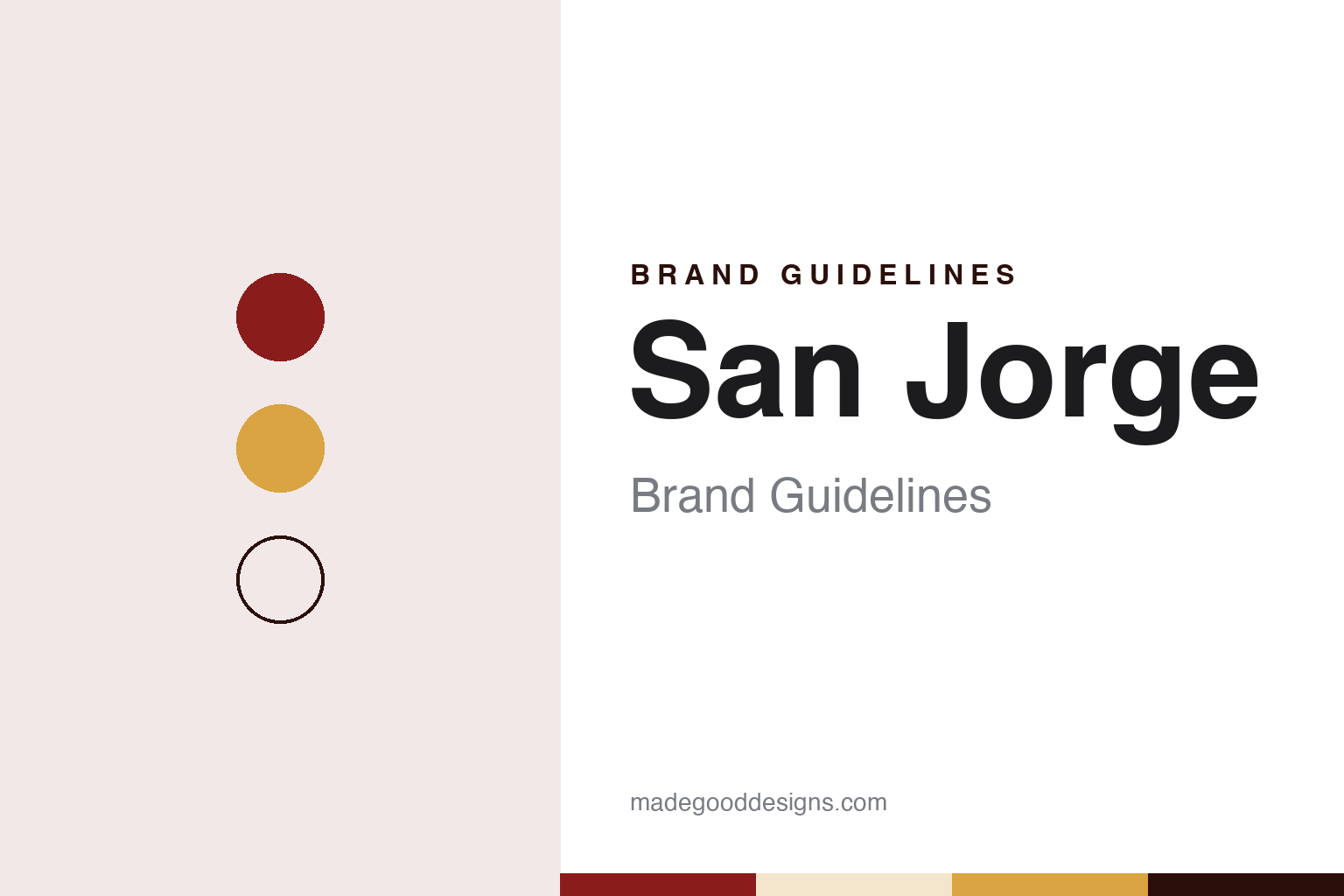
San Jorge Brand Guidelines
The Chosica bakery that became a Peruvian biscuit maker.
Aa
Two constants: a bakery red, gold and cream palette and a warm serif register. Abstract homage — not a San Jorge product or mark; no pack, logo or wordmark is reproduced.
A bakery in Chosica
Vanilla, orange, ginger and lemon biscuits on the road out of Lima.
San Jorge is a Peruvian biscuit brand with a bakery story. The company behind it, Panadería San Jorge S.A., says it began in the mid-1940s in a small bakery in Chosica, a district on the eastern edge of Lima, run by a founding family whose names it does not give in its published history. The company dates itself by that bakery: its website says it has been “sharing more than 75 years” with Peruvians, and its 2025 sustainability report speaks of “almost eight decades” in Peruvian homes.
The company’s own account of the early years is short and specific. It says its first biscuits were flavoured with vanilla, orange, ginger and lemon and were made by hand, and that travellers passing the bakery stopped to buy packets for the road while neighbours queued for freshly baked ones. As word spread, it says, the products became known across Peru. The next step, in the company’s telling, was a product for families to share: a panetón, the sweet loaf with raisins and candied fruit, made to a recipe the company calls the “Gran Panetón,” kept as a family tradition.
That pairing of biscuits and panetón still defines the business. San Jorge describes itself as a maker of mass-market foods “known for our emblematic biscuits, which marked our beginnings,” and in its 2025 report it calls itself a leading company in biscuits and panetones. Chosica remains part of the brand’s map: the company still runs a shop there, as well as one in La Victoria in central Lima, and keeps a warehouse in the town.
Colour
Sweet, savoury and filled biscuits — and a growing pantry.
The range has grown well beyond the bakery’s first four flavours. In its 2025 sustainability report, published in May 2026, San Jorge says it sells more than 60 products under two commercial brands. The portfolio it lists runs from sweet biscuits, savoury crackers and filled biscuits to panetones, jam, pasta, bottled water and canned tuna. Biscuits remain the core: the company says its biscuits are what consumers know it for, and the panetón is the seasonal flagship.
Two products show how the brand is managed today. The company says it relaunched its Panetón Casita in 2025, with what it calls a differentiated, more emotional proposition, and that it launched a Halloween edition of Mini Rellenitas, its small filled biscuits, to extend their sales beyond the season of children’s parties and piñatas. It describes these as “in and out” limited launches meant to keep the brand lively.
The company groups its business under three names on its website: San Jorge itself; Galletera del Norte, presented with the line “tradición norteña,” a northern tradition; and Compañía Molinera del Centro, a milling company it calls Molicentro. It says products from all three are sold through distributors across Peru, and its report says they reach 25 regions of the country and are exported to eight countries.
Where the products are made is stated plainly in the 2025 report: the company has two production plants, one in Lima and one in Trujillo, on Peru’s northern coast, and says both hold food-safety certifications. Spanish Wikipedia’s article on Santa Clara, in the Ate district of eastern Lima, lists a San Jorge bread and biscuit factory among the plants located there. The report says the company employs about 700 people directly and runs distribution centres in Lima, Huancayo and Arequipa, with warehouses in Ate, Chosica and Villa El Salvador.
Typography
Design and documentation.
The seven brands in this group all make food, and all of them come from Peru or Mexico: Gloria, D’Onofrio, San Jorge, La Moderna, Lala, Alpura and Bachoco. Food brands from these two countries in general sit at many different points in the trade, from family firms that still carry a founder’s surname to names that now belong to much larger food groups, and a single brand can be sold everywhere from a neighbourhood shop to a supermarket shelf.
A food brand’s identity is usually carried less by a single product than by a pack, a name and the meal or snack it promises, because the company behind the name may have changed hands, moved its factory or grown far beyond the town where it started. That makes the questions behind each name worth asking plainly: who started it, who owns it now, and where its food is actually made and packed.
Each guide separates what independent sources record from what the company says about itself — its founding story, its owners over time, where its food is made and how its packaging has changed — and marks plainly what rests only on the company’s own word.
Aa
A warm, slightly old-fashioned serif for a brand that began in a family bakery. (Specimen set in Fraunces, a serif STAND-IN; NOT the San Jorge logo.)
San Jorge
A family company with a stated purpose.
San Jorge presents itself as a company built around affordability. Its stated purpose is to make high-quality food that is affordable to all Peruvians “regardless of their economic capacity or place of residence,” and its mission promises products “that reach everywhere.” The 2025 report says the company’s distribution aims to reach even the most remote parts of the country. Its corporate governance, as set out in the same report, runs through a general meeting of shareholders, a board of directors and a general manager; the report does not name the shareholders.
The company also reports on food safety and its wider programmes. San Jorge says it has received the top AA grade in BRCGS food-safety audits for seven consecutive years up to 2025 and maintains HACCP certification. Since 2019, it says, it has supported the Asociación Peruana para la Conservación de la Naturaleza (APECO), a Peruvian conservation group. Its community programmes include a junior race tied to the Maratón de los Andes and “Los Peques se lo Merecen,” which supports children’s foster homes. In 2025 it says it began measuring its organisational carbon footprint.
The brand should not be confused with other Peruvian companies of the same name: the San Jorge biscuit company’s website is sanjorge.com.pe, while sanjorge.pe belongs to an unrelated waste-management and transport firm.
For a design guide, San Jorge shows how a brand can keep a bakery’s warmth while selling everything from crackers to tuna: the panetón and the filled biscuit carry the story, and the town of Chosica anchors it. Compare it with fellow Peruvian food brands D’Onofrio and Gloria. For this guide we use bakery red, panetón gold and biscuit cream with a serif, an unofficial interpretation; no product or logo is reproduced.
Explore & save
Keep San Jorge’s identity on hand — save it to a board in the Made Good inspiration library.
Save the San Jorge palette
Bakery red, panetón gold and biscuit cream, with a warm serif — an unofficial San Jorge-inspired set for packaging and food-brand moodboards.


