Teacher’s Brand Guidelines
Highland Cream from Glasgow’s dram shops.
Aa
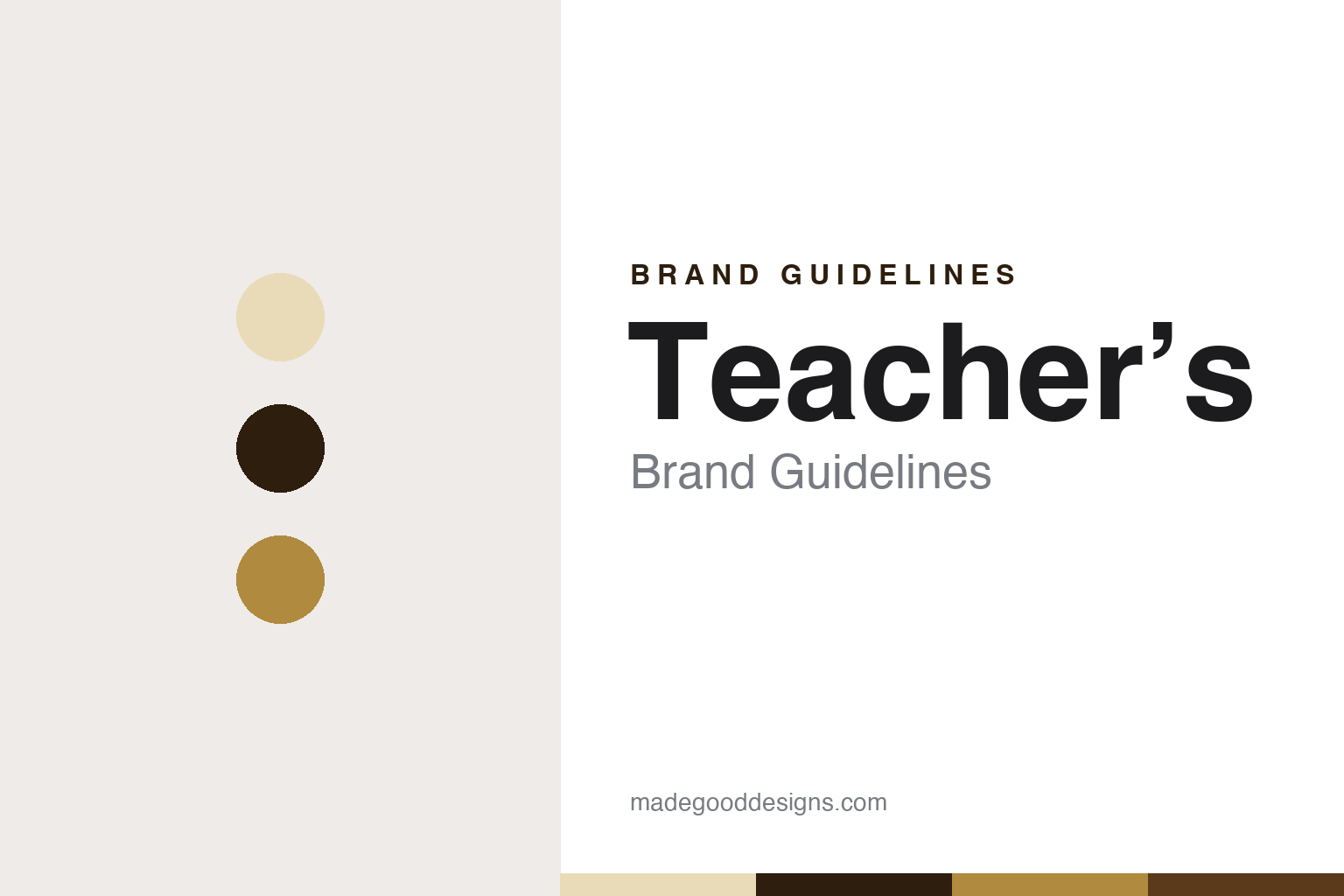
Two constants: a Highland cream, peat brown and hallmark gold palette and an old-style book serif register. Abstract homage — not a Teacher’s product or mark; no bottle, logo or label is reproduced.
The dram shops
A grocer’s counter in Anderston and a licence in 1856.
Teacher’s begins with William Teacher in Glasgow. The brand’s label carries the date 1830, the year of a new Excise Act that, English Wikipedia says, Teacher took advantage of to begin selling whisky. Accounts of the first shop differ slightly: English Wikipedia says he sold whisky from his wife’s grocery shop from 1832, while ScotchWhisky.com’s profile says he married a grocer’s daughter in the city’s Anderston district in 1834 and began selling whisky from the shop.
The decisive step came in 1856, when Teacher was granted a “licence for consumption” and opened his own dram shop, a bar where whisky was served by the glass. ScotchWhisky.com says the chain grew to 18 premises, making him the largest single licence holder in Glasgow. His sons William Jr and Adam joined the business, which moved into wholesaling and blending whisky as well as selling it.
In 1876 the business passed to the two sons as William Teacher & Sons, and the company moved to St Enoch Square in the centre of Glasgow, ScotchWhisky.com says; it stayed there until 1991.
The blend that carries the name today was registered in 1884 as Teacher’s Highland Cream, according to English Wikipedia and ScotchWhisky.com. To secure malt for it, the family built its own distillery. Ardmore, at Kennethmont in Aberdeenshire, was founded in 1898 by Adam Teacher to produce whisky for blending, according to Canmore, Scotland’s national record of the historic environment, which notes that its whisky is still used in Highland Cream. English Wikipedia, citing the whisky writer Charles MacLean, describes Ardmore’s peated single malt as the blend’s “fingerprint” whisky.
Colour
A self-opening bottle and a long run with Allied.
The brand’s best-known packaging story is its stopper. ScotchWhisky.com says Teacher’s patented a “self-opening” whisky bottle in 1913, one that could be opened without a corkscrew. The company’s own history credits the invention to William Teacher’s grandson, William Manera Bergius, and calls it a world first; Difford’s Guide notes that this “first” is the company’s claim. A later packaging change, the Jigger Cap bottle, followed in 1967, ScotchWhisky.com says.
The firm celebrated its centenary in 1930 with an advertising campaign built around the “Right Spirit Boys”, which ran until the 1950s, according to ScotchWhisky.com. After the war the family business grew its malt supply and production: it acquired the Glendronach distillery, which ScotchWhisky.com’s timeline dates to 1957 and its history section and English Wikipedia to 1960, and in 1962 it built a new blending and bottling plant in Glasgow.
Sales grew with it. ScotchWhisky.com says annual UK sales of Teacher’s passed one million cases for the first time in 1972. In 1976 the company was bought by Allied Breweries, which became Allied Lyons in 1978 and Allied Domecq in 1994, English Wikipedia says. By the late 1980s, ScotchWhisky.com says, Highland Cream was the second-best-selling blend in Britain, with about 16 per cent of the market, and was sold in some 150 export markets, with particular success in India.
Glendronach later went its own way: English Wikipedia says the distillery was closed in 1996, reopened in 2002 and later passed to Chivas Brothers, while Ardmore stayed with the Teacher’s brand.
Typography
Blends, blenders and big brands.
The seven brands in this group are all blended Scotch whiskies: Dewar’s, J&B, Ballantine’s, Grant’s, Bell’s, Teacher’s and Cutty Sark. Blended Scotch brands in general sit at many different points in the trade, from names that still carry a founder’s or merchant’s name to labels that now belong to much larger drinks groups, and a single brand can be sold everywhere from a corner shop to a hotel bar.
A blended Scotch brand’s identity is usually carried less by a single distillery than by a label, a name and the style of the blend, because the company behind the name may have changed hands, moved its blending and bottling or grown far beyond the place where it started. That makes the questions behind each name worth asking plainly: who started it, who owns it now, and where its whisky is actually blended and bottled.
Each guide separates what independent sources record from what the company says about itself — its founding story, its owners over time, where its whisky is blended and how its labels have changed — and marks plainly what rests only on the company’s own word.
Aa
An old-style book serif for a Victorian Glasgow merchant’s name. (Specimen set in Libre Caslon Text, a serif STAND-IN; NOT the Teacher’s logo.)
Teacher’s
From Allied to Beam to Suntory, with India as a stronghold.
The brand changed hands again in the 2000s. When Pernod Ricard took over Allied Domecq in 2005, it sold Teacher’s, the Ardmore distillery and Laphroaig to Fortune Brands to gain regulatory approval, English Wikipedia says. Fortune Brands spun off its spirits business as Beam Inc. in 2011, TheStreet reported in October that year, and in 2014 the Japanese drinks group Suntory bought Beam, forming Beam Suntory, now Suntory Global Spirits, the owner of Teacher’s today alongside Jim Beam.
The range has widened around Highland Cream. ScotchWhisky.com says Teacher’s 50 was launched in India in 1997 to mark fifty years of the country’s independence, Teacher’s Origin followed in 2010, and a 25-year-old and a single malt were added in 2012. Its profile describes Teacher’s as the third-best-selling blended Scotch in Britain.
India is also where the newest look appeared first. In June 2025 Suntory Global Spirits announced that a new identity for Teacher’s, created with the London agency Design Bridge and Partners, had been unveiled in May in the state of Uttarakhand, with a national roll-out to follow. The company says the redesign refined the label and reworked the bottle, kept the “WT” hallmark that honours William Teacher, and added raised textured embossing and a palette of deep, saturated colours.
The name needs care online. The word “teachers” is shared with the teaching profession, and the whisky’s full name is Teacher’s Highland Cream.
For a design guide, Teacher’s shows how a founder’s surname, a hallmark of his initials and a blend registered in 1884 can travel from a Glasgow dram shop to markets as far apart as Britain and India. Compare Jim Beam, its Kentucky stablemate, and Suntory, the Osaka group that owns both. For this guide we use Highland cream, peat brown and hallmark gold with a serif, an unofficial interpretation; no product or logo is reproduced.
Explore & save
Keep Teacher’s’s identity on hand — save it to a board in the Made Good inspiration library.
Teacher’s identity set
Pin the Teacher’s Highland cream, peat brown and hallmark gold palette and the old-style book serif register to your own board.