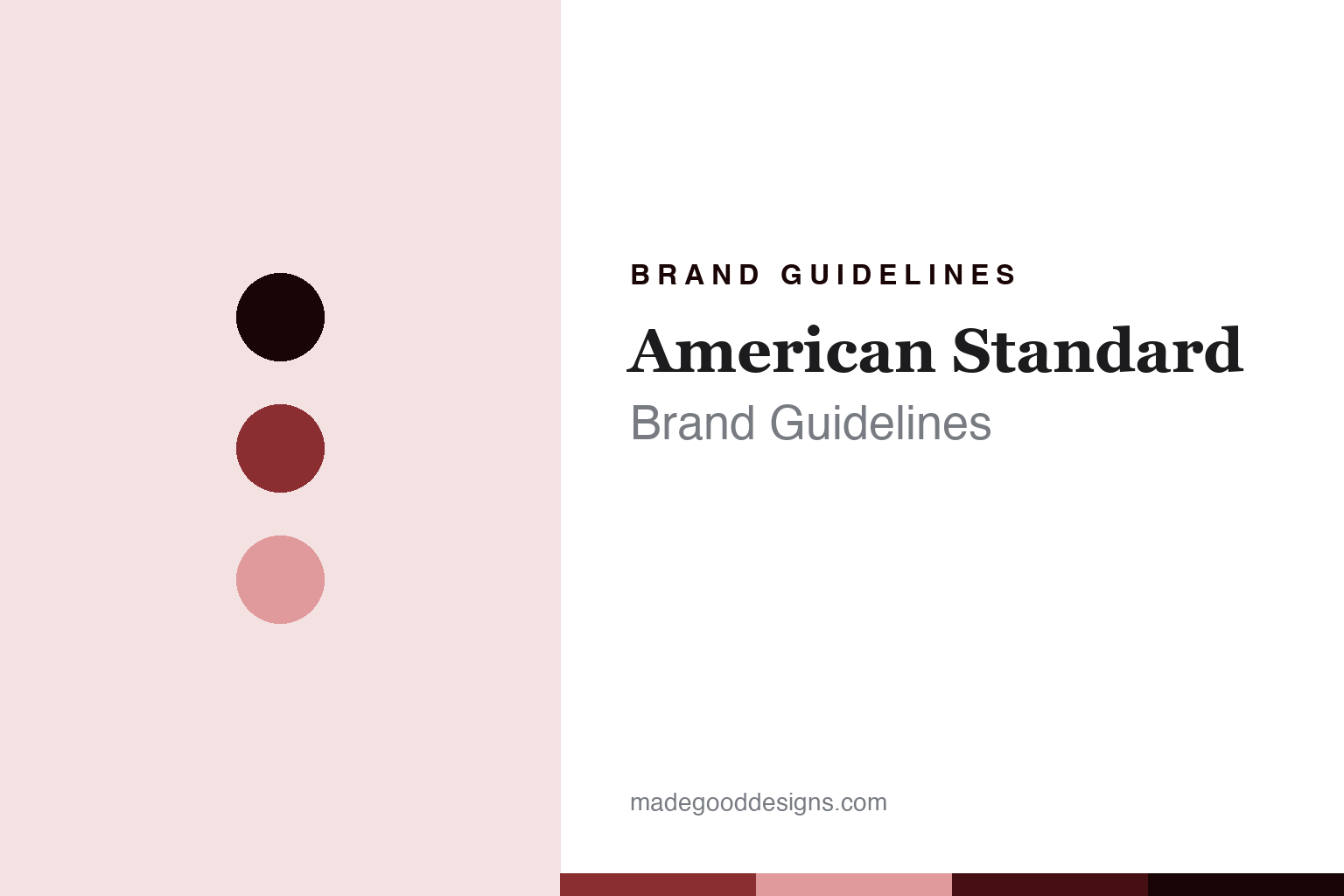
American Standard Brand Guidelines
An American icon, Japanese-owned.
Aa
Two constants: a crimson palette and a heritage-serif register. Abstract homage — not an American Standard product or mark.
An American icon, Japanese-owned
American Standard is the American plumbing icon with roots to 1875, whose Americas brand is now owned by Japan’s LIXIL.
American Standard is the round’s clearest ownership twist — an American household name whose Americas brand is now Japanese-owned. American Standard makes mass-market faucets, toilets, sinks and baths. Its answer to how a maker becomes a name is heritage plus reach: carry a nineteenth-century American plumbing lineage into millions of homes, even as ownership crosses the Pacific. A fixture, American in name.
Its identity is an American icon, Japanese-owned. American Standard’s deep US heritage, its mass-market fixtures and its place inside LIXIL are the work it is known for. A fixture, from the USA. An American icon, Japanese-owned.
(Honest notes, so the story stays precise. American Standard — at americanstandard-us.com — makes mass-market faucets, toilets such as its VorMax line, sinks and baths, headquartered in Piscataway, New Jersey. Its heritage runs deep: it descends from Standard Sanitary Manufacturing, founded in 1875, and American Radiator, founded in 1892, which merged in 1929 and took the American Standard name in 1967 — so we date the roots to 1875 and avoid a single tidy founding year. On where it is made — a theme of this vein — it is an American brand with global manufacturing, across the US, Mexico and Asia. On ownership — the point of this round — the American Standard brand in the Americas is owned by the LIXIL Group of Japan, which acquired American Standard Brands in 2013; LIXIL also owns Grohe, from the earlier round. A detail to get right: the name is fragmented by region — the same historic company’s European arm became the separate Ideal Standard — so LIXIL owns the Americas and Asia-Pacific brand, not Europe’s. Its name and marks are IP, described but never reproduced, and there is no official brand hex; these tones are an unofficial interpretation. This is design commentary and does not promote any product.)
Colour
American Standard lives in a crimson palette. Click a swatch to copy the hex.
American Standard’s identity is heritage, owned and mass-market — a crimson, an ink, a rose, a deep crimson, and a paper. The palette leans crimson and rose: a deep, American-heritage register drawn as colour, not as any flag. It signals a nineteenth-century plumbing icon. The honest caveat: with no published brand hex, these values are an original, unofficial interpretation, not first-party colours, and the crimson is an abstract choice, not a national symbol.
The lesson is a crimson palette signals a heritage, foreign-owned identity. American Standard’s world is a heritage, owned object. For designers, it is a reminder that a deep crimson and a soft rose can carry a heritage brand — the weight of a long American lineage — without lifting a flag. Because these tones can fail as small text, keep type dark and let the colour live in the accents, palette and band. The takeaways: carry a deep lineage; reach the mass market; be honest about foreign ownership; and treat any single hex as unofficial.
Typography
The register is a heritage serif — deep, storied, mass-market.
American Standard’s identity carries a deep, storied, mass-market spirit — a nineteenth-century name, not a newcomer. A heritage serif captures the mood: substantial, historic and American, the register of a plumbing lineage older than most rivals. Set in a crimson palette, the heritage serif feels deep and storied — exactly the personality American Standard carries. It is a long lineage rather than a logo, mirroring an enamelled fixture in millions of homes. (American Standard’s real wordmark is a thing we describe but do not reproduce, and the exact typeface is not ours to use.) Because it is not ours to use, the honest description is “a heritage-serif spirit,” shown here in a stand-in. The type behaves like the brand: deep, storied and mass-market.
Aa
A heritage-serif spirit — deep and storied. (Specimen set in Playfair Display, a heritage-serif STAND-IN; NOT the American Standard logo.)
The tap makers
American Standard stands for an American icon, Japanese-owned.
American Standard is a lesson in how a name and its owner can part ways. A crimson palette, a heritage serif and a deep lineage make one thing — an American icon, Japanese-owned — the whole identity: heritage, owned and mass-market. The nineteenth-century American lineage is the differentiator, and the LIXIL ownership is the meaning. The point is an American household name whose Americas brand now belongs to a Japanese group.
Put to work, the identity is a name outliving its origin, told straight, as design. A maker in this spirit would carry a lineage forward under whoever owns it — American Standard, under LIXIL. A reader in this spirit would keep the facts straight: the roots run to Standard Sanitary in 1875 and American Radiator in 1892, merged in 1929; the Americas brand is owned by LIXIL of Japan, which also owns Grohe; and the same historic company’s European arm is the separate Ideal Standard, so the name is split by region across two different owners. American Standard holds the round’s ownership-twist thread as its clearest case, its same-root thread with Ideal Standard, and its cross-round thread with Grohe. The honest editorial moves are to date the roots to 1875, to name LIXIL as the Americas owner, and to flag the Ideal Standard split. The lesson American Standard teaches is that a name can outlive its origin: the American lineage gives it substance, and the Japanese ownership shows how far a name can travel.
For designers and brand-builders, American Standard holds the round’s headline in the tap makers: a name can outlast its nationality — so tell the ownership honestly. The lessons: carry a lineage forward; reach the mass market; disclose foreign ownership plainly; explain a region-split brand; and never reproduce a logo or a flag. It is also a reminder to stay precise: American Standard is the American plumbing icon with roots to 1875, whose Americas brand is now owned by Japan’s LIXIL — with the palette here an unofficial interpretation. Read that way, American Standard is less a tap than a lesson in labels: the most American of names, owned across the Pacific, and split from its own European half. American Standard made an-American-icon-Japanese-owned the identity — proof that a fixture, honestly told, can be the difference.
Explore & save
Keep American Standard’s identity on hand — save it to a board in the Made Good inspiration library.
American Standard identity set
Pin the crimson palette and the heritage-serif register to your own board.