Arnold Genthe came to photography as an outsider. He trained as a classical scholar in Germany and arrived in San Francisco as a private tutor. The results range from street scenes shot with a small camera to studio portraits of dancers in mid-movement. For anyone designing with photography, Arnold Genthe shows how much a picture can say with very little contrast.
This guide looks closely at one public-domain print from the Art Institute of Chicago and describes his other work in text. For more public-domain prints and photographs to study, browse the MGD museum inspiration collection.
Who was Arnold Genthe?
He was born in Berlin in 1869; the Metropolitan Museum of Art’s records give Berlin, and the California Historical Society’s collection guide at Stanford gives the date as 8 January 1869. He followed his father into academic life. The Bates College Museum of Art says he received a doctorate in philology from the University of Jena in 1894, and David S. Shields, writing for the University of South Carolina’s Broadway Photographs project, also places his doctorate at Jena.
In 1895 he went to San Francisco to work as a tutor, a move that the New-York Historical Society’s finding aid describes as meant to last a year. The Stanford guide, the New-York Historical Society and the Library of Congress all agree that he taught himself photography there. SFMOMA dates the opening of his portrait studio to 1897.
The earthquake and fire of April 1906 destroyed his studio, according to SFMOMA, the Stanford guide and the Library of Congress. The Library of Congress adds that his Chinatown negatives survived because they were stored outside the city. The Stanford guide says he rebuilt his studio in 1907, and both it and SFMOMA say his Chinatown photographs were published in 1908.
He moved to New York in 1911, which SFMOMA, the Stanford guide and the New-York Historical Society all record. SFMOMA notes that he published Impressions of Isadora Duncan in 1929 and an autobiography, As I Remember, in 1936, a book the Library of Congress also cites. He died in 1942; the Met and SFMOMA both give New Milford, Connecticut, as the place.
Key works and series
San Francisco’s Chinatown, about 1895–1906
The Stanford collection describes photographs of the Chinese American inhabitants of Chinatown made between 1895 and 1906: children and families, tradespeople and street scenes. The Bates College Museum of Art says around 200 of these pictures survive. The Art Institute of Chicago holds several, dated around 1900 and printed around 1920, which shows that he went on printing the series long after he left the city.
The Library of Congress quotes As I Remember on why he needed a camera small enough to carry in a pocket: people scattered when he tried to sketch them. The Broadway Photographs essay also describes a hidden camera. That method explains the look of the series: figures caught mid-step, framed by doorways and balconies, rarely facing the lens.
The 1906 earthquake and fire
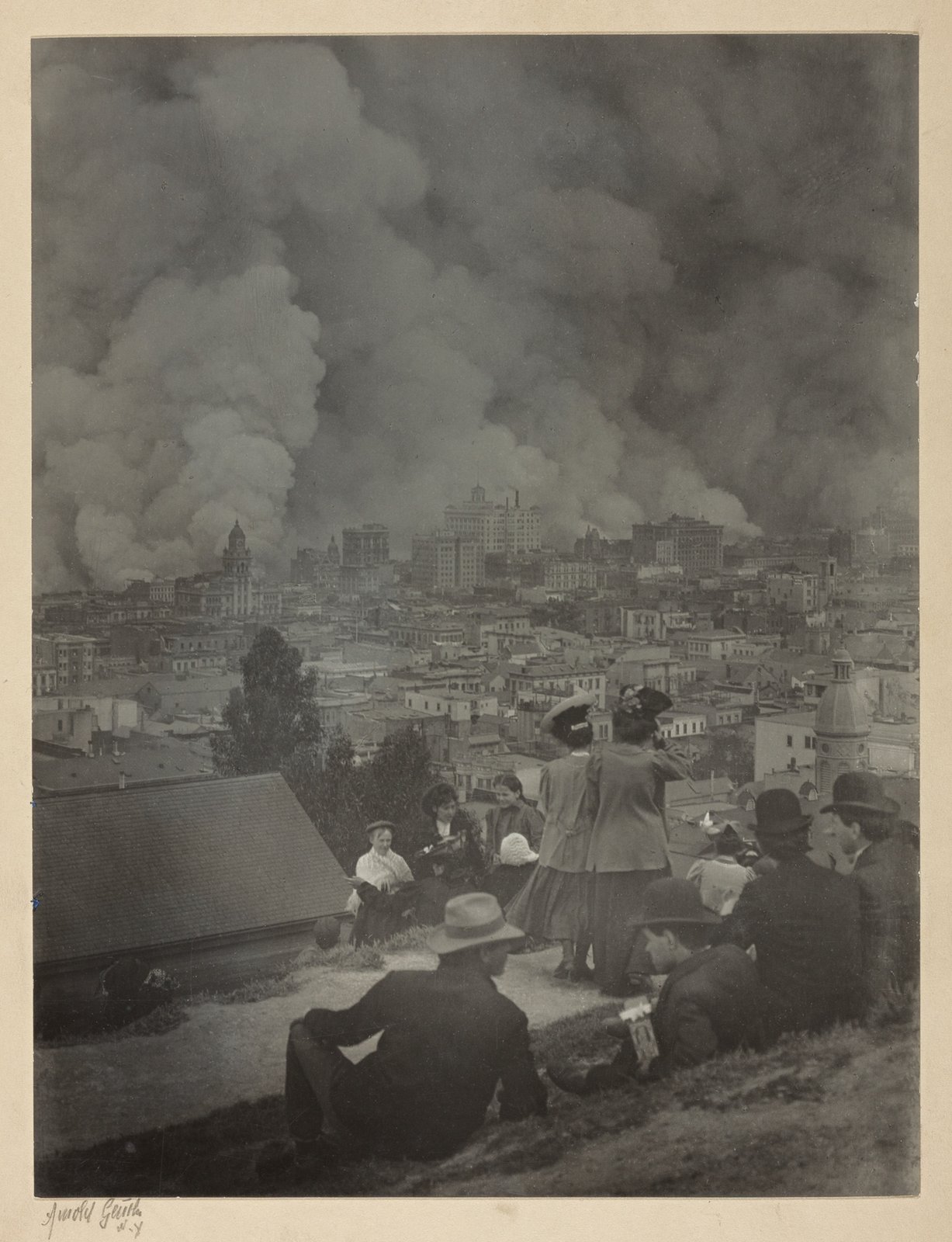
The print above is in the Art Institute of Chicago, which dates it April 1906 and catalogues it as a gelatin silver print, 24 by 18.3 centimetres, on a mount of 45.8 by 35.5 centimetres. Its record is flagged public domain. His pencil signature sits in the lower left corner of the mount. The Stanford collection holds 16 original prints of the aftermath.
The composition works in two halves. The top half is almost all smoke, a soft grey mass with no hard edges. The bottom half is a dark slope of people seen from behind, hats and coats making solid shapes. Between them runs a thin band of rooftops and towers in sharp detail. Your eye lands on the crowd, follows their gaze across the roofs and ends in the smoke.
Dancers and portraits, 1911–1940s
The Bates College Museum of Art and the New-York Historical Society both list the dancers Isadora Duncan, Anna Pavlova and Ruth St. Denis among his subjects, and the Met holds his 1915 print of Pavlova in Réveil de Flore. His sitters included Greta Garbo, Theodore Roosevelt, Woodrow Wilson and John D. Rockefeller Jr., according to Bates and the Library of Congress; the Art Institute of Chicago dates two of its Garbo prints to 1925. Shields writes that Genthe preferred to photograph dancers improvising rather than performing set choreography, and that he would not let editors crop his images.
Colour and travel
Genthe also worked in colour. The Met holds an autochrome, an early colour process on glass, catalogued as [Pan-Pacific International Exposition] and dated 1915, and Shields describes his autochrome work as part of what made his name in New York. The New-York Historical Society’s collection includes colour and black-and-white landscapes from Long Island, Guatemala and Japan, and Shields mentions extended visits to Japan, New Orleans and Greece.
Technique: atmosphere over detail
Shields places Genthe within pictorialism, a movement that treated photography as a fine art and often used soft focus and tonal printing to get closer to painting. The earthquake print shows how he applied that taste even to news. Nothing is pin-sharp except the middle band of buildings. Smoke and foreground blur into broad masses of tone, so the picture reads as a mood before it reads as information.
Three habits are worth naming. First, he shot people from behind or in profile, so viewers share their point of view instead of meeting their eyes. Second, he left large areas of near-uniform tone, here the smoke, as breathing space. Third, he kept the brightest values small: the white blouses and the single pale hat in the crowd catch light against dark coats and become the points where the eye rests.
A palette measured from the scan
These six colours were measured from the Art Institute of Chicago’s scan of this print with a six-colour quantisation. They describe the scan of the print and its mount as they look today, not the original materials:
- #D9C9AE: the cream card mount around the image.
- #7E7B71: the palest smoke and the lit rooftops.
- #6E6B63: the main body of the smoke.
- #635F58: middle-distance buildings.
- #5A5750: shaded smoke and the hillside grass.
- #44403A: coats, hats and the roof in the foreground.
Five of the six values sit within a narrow band of warm greys, and only the mount is light. That is why the print feels calm even though the subject is a city on fire. You can sample other museum scans with the image colour picker and build a scheme from them in the colour palette generator; our guide to vintage colour palettes covers keeping low-contrast schemes from turning muddy.
How designers can borrow from Arnold Genthe
- Use a figure from behind as a guide. People seen from the back point the viewer into the scene. In hero images and posters, a silhouette looking towards your headline does the same job as an arrow, with more feeling.
- Let one soft mass carry the space. His smoke fills half the frame with almost no detail. A blurred photo or a flat tint behind type gives text room without an empty box.
- Keep highlights small. Reserve your lightest value for one or two spots, such as a button or a key word, and keep the rest in the middle greys.
- Do not crop the moment away. Shields records that Genthe resisted cropping. When you choose photography, keep the surrounding air around a gesture instead of cutting tight to the face.
For the wider pictorialist circle, see our guides to Alfred Stieglitz, who collected Genthe’s work according to Shields, and to Gertrude Käsebier, another portrait photographer of the same generation.
Where to see his work
The Library of Congress bought the photographs left in his studio after his death, according to its own blog and to Shields. The Stanford guide records that negatives were transferred from the Library of Congress to the California Historical Society in 1954; that collection moved to Stanford University Libraries in 2025. The New-York Historical Society holds a large collection of prints in six series, including Chinatown, portraits, landscapes and dancers. The Art Institute of Chicago, the Met, SFMOMA and Bates also hold prints.
Frequently asked questions
What is Arnold Genthe known for?
He is known for photographs of San Francisco’s Chinatown made between about 1895 and 1906, for his pictures of the 1906 earthquake and fire, and for New York portraits of dancers such as Isadora Duncan and Anna Pavlova.
Did Arnold Genthe work in colour?
Yes. The Met holds a 1915 autochrome by him, and the New-York Historical Society’s collection includes colour landscapes.
When were his Chinatown photographs published?
SFMOMA and the Stanford collection guide both date the publication of his Chinatown photographs to 1908. The Library of Congress also mentions a later book, Old Chinatown, published in 1913.
Is Arnold Genthe’s work in the public domain?
It depends on the print and the museum. The Art Institute of Chicago flags its April 1906 San Francisco Earthquake print as public domain, but most of his prints at the Art Institute and the Met are not marked public domain, so check each museum record.