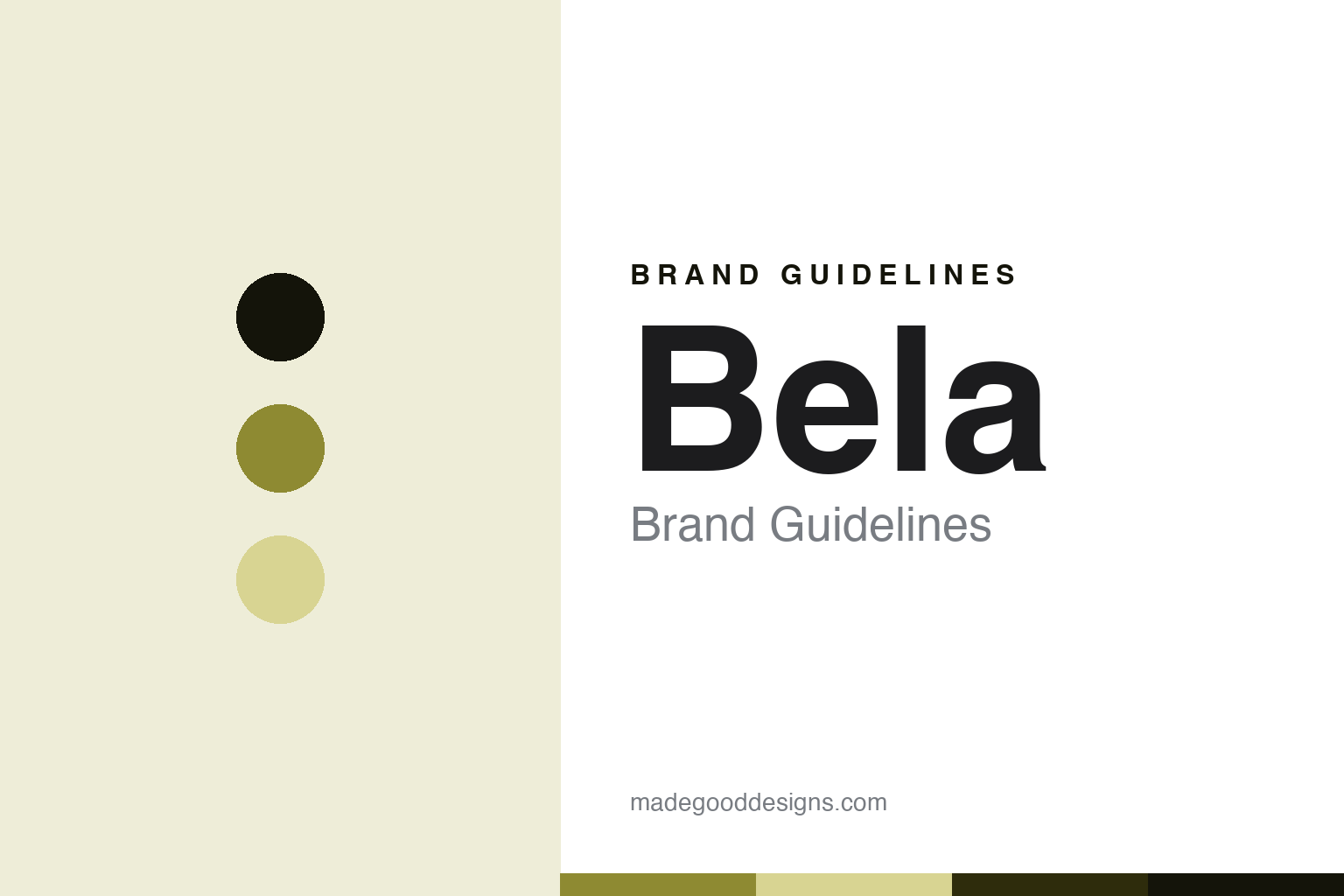
Bela Brand Guidelines
The American brand made in Portugal.
Aa
Two constants: an olive-gold palette and a litho-sans register. Abstract homage — not a Bela product or mark.
The American brand made in Portugal
Bela is the US, family- and veteran-owned sardine brand canned in Olhão, Portugal.
Bela brings the round a border-crossing story — the American sardine brand, family- and veteran-owned, whose fish are canned by a family cannery in Olhão, in the Portuguese Algarve, under the motto Olhão roots, New England heart. Bela makes tinned sardines in organic extra-virgin olive oil and other conservas, and its answer to a round about the specialists is a partnership across the Atlantic: an American brand made in Portugal. A brand, between two shores.
Its identity is the American brand made in Portugal. Bela’s American ownership, its Olhão canning and its olive-oil sardine are the story here. A brand, transatlantic. The American brand made in Portugal.
(Honest notes, so the story stays precise, because Bela is easy to mistake for a Portuguese house. Bela, at belabrandseafood.com, is a United States brand, family- and veteran-owned, founded in 1997 by Joshua Scherz with his mother Florence, with New England roots, and it is not itself a Portuguese cannery: it partners with a family-owned cannery in Olhão, in the Algarve, to make its products, hence Olhão roots, New England heart. It makes tinned sardines, its specialty in organic extra-virgin olive oil, plus mackerel, codfish and spiced piri-piri and other variants. On where it is made — a theme of this vein — its fish are hand-packed by family-owned canneries in Portugal, in Olhão, a product of Portugal, so we frame it as an American brand made in Portugal, not a native Portuguese house. On ownership, it is an independent, privately held United States company, the Scherz family, while the Olhão factory is a separate Portuguese partner. We note that a Portuguese distributor markets Bela as a fully Portuguese brand, which conflicts with the brand’s own American-ownership account, and we follow the brand’s own account. It claims to be the first to bring sardines in organic extra-virgin olive oil to the United States, holds MSC certification, and pioneered lithographed cans over cardboard, which is a genuine design point. Its name, logo and lithographed can artwork are IP we describe but do not reproduce; there is no official brand hex; these tones are an unofficial interpretation. This is design commentary.)
Colour
Bela lives in an olive gold. Click a swatch to copy the hex.
Bela’s identity is transatlantic, olive-oil and lithographed — an olive gold, an ink, a straw, a deep olive, and a paper. The palette leans olive gold and straw: a warm, olive-oil register that nods to extra-virgin oil and a printed tin rather than a loud palette. It signals an American brand made in Portugal. The honest caveat: with no published brand hex, these values are an original, unofficial interpretation, not first-party colours.
The lesson is an olive gold signals a transatlantic, olive-oil identity. Bela’s world is a printed, made object. For designers, it is a reminder that an olive gold and a soft straw can carry a food brand — the tone of extra-virgin oil. Because these tones can fail as small text, keep type dark and let the colour live in the accents, palette and band. The takeaways: be honest about a made-in partnership; own a signature like the olive oil; lead a design point like the litho can; and treat any single hex as unofficial.
Typography
The register is a litho sans — transatlantic, printed, plain.
Bela’s identity carries a transatlantic, printed, plain spirit — an American brand made in Portugal, not a fashion. A litho sans captures the mood: clean, warm and confident, the register of a printed tin. Set in an olive-gold palette, the litho sans feels transatlantic and printed — exactly the personality Bela carries. It is a partnership rather than a logo, mirroring olive oil and tin. (Bela’s real lithographed can artwork is a thing we describe but do not reproduce, and the exact typeface is not ours to use.) Because it is not ours to use, the honest description is “a litho-sans spirit,” shown here in a stand-in. The type behaves like the brand: transatlantic, printed and plain.
Aa
A litho-sans spirit — transatlantic and printed. (Specimen set in Manrope, a litho-sans STAND-IN; NOT the Bela logo.)
The specialists’ tins
Bela stands for the American brand made in Portugal.
Bela brings the round a border-crossing story. An olive-gold palette, a litho sans and a cross-Atlantic partnership make one thing — the American brand made in Portugal — the whole identity: transatlantic, olive-oil and lithographed. The sardine in organic olive oil is the signature, and Olhão roots, New England heart is the meaning. The point is an American, family- and veteran-owned brand whose fish are canned by a family cannery in Portugal.
Put to work, the identity is a made-in partnership told straight, as design. A maker in this spirit would be honest about the partnership, own a signature, and lead a design point. A reader in this spirit would keep the facts right: Bela is a United States brand, founded in 1997 by Joshua Scherz with his mother Florence, family- and veteran-owned, not a Portuguese cannery; it partners with a family cannery in Olhão, Algarve, to make its products; it makes sardines in organic extra-virgin olive oil, plus mackerel, cod and piri-piri; it is made in Portugal, a product of Portugal, while the brand is American; and it pioneered lithographed cans and claims a first for organic-olive-oil sardines in the United States. Bela sits in the round’s where-made thread as its transatlantic case, an American brand made in Portugal, against the Spanish regional houses. The honest editorial moves are to say American brand not Portuguese house, to name the 1997 Scherz founding, to credit the Olhão partner cannery, and to follow the brand’s own ownership account. The lesson Bela teaches is that a made-in partnership can be a whole identity, and honesty about who owns and who cans keeps it credible.
For designers and brand-builders, Bela closes the specialists’ tins arc of Iberian makers: be honest about a made-in partnership — and own a signature. The lessons: separate who owns a brand from who cans it; own a signature like organic-olive-oil sardines; lead a design point like the litho can; follow the brand’s own account over a reseller’s; and never reproduce a logo. It is also a reminder to stay precise: Bela is the US, family- and veteran-owned sardine brand canned in Olhão, Portugal — with the palette here an unofficial interpretation. Read that way, Bela is less a tin than a bridge: an American brand made in Portugal. The lesson for a brand is that a partnership and honest disclosure reinforce each other, and saying American-brand-made-in-Portugal keeps the story earned. Bela made the-American-brand-made-in-Portugal the identity — proof that a partnership can define a brand.
Explore & save
Keep Bela’s identity on hand — save it to a board in the Made Good inspiration library.
Bela identity set
Pin the olive-gold palette and the litho-sans register to your own board.