Bollinger Shipyards Brand Guidelines
A family yard on the bayou that became a builder of Coast Guard cutters.
Aa
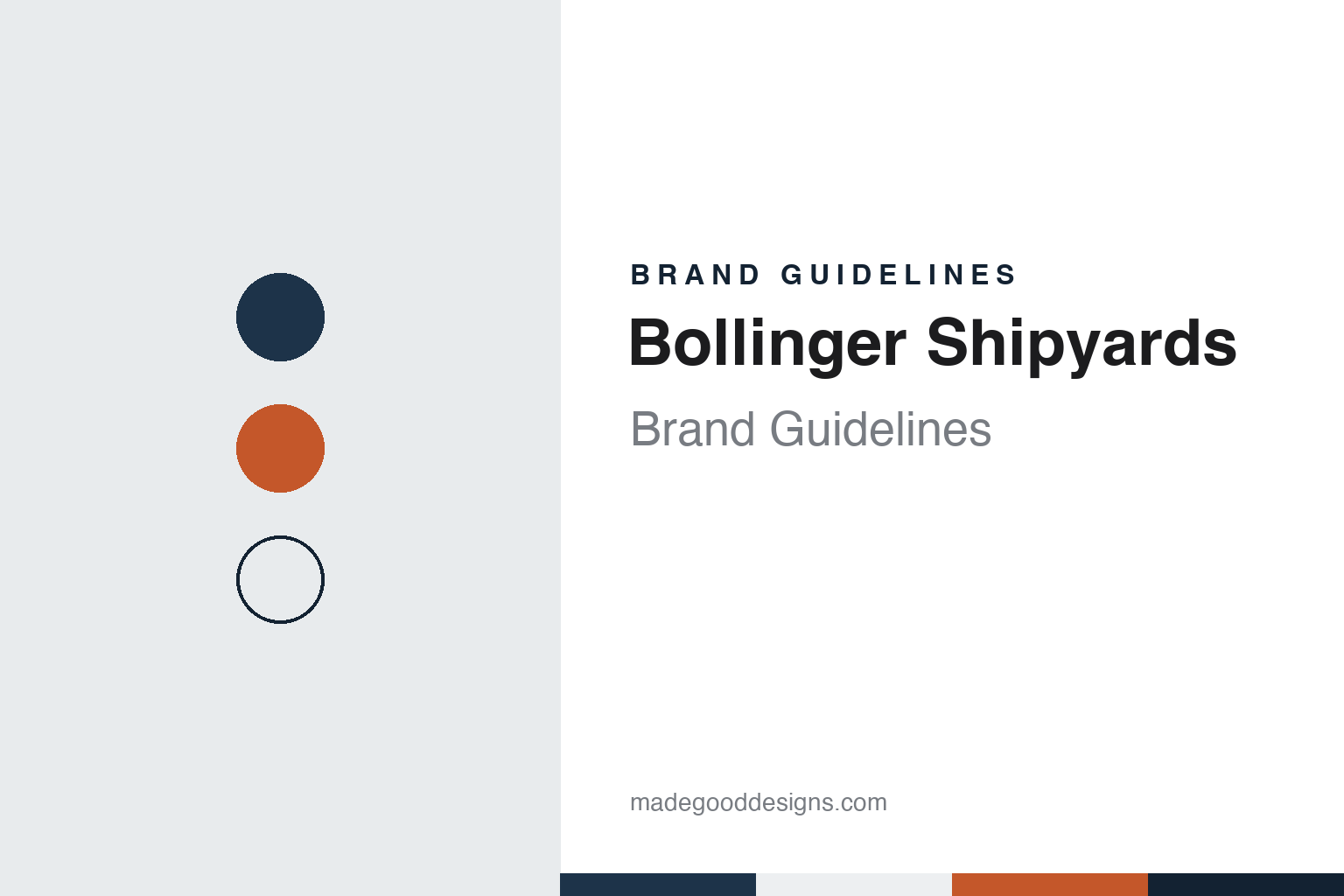
Two constants: a cutter navy, signal orange and dock grey palette and a workboat sans register. Abstract homage — not a Bollinger Shipyards product or mark; no vessel, logo or nameplate is reproduced.
Lockport, 1946
A family shipyard on the Louisiana bayou.
Bollinger Shipyards is a shipbuilding and ship-repair company based in Lockport, Louisiana. The trade magazine WorkBoat reported in December 2014 that Donald G. Bollinger founded the company there in 1946 and served as its chairman until 1985, when his son, known as Boysie, took over. English Wikipedia describes Bollinger as an American builder of ships, workboats and patrol vessels whose thirteen shipyards and forty drydocks are in Louisiana and Texas, handling vessels from 100 tons up to 22,000 tons displacement.
Much of its work has been for the Gulf of Mexico’s offshore and inland trades. In 2014 WorkBoat listed offshore supply vessels, oceangoing barges, tugs, rigs, liftboats and inland pushboats and barges among the company’s products, alongside fast military patrol boats and other vessels in steel and aluminium. The magazine counted ten Bollinger shipyards between New Orleans and Houston at that time and described the company as the largest vessel-repair business in the Gulf, with 30 drydocks.
The company changed hands in December 2014. Bollinger said in a statement that Ben Bordelon, a grandson of the founder, and Edison Chouest Offshore of Galliano, Louisiana, had acquired all of its assets and stock, WorkBoat reported; the terms were not disclosed. Bordelon, who had sat on the board since 2002 and had been chief operating officer, became chairman, president and chief executive. Edison Chouest, founded in 1960, operated a fleet of more than 200 vessels and its own shipyards in the US Gulf and in Brazil, the magazine said.
Colour
Cutters for the Coast Guard.
Bollinger has built many vessels for the US government. English Wikipedia says the company built 49 110-foot Island-class patrol boats for the US Coast Guard, which gCaptain dates to between 1982 and 1992, and more than 70 87-foot Marine Protector-class cutters, including a few for other countries. For the US Navy it built 14 Cyclone-class patrol ships between 1993 and 2000, English Wikipedia says.
From 2008 the company also built the Coast Guard’s Sentinel-class fast response cutters, 154-foot patrol boats designed to replace older cutters, including the Island class it had built itself. In 2008 the Coast Guard awarded Bollinger the contract for the lead ship, the Bernard C. Webber, and by November 2014 the company had delivered the eleventh, WorkBoat reported; English Wikipedia says a further contract in May 2016 brought the number on order to 58. Bollinger also builds auxiliary personnel lighters, the berthing and messing barges the US Navy uses to house crews while ships are in port: it delivered APL 70 and APL 71 in 2022 and 2023 and won a contract for APL 73 in October 2024, Naval Today reported. In April 2021, English Wikipedia says, it took over the contract for seven Navajo-class rescue and salvage ships from Gulf Island Fabrication, together with that company’s shipyard in Houma, Louisiana.
One Coast Guard contract ended in court. In 2002 Bollinger was hired to lengthen the Island-class boats to 123 feet; after the first eight were converted, hull problems led the Coast Guard to decommission them in 2007 and cancel the programme, gCaptain reported. The US government filed a False Claims Act suit against the company in August 2011, according to English Wikipedia, and Bollinger agreed to settle it in December 2015, gCaptain reported.
Typography
Design and documentation.
Shipbuilders present themselves to a small number of very large customers: navies, coast guards, shipowners and energy companies. Their identities therefore lean on a short, sturdy wordmark, often a set of initials or a group name, set in navy, blue or red against white, and repeated on yard gates, crane girders, hard hats and the hulls of ships still on the slipway. Many yards sit inside wider industrial groups, so the mark on the crane is frequently the parent’s symbol rather than the yard’s own.
The photography does most of the work. Launch ceremonies, float-outs and naming days, sea trials with a bow wave, aerial views of a dry dock with a goliath crane spanning it: these are the standard images on yard websites and in annual reports. Scale is the message, and a single picture of a hull in dock is usually given more room than any slogan.
Ships are named by type and class, in the words the yards themselves use: LNG carriers, container ships, tankers and bulk carriers, ferries and research vessels, and, for naval yards, patrol vessels, frigates, corvettes and submarines described by programme or class name. Specification panels with length, beam, deadweight and capacity in containers or cubic metres stand in for product shots, and order books are reported ship by ship.
Most shipbuilder websites follow a similar plan: a history page told as a timeline of yards, mergers and renamings; sections for new builds, repair and conversion, and offshore work; a page on facilities, docks and cranes; and, for listed and state-owned yards, investor pages with annual reports. For a designer, the sector shows how an identity can be built from places, dates and ship classes rather than from consumer advertising.
Aa
A sturdy workboat sans for a Gulf Coast yard. (Specimen set in Archivo, a sans STAND-IN; NOT the Bollinger Shipyards logo.)
Bollinger Shipyards
From patrol boats to icebreakers.
Bollinger is also building icebreakers. The Coast Guard’s heavy Polar Security Cutter was first awarded to VT Halter Marine; Bollinger then bought VT Halter, including that contract, English Wikipedia says. In January 2026 nola.com reported that the Polar Security Cutters are being built at Bollinger’s shipyard in Pascagoula, Mississippi, and that in March 2025 the company had won a Coast Guard contract for the first heavy polar icebreaker built in the US in nearly fifty years.
A second icebreaker programme followed. In a statement on 29 December 2025, Bollinger said it had finalised a contract with the US Department of Homeland Security for four Arctic Security Cutters to be built at its Houma shipyard, nola.com reported. The ships are part of a partnership between the US, Canada and Finland, are designed mostly by Seaspan Shipyards of Canada as a variant of an icebreaker being built for the Canadian Coast Guard, and are to be built from a thick, high-strength steel. Company officials told the newspaper that Bollinger had built 187 cutters for the Coast Guard over the previous forty years.
The Bollinger name has stayed on the company through these changes. Ben Bordelon, the founder’s grandson, was quoted as its president and chief executive in the nola.com report of January 2026, and the yards named in these reports run from Lockport and Houma in Louisiana to Pascagoula in Mississippi.
For a design guide, Bollinger Shipyards shows how a family name can stay on a yard through a change of ownership and a move from workboats to icebreakers. Compare Austal, another builder of patrol vessels for government fleets, and Davie, a shipyard also building icebreakers. For this guide we use a cutter navy, a signal orange and a dock grey with a sans, an unofficial interpretation; no product or logo is reproduced.
Explore & save
Keep Bollinger Shipyards’s identity on hand — save it to a board in the Made Good inspiration library.
Bollinger Shipyards identity set
Pin the Bollinger Shipyards cutter navy, signal orange and dock grey palette and the workboat sans register to your own board.