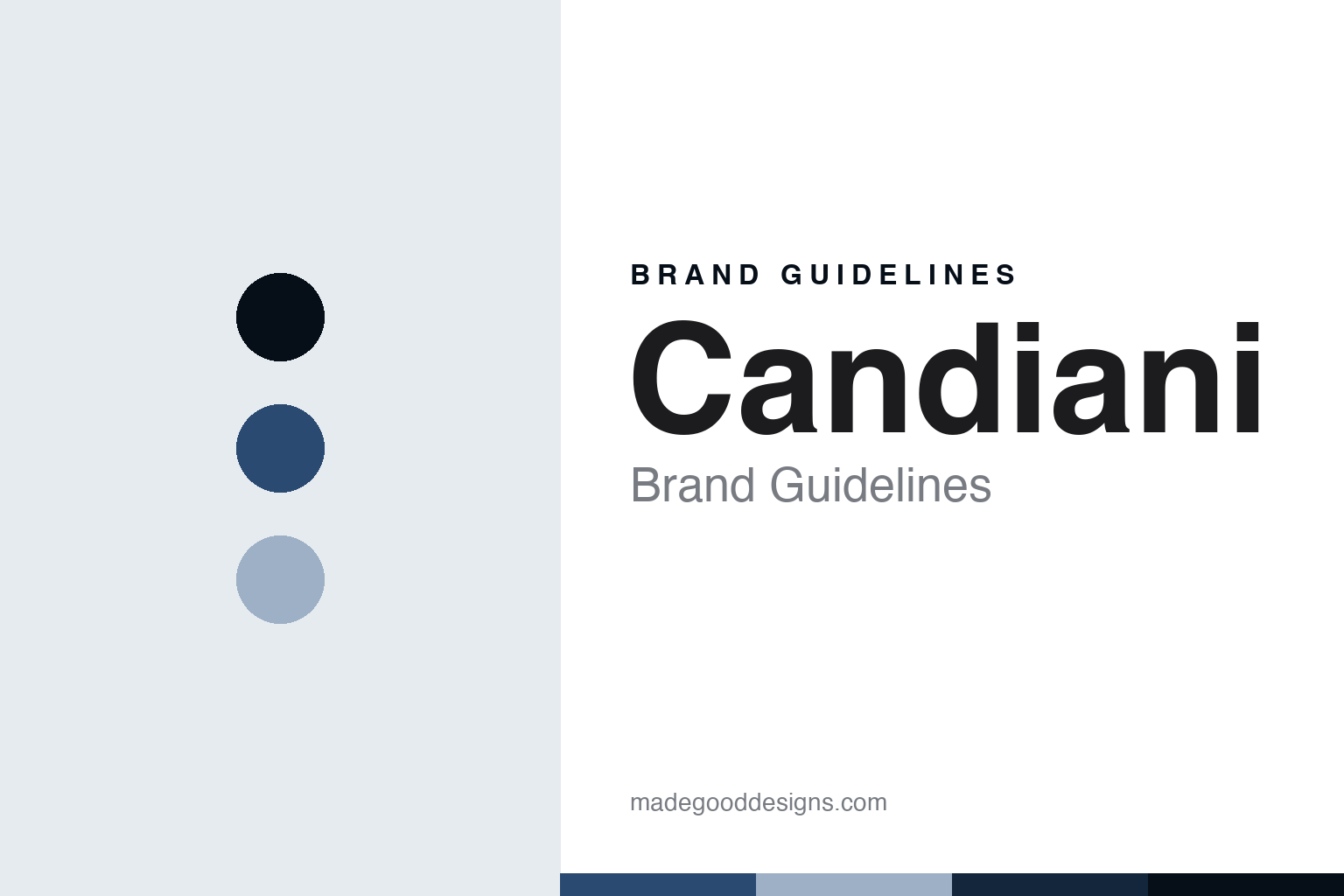
Candiani Brand Guidelines
The Milan denim mill.
Aa
Two constants: an indigo palette and a sustainable-sans register. Abstract homage — not a Candiani fabric, loom or Coreva mark.
The Milan denim mill
Candiani is the four-generation Italian denim mill in Robecchetto near Milan, weaving its fabric in Lombardy and known for Coreva, its plant-based compostable stretch denim.
Candiani opens this round on the other side of the seam — not a jeans brand, but the mill that weaves the cloth. From Robecchetto con Induno, in Lombardy near Milan, Candiani makes denim fabric and supplies it to the world’s premium jeans brands. Its answer to how a mill becomes a name is craft and conscience: weave fine denim in Italy for four generations, and lead the industry’s move to cleaner materials. A denim mill, in the Ticino valley.
Its identity is the Milan denim mill. Candiani’s Italian-woven denim, and its Coreva compostable stretch fabric, are the work it is known for. A cloth, not a jean. A mill behind the labels.
(Honest notes, so the story stays precise. Candiani is a denim fabric mill — Candiani S.p.A. — in Robecchetto con Induno, in the Ticino river valley of Lombardy, and it describes itself as a four-generation, family-held house of over eighty-five years (its founding is widely reported as 1938, which we present lightly); we name no specific family member’s job title beyond noting the fourth generation now leads it. On where it is made — for a mill, this is the whole story — Candiani genuinely weaves its denim in Italy, in Robecchetto, which is the honest, clean core of its identity. Its signature innovation is Coreva, which it markets as the world’s first compostable, plant-based stretch denim, replacing synthetic elastane; along with its “gold standard” and “most sustainable” language, we present these as the mill’s own claims rather than independent fact. It runs a made-to-measure concept and a Milan retail corner, and it supplies premium brands, which we keep general and name none of. Its name and the Coreva mark are IP, described but never reproduced, and there is no official brand hex; these tones are an unofficial interpretation. This is design commentary and does not promote any product.)
Colour
Candiani lives in an indigo palette. Click a swatch to copy the hex.
Candiani’s identity is refined, Italian and conscientious — an indigo, an ink, a sky, a midnight, and a paper. The palette leans indigo and sky: the register of woven Italian denim and a Lombardy mill. It signals craft and conscience over noise. The honest caveat: with no published brand hex, these values are an original, unofficial interpretation, not first-party colours.
The lesson is an indigo palette signals a refined, made-in-Italy mill identity. Candiani’s world is a refined, woven, Italian object. For designers, it is a reminder that a deep indigo and a soft sky can carry a mill built on cloth — the blue of the dye range and the neutral of a warp beam. Because these tones can fail as small text, keep type dark and let the colour live in the accents, palette and band. The takeaways: weave at home; lead on materials; frame the green claims as your own; and treat any single hex as unofficial.
Typography
The register is a sustainable sans — refined, modern, considered.
Candiani’s identity carries a refined, modern, considered spirit — a mill with a conscience, not a jeans label. A sustainable sans captures the mood: even, clean and forward, the register of a mill that leads on materials. Set in an indigo palette, the sustainable sans feels refined and modern — exactly the personality Candiani carries. It is a weaving hall with a lab rather than a shopfront, mirroring a bolt of Italian denim. (Candiani’s real logo and the Coreva mark are things we describe but do not reproduce, and the exact typeface is not ours to use.) Because it is not ours to use, the honest description is “a sustainable-sans spirit,” shown here in a stand-in. The type behaves like the mill: refined, modern and considered.
Aa
A sustainable-sans spirit — refined and modern. (Specimen set in Space Grotesk, a sustainable-sans STAND-IN; NOT the Candiani logo or the Coreva mark.)
The denim mills
Candiani stands for the mill that weaves the cloth behind the jeans.
Candiani opens the round with the point the whole vein turns on: the mill is where a jean is really born. An indigo palette, a sustainable sans and a bolt of Italian denim make one thing — the Milan denim mill — the whole identity: refined, Italian and conscientious. The made-in-Italy weaving is the differentiator, and the Coreva innovation is the meaning. The point is that behind the makers of the last round stood mills like this — Candiani is, in fact, the loom behind several of them — and the cloth’s own origin is a story worth telling on its own.
Put to work, the identity is a mill, honestly told, as design. A mill in this spirit would weave at home, lead on materials, and be candid about its claims — an Italian house, four generations, a compostable-denim innovation it markets as a first. A brand learning from it would see that being the cloth behind the label is a real identity — that a mill weaving in Lombardy for four generations carries an authority a fabric trader cannot — and that being precise, a Robecchetto mill, Italian-woven, with sustainability language presented as its own claim, keeps the story honest. Candiani makes the round’s opening argument explicit: the raw-denim makers of the previous round each answered where their jeans were sewn, but the cloth came from somewhere too, and here is one of those somewheres, named and located. There is a discipline in the green claims, too: framing “most sustainable” and “gold standard” as the mill’s own words, and Coreva as its marketed first, keeps the account credible while still crediting a genuine innovation. The lesson Candiani teaches is that a mill can hold an identity: the Italian weaving gives it authority, and the honesty about its claims keeps it credible. The cloth is the personality, and the Italian-woven denim is the proof.
For designers and brand-builders, Candiani opens the denim mills, from Italy: weave at home, and lead on materials honestly. The lessons: own the weaving; innovate on the cloth; frame green claims as your own; keep client brands unnamed; and never reproduce a logo, loom or Coreva mark. It is also a reminder to stay precise: Candiani is the four-generation Italian denim mill in Robecchetto near Milan, weaving its fabric in Lombardy and known for Coreva, its plant-based compostable stretch denim — with the palette here an unofficial interpretation. Candiani made the mill the identity — proof that the cloth behind the jean can be the difference.
Explore & save
Keep Candiani’s identity on hand — save it to a board in the Made Good inspiration library.
Candiani identity set
Pin the indigo palette and the sustainable-sans register to your own board.