Carlo Bugatti made furniture that looks like architecture shrunk to room size: towers on a cabinet, arches cut through a table frame, chair legs that sweep down like struts. The surfaces are stretched vellum, ebonised wood, hammered copper and threads of inlaid metal. For product designers, interior designers and brand designers who work with ornament, Carlo Bugatti shows how far decoration can be pushed before it collapses, and what keeps it standing.
His furniture and silver of the 1890s and 1900s are public domain in the US, and the Cleveland Museum of Art and the Art Institute of Chicago release their scans of several pieces as CC0 or public domain. More decorative-arts references sit in the MGD museum inspiration collection.
Who was Carlo Bugatti?
Bugatti was born in Milan in 1856, according to the Encyclopaedia Universalis, the Vitra Design Museum and the auction house Sworders; Vitra and Sworders both give the date as 16 February. Universalis, Vitra and Sworders all record that he studied at the Brera Academy in Milan and then at the École des Beaux-Arts in Paris.
The Vitra Design Museum dates his first furniture to about 1880, including a bedroom suite for his sister’s marriage to the painter Giovanni Segantini. Vitra and Sworders both record that he showed work at the Italian Exhibition in London in 1888. Universalis and Vitra both note a silver medal at the 1900 Paris Exposition Universelle.
In 1904 he sold his Milan business and moved to Paris, according to Vitra and Sworders. In Paris, Vitra and Sworders both name the department store Au Bon Marché among his clients. Both also record that the art dealer and founder Adrien-Aurélien Hébrard showed his silverwork in 1907.
From 1910 he lived at Pierrefonds, north-east of Paris, according to Vitra and Sworders, and both record that he served as its mayor during the First World War. He later moved to Molsheim in Alsace, where his son Ettore ran the car factory: Universalis gives 1937, while Vitra gives 1935 or 1937. He died at Molsheim in April 1940, according to Vitra and Sworders. His younger son Rembrandt became an animal sculptor; our Rembrandt Bugatti guide covers his bronzes.
Key works by Carlo Bugatti
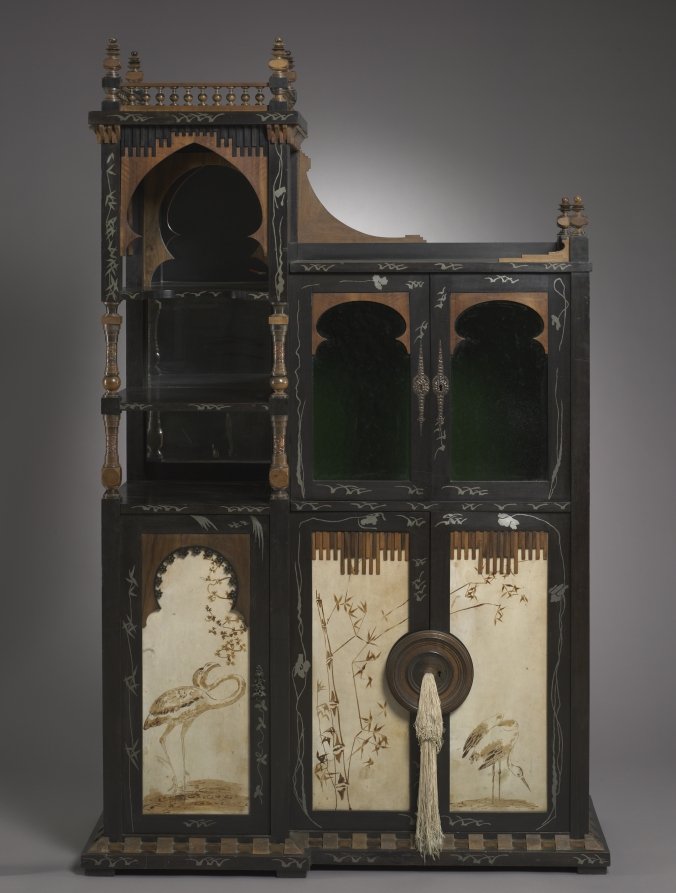
Cabinet, about 1895
The Cleveland Museum of Art dates this cabinet to about 1895 and lists it as wood with metal inlays and painted parchment, with glass doors and a mirror, standing 224.5 centimetres high. One side rises into a tower with turned finials and a little gallery; the other steps down. Horseshoe arches frame the glass and the painted panels, which show wading birds and bamboo in sepia on pale vellum. A large tassel hangs from a turned wooden disc at the centre.
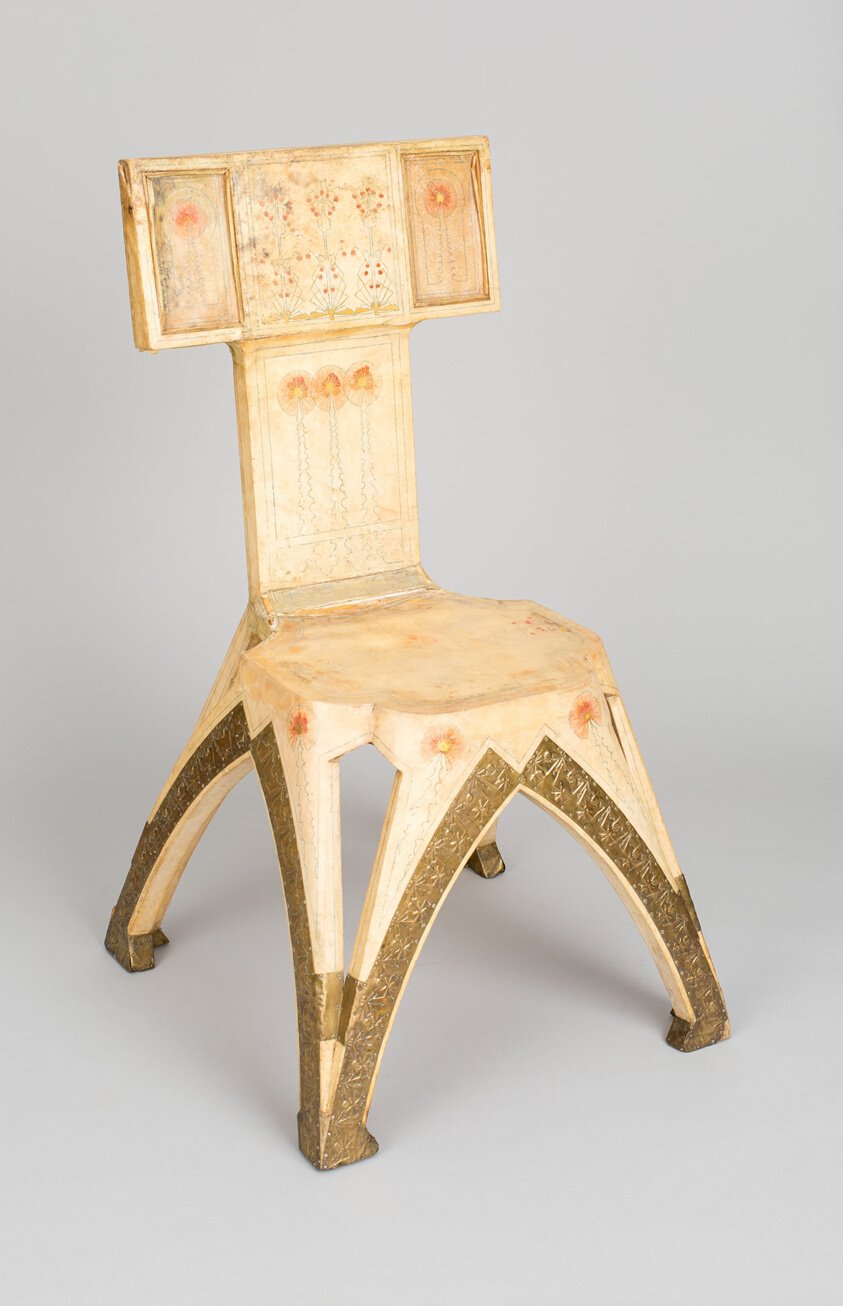
Eiffel Tower Chair, 1902
The Art Institute of Chicago dates this chair to 1902 and describes it as a wood frame covered with parchment, painted and gilded, with applied brass mounts; it is 88.3 centimetres high. Four legs splay out and meet under the seat in pointed arches, a tapering, tower-like stance. The frame disappears under vellum, with a few painted flower discs on long stems.
The Snail Room, Turin, 1902
At the First International Exhibition of Modern Decorative Arts in Turin in 1902, Bugatti showed four interiors, according to the National Gallery of Victoria and Universalis. One, the Snail Room, took its forms from a snail shell. Vitra and Sworders both record that he received a diploma of honour at Turin. The National Gallery of Victoria, which holds one of the room’s chairs, describes it as having no legs: seat and back form one continuous curve of carved wood covered entirely in vellum to hide the joints, painted in red, green and gold with dragonflies and stylised flowers. Sotheby’s calls the same model the Cobra chair.
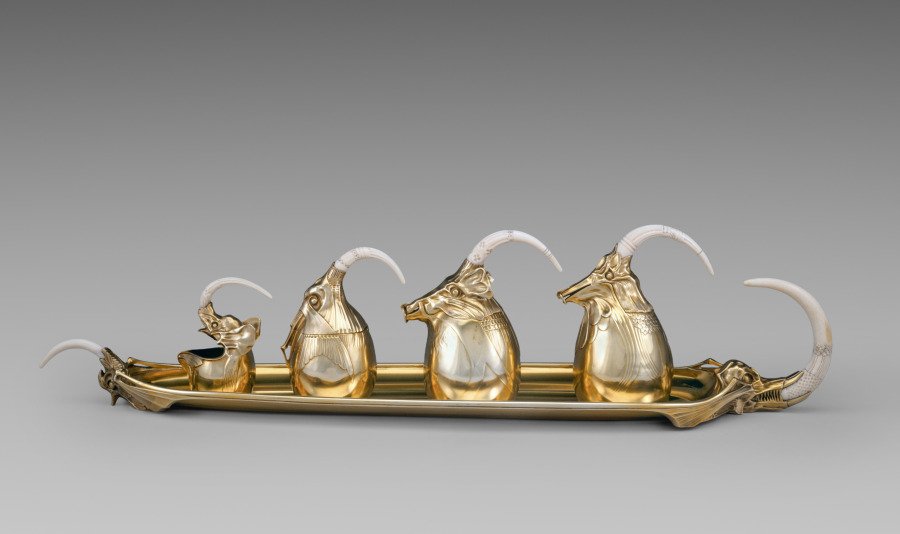
Tea and Coffee Service, about 1907
Cleveland lists this service in gilt silver and ivory, dated about 1907, with Hébrard credited alongside Bugatti. The pots sit in a row on a long, narrow tray, each one an egg-shaped body with an animal head for a spout and a curved ivory handle that reads like a horn. Cleveland notes that the set was probably bought at Bugatti’s 1907 Hébrard exhibition; Universalis says his silver drew on insect motifs.
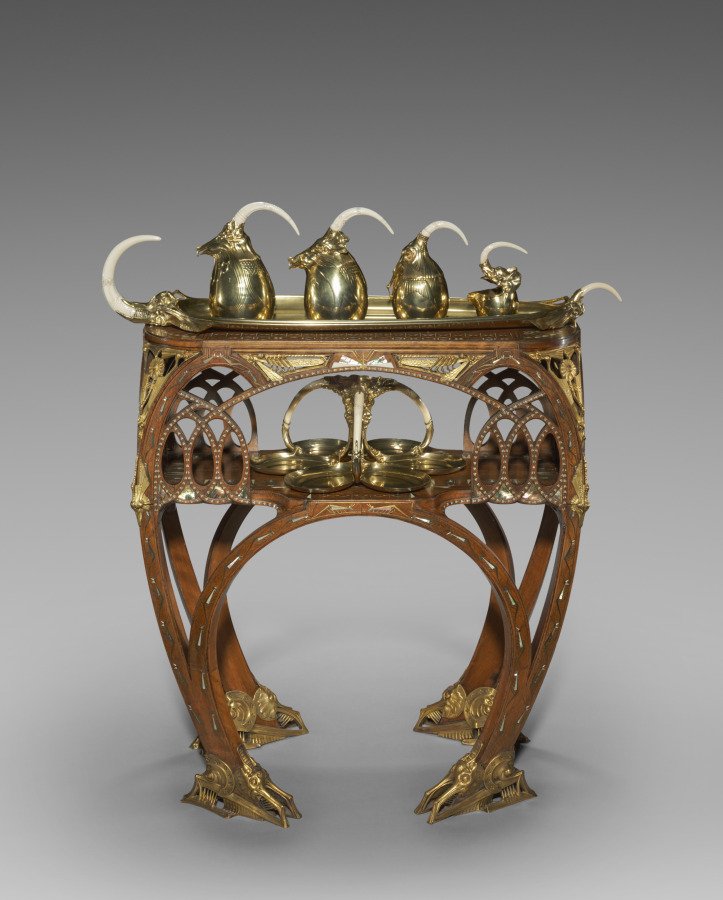
Tea Table, about 1907
Cleveland dates the matching table to about 1907 and lists inlaid wood (possibly mahogany), cast and gilded bronze mounts and inlays of ivory or bone, metal and mother-of-pearl, at 71.5 centimetres high. Four legs bow outward into arches, and the frieze is cut into rows of interlocking openwork loops. Cleveland records the signature “Bugatti” in ligature, inlaid in white metal on the central shelf.
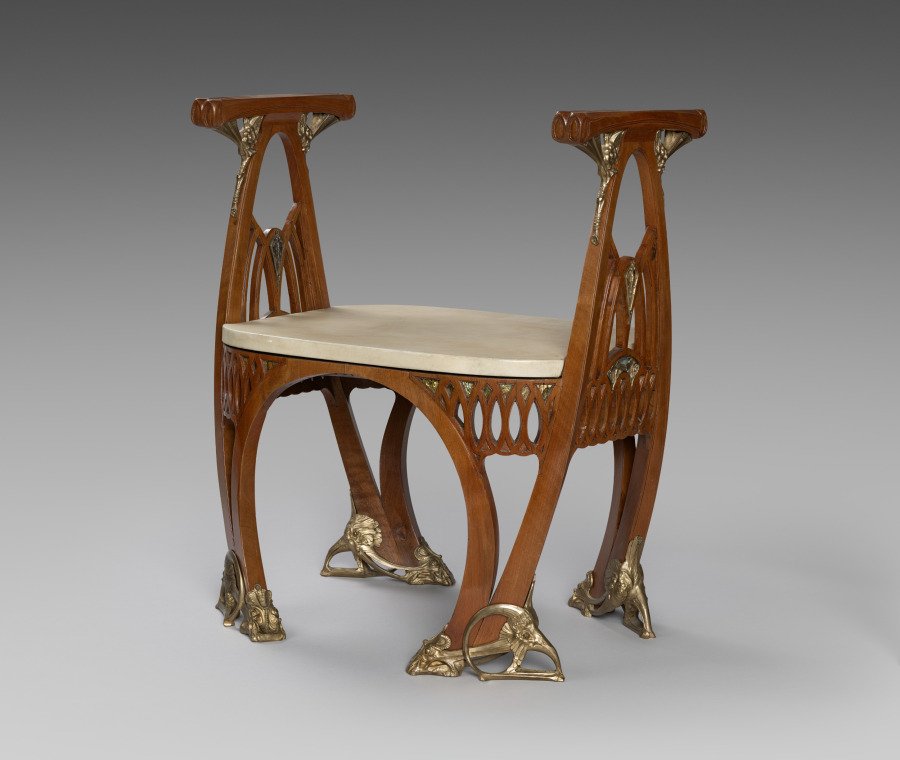
Tabouret, about 1907
Cleveland lists this stool in mahogany, parchment, gilt bronze and mother-of-pearl and assigns it to Bugatti’s Paris period, about 1907, because its forms and mounts match the tea table.
Technique: vellum, inlay and metal mounts
Sworders describes his early furniture as heavy ebonised wood inlaid with copper, brass, ivory and mother-of-pearl, and Universalis lists wood inlaid with metal, small columns and heavy tassels and fringes. The National Gallery of Victoria describes a shift from the 1880s and 1890s, when the work was densely ornamented with inlaid metal, to a curvilinear, solid manner in which vellum covered everything, painted geometric designs replaced inlay and circles replaced arches. The same essay says the dragonfly became his signature motif from around 1895.
Sotheby’s calls parchment his favourite material and says the Cobra chairs were painted by hand in Indian ink, which explains why surviving examples differ. Universalis and Sotheby’s both describe his sources as Moorish and Eastern. Cleveland’s record of the 1895 cabinet points to both Islamic and Japanese influences.
What to look at: silhouette, arch and palette
The silhouette carries the ornament. The cabinet is covered in detail, yet from across a room it reads as one stepped, asymmetric outline: a tower on the left, a lower block on the right. Dense detail survives inside a clear outer shape.
The horseshoe arch as a repeat unit. The same arch appears in the cabinet’s doors, its painted panels and its shelves, at different sizes. On the chair it becomes the space between the legs. One shape, scaled and repeated, ties the object together.
Contrast of skin and line. Pale vellum with fine, sparse painting sits against black wood edged with hairlines of metal.
The signature as ornament. The “Bugatti” ligature on the tea table is inlaid like any other line of decoration, so the maker’s mark belongs to the pattern rather than sitting on top of it.
A two-tone palette. Measured from the museums’ scans with a PIL quantize, the cabinet’s ebonised wood reads around #272521 and #42392E, its vellum panels around #BAAD93 and #A89E84, and the sepia painting about #4C3F2F. The Chicago chair’s vellum measures near #FDE8C3 and #FAE2B9, with flower discs around #F4AE6E and brass mounts near #9A7743; the tea table’s wood reads about #5C3D23. These are the colours of the photographs, not a record of original finishes. Build your own set with the colour palette generator.
How designers can borrow from Carlo Bugatti
- Pick one ornamental shape and scale it. A single arch, loop or circle repeated at three sizes gives a brand pattern or product family a consistent voice.
- Wrap the structure. His vellum hides every joint. In packaging and product design, a single wrap material can turn many parts into one calm object.
- Pair a pale field with a dark frame. Cream panels inside black borders work for editorial layouts, labels and menus.
- Design the maker’s mark into the pattern. Treat a monogram as one more line in the ornament.
For the wider movement around him, read our Art Nouveau graphic design guide, and browse the ornament theme for related pieces.
Where to see Carlo Bugatti’s work
The Cleveland Museum of Art holds the cabinet, the tea table, the tabouret and the tea and coffee service with its salver, and showed Bugatti in an exhibition titled Bugatti, according to its records. The Art Institute of Chicago holds the Eiffel Tower Chair along with other furniture by him, and the National Gallery of Victoria in Melbourne holds a chair from the Snail Room.
Frequently asked questions
What is Carlo Bugatti known for?
He is known for furniture covered in painted vellum and inlaid with metal, often with horseshoe arches and tassels, and for the Snail Room he showed at Turin in 1902.
Was Carlo Bugatti related to the Bugatti car company?
Yes. He was the father of Ettore Bugatti, who ran the car factory at Molsheim, and of the sculptor Rembrandt Bugatti. Carlo moved to Molsheim late in life and died there in 1940.
What materials did Carlo Bugatti use?
Museum records list walnut, mahogany and ebonised wood, vellum or parchment, copper, brass, pewter, ivory or bone and mother-of-pearl, with cast and gilded bronze mounts. His silverwork used gilt silver and ivory.
Are Carlo Bugatti’s designs in the public domain?
His furniture and silver of the 1890s and 1900s are public domain in the US. The Cleveland Museum of Art releases its images of his work under CC0, and the Art Institute of Chicago marks its scan of the Eiffel Tower Chair as public domain; other collections’ photographs may carry their own terms.