Charles Webster Hawthorne taught a generation of painters to squint. He placed his models on a bright Provincetown beach, so that a face against sky and water read as a single patch of colour, and he asked students to get that patch right before they thought about eyes or noses. His own canvases, mostly fishermen, their families and their catch, keep that discipline: large dark shapes, a few warm notes and a clear light. For anyone who designs with colour blocks, Charles Webster Hawthorne is a lesson in seeing the whole before the parts.
One of his paintings is flagged CC0 in the museum databases this collection draws on; other works are described in text. For more public-domain art you can download and study, browse the MGD museum inspiration collection.
Who was Charles Webster Hawthorne?
The Smithsonian American Art Museum (SAAM) records that he was born in 1872 in Lodi, Illinois, where his mother was visiting family, and that he grew up in Richmond, Maine. An essay by James R. Bakker, published by the Provincetown Art Association and Museum (PAAM) and the New Britain Museum of American Art, also places his childhood in Richmond, on the Kennebec River, and says his father was a sea captain and ice farmer.
SAAM says he began studying at the Art Students League in New York in 1890, taking night classes with George de Forest Brush and H. Siddons Mowbray and evening classes with Frank Vincent DuMond. Bakker’s essay names the same three teachers. Both sources then connect him with William Merritt Chase: SAAM says he enrolled in Chase’s summer school in 1896 and became his assistant, both in New York and at the Shinnecock summer school on Long Island, and that these were his last formal classes. SAAM and Bakker agree that he met his future wife, Ethel Marion Campbell, at Chase’s summer school; Bakker dates their marriage to 1903.
SAAM records that he painted on his own in Holland for a summer; Bakker dates the trip to 1898 and places it in the fishing village of Zandvoort.
In 1899 he went to Provincetown, at the tip of Cape Cod, and opened the Cape Cod School of Art. SAAM, the US Department of State’s Art in Embassies programme and Bakker all give that year; SAAM calls it the town’s first formal art school. A 1938 review in Time says he set up the school in an old sail loft and that, by the time he died, it drew about 125 students a summer. He died in 1930 in Baltimore, as SAAM and PAAM record.
Key works by Charles Webster Hawthorne
SAAM describes his subjects as New England types and the Portuguese fishermen of Provincetown, along with the local coast and dunes.
- The Fisher Boy, 1908. Bakker describes a young fisherman in oilskins holding a green glass demijohn, in a dark, almost monochrome palette, and notes that the square format was a favourite of Hawthorne’s.
- The Trousseau, 1910. The Met records this oil on canvas mounted on wood, 40 by 40 inches, bought through the George A. Hearn Fund in 1911. It is another square canvas. Bakker says it was painted on a trip to Bermuda and won the National Academy of Design’s Thomas B. Clarke Prize in 1911. The Met does not flag it public domain.
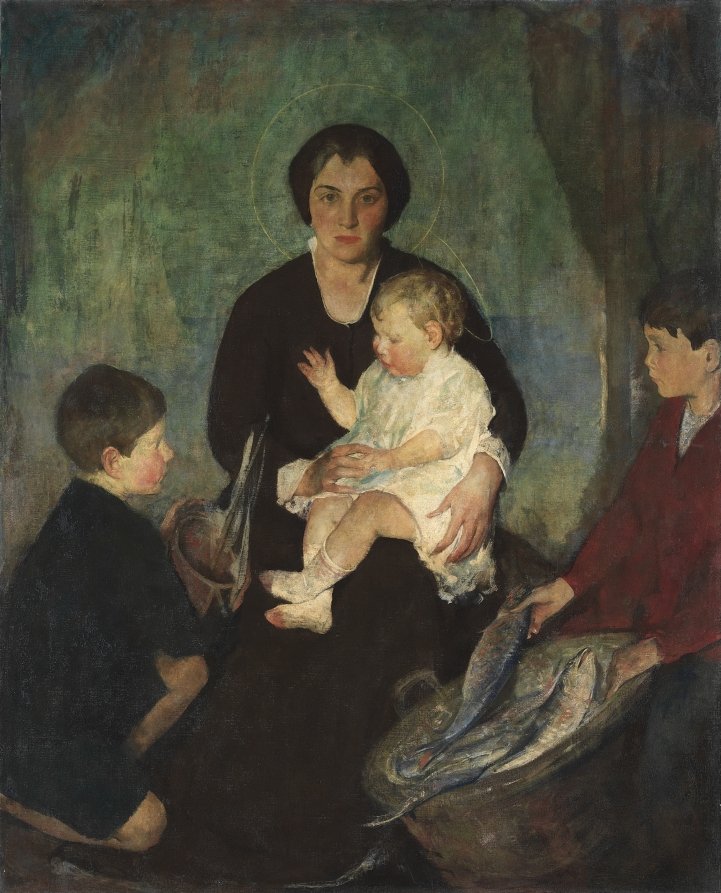
- The Offering, about 1915. The Cleveland Museum of Art dates this oil, about 153 by 122.5 centimetres, to about 1915 and says it was painted in Provincetown. Its record describes two boys offering a toy boat and fish to a modern Madonna and Child. Cleveland flags it CC0.
- The Crew of the Philomena Manta, 1915. Bakker names this group portrait of a fishing crew, owned by the town of Provincetown.
- Selectmen of Provincetown, about 1924. The Art Institute of Chicago records this oil on fabric mounted on pulp board; it is not flagged public domain.
What to look at in the paintings
Start with The Offering. The composition is a broad triangle: the mother’s black dress forms a dark pyramid in the centre, and the two boys close the base at left and right. Inside that dark mass sit the brightest shapes in the picture, the toddler’s white dress and pale skin, so the eye lands where the story is. A thin gold ring around the mother’s head is one of the few drawn lines; almost everything else is a patch of tone.
The mottled grey-green background stays within a narrow band of values, so the figures stand forward without hard outlines. The one strong warm colour, the red jumper on the right-hand boy, is placed at the edge and repeated faintly in the cheeks, so it ties the group together without pulling focus.
Bakker writes that portrait combined with a still life of fish recurs throughout Hawthorne’s career. Here the silvery fish echo the background green and balance the white of the child above.
Technique and teaching
Bakker’s essay describes his early canvases as tonal, with bold brushwork and dark brown or black backgrounds close to the Munich manner of Frank Duveneck. The State Department’s Art in Embassies text likewise notes the tonal influence of his teacher Chase on his early work, and contrasts the more structured surfaces of his oils with the loose washes of his watercolours.
His classroom method is the part designers can use most directly. Time’s 1938 review says he posed models on the beach so that sky and water reduced the head to a spot of colour, gave students large putty knives and squares of building board, and told them to concentrate on colour rather than drawing. Visitors called the results “mudheads,” featureless faces painted as a single patch, and Bakker’s essay records the same nickname. A 1916 Boston Globe article quoted by Bakker described his style as combining “the impressionism of pure color juxtaposition” with realism that avoided fussy detail.
After his death, students’ notes from his classes were gathered into a book, Hawthorne on Painting. Time reviewed it in 1938 and quoted lines such as “Painting is just getting one spot of color in relation to another spot of color” and “Go out like a savage, as if paint had just been invented.”
A palette measured from The Offering
These values are measured from the museum’s scan of this painting, not from the original pigments, using a twelve-colour quantisation of the Cleveland image:
- Near-black dress: #1A1613
- Olive umber shadow: #453D26
- Slate grey-green wall: #47595D
- Sage highlight: #7A8B78
- Rose flesh tone: #B16B52
- Brick red jumper: #823926
- Cream white dress: #DBCF9D
Most of the canvas sits in the first three values; the cream and brick red cover only a small part, which is why they read so clearly. Build your own variations in the colour palette generator, or sample other scans with the image colour picker.
How designers can borrow from Charles Webster Hawthorne
- Block in the spots first. Before type or icons, reduce a layout to five or six flat shapes and check their colours and values together.
- Squint test your hierarchy. Blur a draft and check that the key element is still the lightest or darkest spot.
- Put the light inside the dark. In The Offering the brightest shape sits inside the darkest mass. A pale card or product shot on a deep ground does the same job on a page.
- Use one warm accent, then echo it. The red jumper appears once at full strength and returns in small touches. A single brand colour used this way stays strong without shouting.
- Try the square. The Fisher Boy and The Trousseau are square; square posts and covers suit his centred groups.
Provincetown and the wider circle
Hawthorne’s lineage runs straight back to William Merritt Chase, whose summer school SAAM and Bakker both identify as his formative training. His outdoor method borrowed the bright light of Impressionism but kept the solid, dark figure of the older studio tradition. Bakker’s essay lists painters who studied with him in Provincetown, including R. H. Ives Gammell, Edwin Dickinson and Agnes Weinrich, and says he was a founder and vice president of the Provincetown Art Association in 1914.
Frequently asked questions
Who was Charles Webster Hawthorne?
He was an American portrait and genre painter, born in 1872 and raised in Maine, who trained in New York with William Merritt Chase and others. He opened the Cape Cod School of Art in Provincetown in 1899 and died in Baltimore in 1930.
What is a mudhead?
It was the nickname for the featureless heads his students painted as single spots of colour, according to Time’s 1938 review and James R. Bakker’s essay for PAAM. The exercise trained them to see colour and light before detail.
Where can I see his paintings?
The Metropolitan Museum of Art holds The Trousseau, the Cleveland Museum of Art holds The Offering, and the Art Institute of Chicago holds Selectmen of Provincetown.
Are his paintings public domain?
It depends on the museum record. The Cleveland Museum of Art flags The Offering as CC0, while the Met and the Art Institute of Chicago do not flag the works named here. Check each record before reusing an image.