Chicago Botanic Garden Brand Guidelines
A garden of islands on a former marsh north of Chicago.
Aa
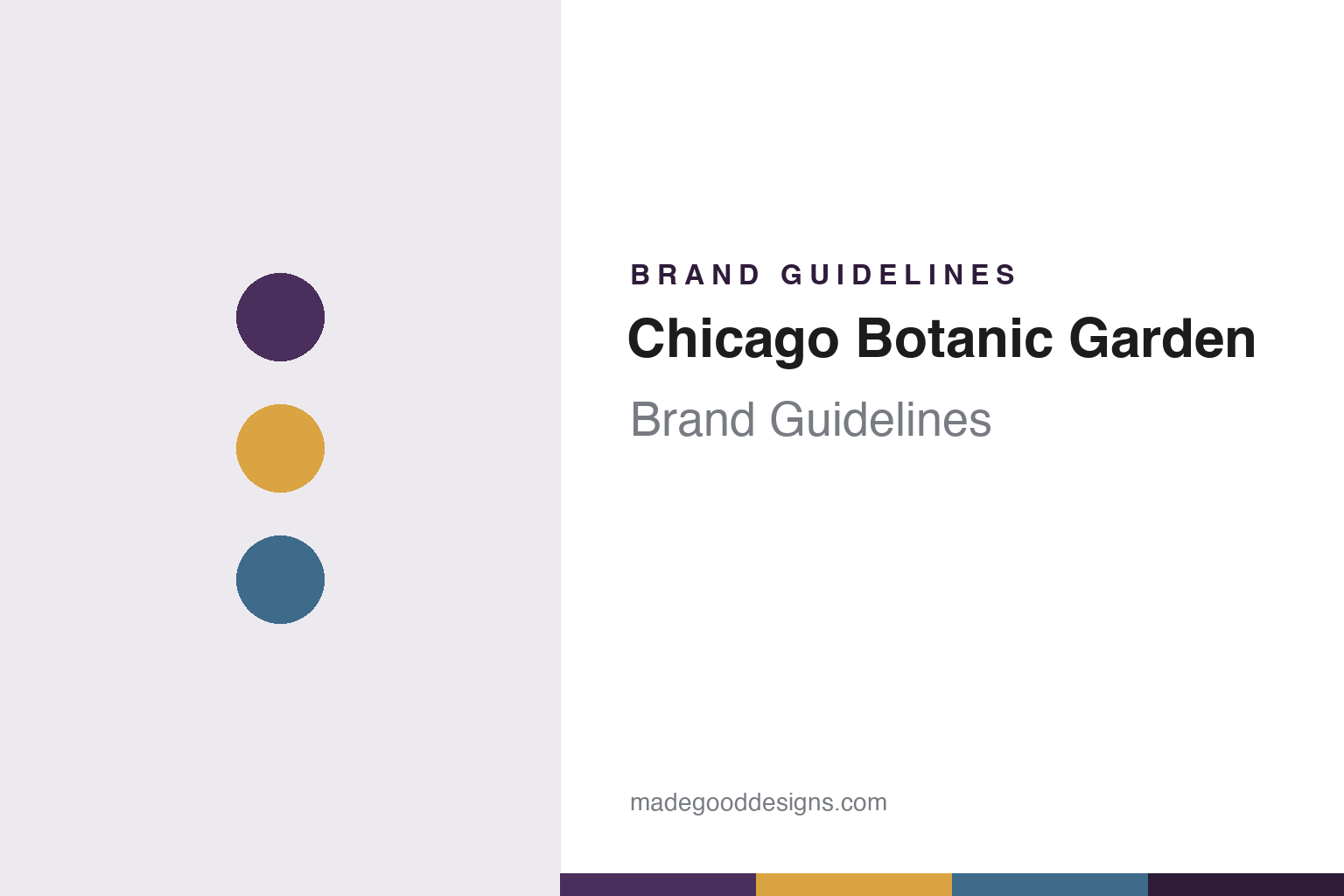
Two constants: a plum, prairie gold and lagoon blue palette and an open sans-serif register. Abstract homage — not a Chicago Botanic Garden mark; no logo, sign or photograph is reproduced.
A society builds a garden
A horticultural society, a forest preserve and a marsh.
The Chicago Botanic Garden is older on paper than on the ground. It traces its origins to the Chicago Horticultural Society, founded in 1890, which the garden says used the motto Urbs in Horto, “city in a garden,” and staged flower shows, among them a chrysanthemum show held with the World’s Columbian Exposition in October 1893. The garden says the society went quiet for a time and was restarted in 1943.
Its modern history began in the early 1960s. The garden says that in 1962 the society agreed to help create and manage a new public garden, working with the Forest Preserves of Cook County on the Skokie Marsh north of the city; The Cultural Landscape Foundation says some 300 acres of forest-preserve land were given over to the society in 1963. The landscape architects John O. Simonds and Geoffrey Rausch drew the master plan, which the American Planning Association dated to 1963 in a 2012 profile that also described the site as once degraded land affected by highway construction. Construction began in 1965, and the garden opened to the public in 1972.
The arrangement set then still holds. English Wikipedia and the garden both state that the Chicago Botanic Garden is owned by the Forest Preserve District of Cook County and operated by the Chicago Horticultural Society, a public–private partnership. The garden sits within the nominal boundaries of Glencoe, Illinois, about 20 miles north of Chicago, according to the APA profile, and covers 385 acres.
Colour
Nine islands, many gardens.
The Simonds and Rausch plan arranged the garden across nine islands set in lakes, which The Cultural Landscape Foundation says were to hold 24 display gardens and four natural habitats. The count has grown: Wikipedia gives 27 display gardens and five natural areas, and the garden itself now says 28 gardens and four natural areas. When it opened in spring 1972, the garden says, it had a small greenhouse, one garden area open to the public and about 30 staff.
Buildings and named gardens followed through the next two decades. The Education Center, now the Regenstein Center, is dated 1976 by the garden and 1977 by The Cultural Landscape Foundation. The Japanese garden, Sansho-En, was designed by Koichi Kawana in 1975 and dedicated in 1982, the garden says; it is now the Elizabeth Hubert Malott Japanese Garden. The garden dates its Regenstein Fruit & Vegetable Garden and Krasberg Rose Garden to 1985, and its English Walled Garden, by a British landscape designer, to 1991. In 1999, The Cultural Landscape Foundation records, the five-acre Evening Island was laid out in a New American Garden style drawing on Prairie-style planting. Formal landscapes, the Esplanade and Crescent, were added later, and Wikipedia dates the Esplanade to 2004.
The garden’s science work has its own building. The Daniel F. and Ada L. Rice Plant Conservation Science Center, designed by Booth Hansen, opened on 23 September 2009, Wikipedia says, with a planted roof garden. The garden says its seed bank, the Dixon National Tallgrass Prairie Seed Bank, now stores more than 100 million seeds of more than 1,800 native species, and Wikipedia records that the garden takes part in the Seeds of Success project, part of the Millennium Seed Bank Partnership managed by Kew. The garden says it started its Windy City Harvest urban agriculture program in 2003 and opened the Regenstein Learning Campus in 2016.
Typography
Gardens, glasshouses and names.
Botanic gardens tend to carry their place in their names. Many take a city, a state or a country, some carry a royal title, and some are better known locally by a founder’s name or a short form. Edinburgh’s garden received a royal warrant in 1699 and is called “the Botanics” in the city; St. Louis has long called the Missouri Botanical Garden “Shaw’s Garden”, after Henry Shaw, who created it. Initials such as RBGE stand in for a long formal name on websites and publications.
Glasshouses often act as the visual signature. Edinburgh’s Tropical Palm House dates from 1834 and its Temperate Palm House from 1858, and the pair reopened in October 2026 after five years of restoration; in St. Louis the Climatron, a geodesic dome opened in 1960, has given the garden a shape that its anniversaries are built around. Newer visitor buildings, such as Edinburgh’s John Hope Gateway, add a contemporary entrance alongside the historic houses.
The institutions behind the names differ. Some gardens are public bodies, as the Edinburgh garden is in Scotland; some are run by trusts and boards of trustees, as Shaw’s will arranged for St. Louis in 1889; others belong to cities, national institutes, horticultural societies or families. Many manage more than one site, from regional gardens to nature reserves, and heritage registers list several of their grounds and buildings.
Named seasonal events extend the identity beyond the gates. Illuminated winter trails such as Christmas at the Botanics in Edinburgh and Garden Glow in St. Louis carry the garden’s name into the evening, alongside festivals and concert series. This guide sets out what can be checked about each garden — when it was founded, who runs it, what it built and when — and marks clearly what rests on the garden’s own account.
Aa
An open sans-serif in the spirit of a refreshed, programme-wide identity. (Specimen set in DM Sans, a sans STAND-IN; NOT the Chicago Botanic Garden logo.)
Chicago Botanic Garden
A coneflower mark and three words.
The garden’s current identity dates from 14 March 2024, when it announced a new logo and tagline. In that release the garden described the logo as an abstract flower first inspired by the centre of a coneflower (Echinacea), with colours drawn from the garden that stand for its programmes, and gave the tagline as “Plants. People. Planet.” The release credited the work to The Scratch Collective, a firm in the Chicago area, and said the refresh ties the main campus to its science, learning and urban agriculture programmes — the Negaunee Institute, Regenstein School and Windy City Harvest — while letting each keep its own name. A later history page on the garden’s site dates the new logo to 2023.
Lightscape, an illuminated after-dark trail, made its U.S. debut at the garden on 22 November 2019, CBS Chicago reported the day before, and the garden has staged it in later winters as a holiday event; its events pages also list a Night of 1,000 Jack-o’-Lanterns in the autumn. In 2012 the APA profile put attendance at nearly a million visitors a year and counted 2.5 million plants on the site.
The garden’s place names are part of its vocabulary. Wikipedia lists its natural areas as Mary Mix McDonald Woods, the Barbara Brown Nature Reserve, Dixon Prairie, the Skokie River Corridor and the Lakes and Shorelines; The Cultural Landscape Foundation describes McDonald Woods as about 100 acres and Dixon Prairie as 15 acres holding six prairie ecosystems. The garden is accredited by the American Alliance of Museums and is a member of the American Public Gardens Association, Wikipedia says.
For a design guide, the Chicago Botanic Garden shows how an institution with several programmes can bring them under one mark and a three-word line while keeping each name visible. Compare the Missouri Botanical Garden in St. Louis and Kew Gardens, whose Millennium Seed Bank Partnership the garden works within. For this guide we use a deep plum, a prairie gold and a lagoon blue with a sans-serif, an unofficial interpretation; no product or logo is reproduced.
Explore & save
Keep Chicago Botanic Garden’s identity on hand — save it to a board in the Made Good inspiration library.
Chicago Botanic Garden identity set
Pin the Chicago Botanic Garden plum, prairie gold and lagoon blue palette and the open sans-serif register to your own board.
Source & notes
Frequently Asked Questions
What font can I use to match the Chicago Botanic Garden look?
This guide describes Chicago Botanic Garden’s type as “An open sans-serif in the spirit of a refreshed, programme-wide identity”. Its type specimen is set in DM Sans from Google Fonts as a stand-in; DM Sans is not Chicago Botanic Garden’s own lettering.
What colours are in the Chicago Botanic Garden palette?
This guide’s Chicago Botanic Garden palette is Coneflower plum #4A2E5C, Night prairie #2E1C3A, Prairie gold #D9A441, Lagoon blue #3E6B8A and Marsh mist #F2F1EC. The tones are the guide’s own unofficial interpretation, not official Chicago Botanic Garden hex codes.
When did Chicago Botanic Garden open?
Chicago Botanic Garden opened in 1972, in Glencoe, Illinois. Chicago Botanic Garden is known for Malott Japanese Garden, Evening Island, Lightscape.
Who owns Chicago Botanic Garden?
Chicago Botanic Garden is owned by Forest Preserve District of Cook County.