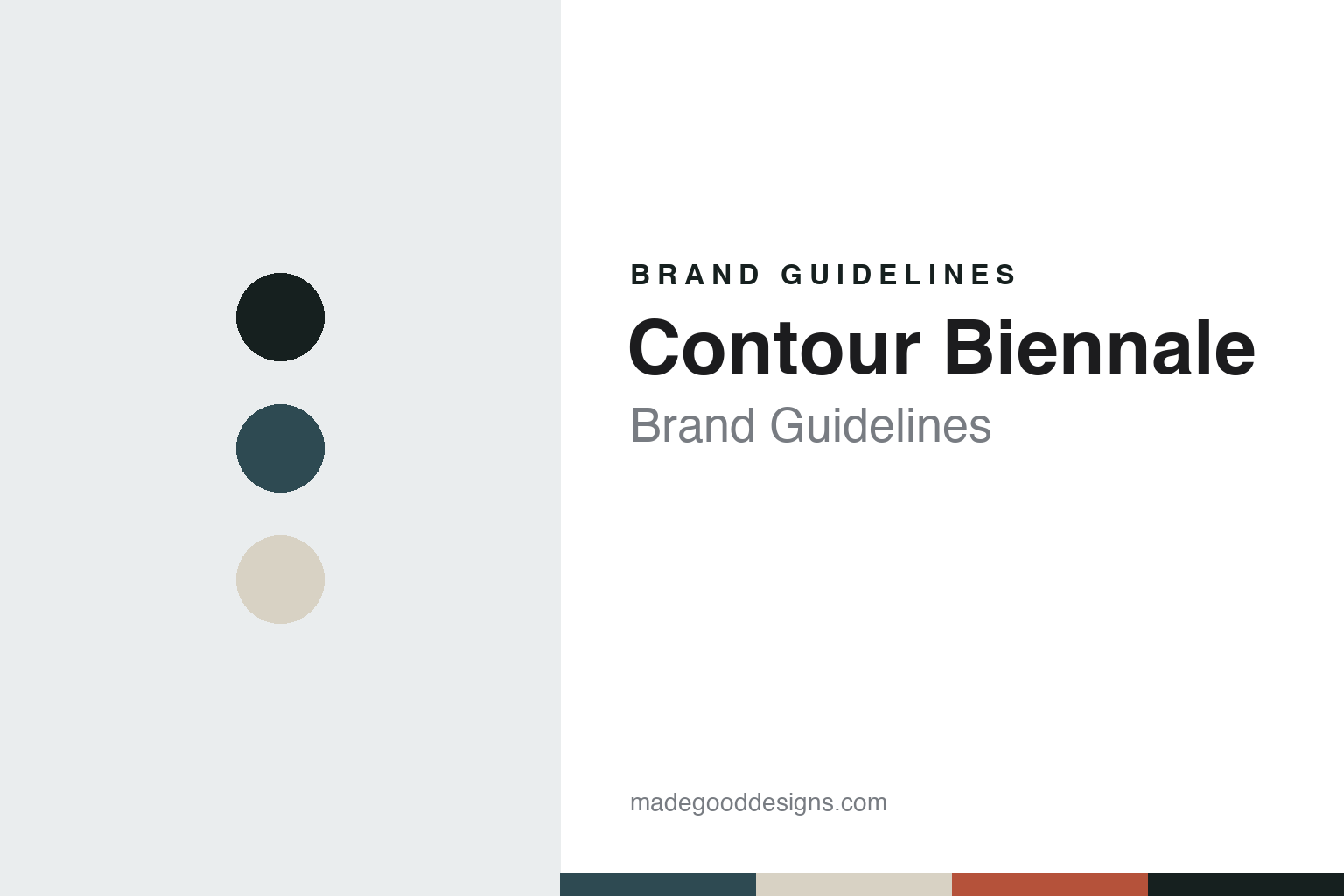
Contour Biennale Brand Guidelines
A walk through Mechelen, with a screen waiting in each old building.
Aa
Two constants: a Dyle slate and projector ember palette and a Projection sans register. Abstract homage — not a Contour Biennale asset; no logo, poster or edition graphic is reproduced.
A Walk Along Contemporary Moving Image
Fifteen artists, eight locations, one route.
The Contour Biennale began in 2003 in Mechelen, the Flemish city between Brussels and Antwerp. Dutch Wikipedia credits its founding to Etienne Van den Bergh, a former Flemish broadcast journalist who had turned to writing about contemporary art. He started the event and curated its first edition, titled “Contour – A Walk Along Contemporary Moving Image.” Fifteen artists showed work at eight locations in the historic centre of Mechelen, and the exhibition set video and moving-image art inside churches, historic buildings and other unusual sites, Dutch Wikipedia says.
That first title already described the format. Visitors followed a walking route through the city and found a screen, a projection or an installation in each building along the way. Dutch Wikipedia calls this original concept of a walk past moving images in varied historic locations the idea that shaped how the biennale developed afterwards. The founder stayed involved: around 2009 he was its chair, and he remains a member of the general assembly of the organisation that now runs it.
The magazine springerin reviewed the third edition in its fourth issue of 2007. “Contour 2007: Decoder” ran from 18 August to 21 October 2007, and the reviewer noted that Mechelen was hosting what was then called the Contour Video Art Biennial for the third time. The name fitted, the review said: the biennial took visitors on a route through the city, to places that had lost their original use, such as a chapel, an old hospital, a meat market and a supermarket, and to places charged precisely because of their use, such as a café, an underground car park and a bank. In that sense, the reviewer wrote, the biennial drew the contour of the city itself.
The British guest curator Nav Haq titled that edition “Decoder.” The springerin review followed works placed around the Grote Markt, a six-channel installation set in a court building and a five-channel installation spread across a room, and it quoted from the interviews printed in the catalogue.
Colour
Numbered editions, a new curator each time.
From the start, Contour counted its editions. The Biennial Foundation directory lists them as the biennale presents itself: the fourth edition in 2009, titled with a long phrase about memory and history, offered more than five hours of film; the fifth, in 2011, was titled “Sound and Vision: Beyond Reason” and linked music, the moving image and society. The sixth, Contour 2013, carried the title “Leisure, Discipline and Punishment” and used four venues in Mechelen: the prison, the KV Mechelen football stadium, the Church of Our Lady over the Dyle and the Hof van Busleyden museum, the directory says.
Around then the name of each edition changed shape. CONTOUR 7 ran from 29 August to 8 November 2015, according to the Lieven Gevaert Centre, a photography and image research centre of KU Leuven and UCLouvain. It took Thomas More as its starting point, since More wrote much of Utopia while in Flanders in the summer of 1515 and passed through Mechelen. More than twenty international artists showed work at several venues in the city, many of them new productions.
Contour Biennale 8, titled “Polyphonic Worlds: Justice as Medium,” ran from 11 March to 21 May 2017. Its films, videos, installations and performances were set against the four-hundred-year history of the Great Council, the court once based in Mechelen, the directory notes. In January 2017 the biennale had become part of kunstencentrum nona, the Mechelen arts centre, which produced the next editions.
Contour Biennale 9, “Coltan as Cotton,” changed the format. Instead of one continuous exhibition in several places, it became a long continuum: an introductory phase began on 25 October 2018, three long weekends formed its spine, and it closed in October 2019, the directory says, with more than fifty contributors and more than twenty new projects.
The tenth edition turned its number into the name. C0N10UR, with a zero in place of the O and the number ten set inside the word, ran from 9 September to 5 November 2023 under the title “We are rooted but we flow,” a phrase borrowed from a contemporary philosopher. The organisers’ announcement on e-flux said it was curated by Auguste Orts, a Brussels production and distribution platform led by artists, that it worked only with artists living in Belgium and had no overarching theme, and that it reached beyond Mechelen to argos in Brussels and Kunsthal Extra City in Antwerp. The same announcement credited the visual identity to Atelier Brenda.
Typography
A medium as the constant, a city as the frame.
Some biennials are defined less by a city or a theme than by a single commitment: one medium, one format or one host. A biennial of moving image, a photography meeting, an assembly or a summit, or an exhibition run by a museum each sets a rule that stays put while everything else changes. That rule becomes the steadiest part of the identity, more lasting than any poster, title or curator.
Numbering is the simplest tool these events use. An edition count turns a series of separate exhibitions into a sequence, and the way the number is written can carry character of its own: spelled out, set as a numeral, or folded into the name itself. A recurring host institution plays a similar role. When the same museum, arts centre or foundation stages every edition, its building and its name give visitors a fixed point to return to, even when the curatorial team is new each time.
Publications often outlast the exhibitions. Catalogues, readers, companion books and printed handouts record what each edition argued and who took part, and some events present them as part of the edition rather than as souvenirs. A consistent format for these books, or a deliberate change from one edition to the next, says as much about the event as its signage does.
Finding the work is the other half of the identity. A moving-image biennial needs screening schedules and running times; a programme spread over several weekends needs a clear calendar; an exhibition spread across a city needs a map and a route from one venue to the next. For a designer, these practical documents are where the event’s rule becomes visible: in how a timetable is set, how venues are numbered and how a visitor is led from one room to the next.
Aa
A plain projection sans — an edition number that keeps changing shape around one name. (Specimen set in Archivo, a sans STAND-IN; NOT the Contour Biennale logo.)
The Eyes of the Heart
Contour Biennale 11 and a new organisation.
After the 2023 edition, the biennale’s structure changed. According to its announcement on e-flux in August 2026, a group of Belgium-based curators, artists and cultural workers founded a new non-profit organisation to carry it on, with Kunsthal Mechelen as its main partner; Dutch Wikipedia names that organisation as Contouristen vzw, organiser since 2024. The announcement says the biennale is funded by the Flemish Community, supported by the City of Mechelen and is a member of the International Biennial Association.
Contour Biennale 11 ran from 5 September to 1 November 2026, curated by Sofia Lemos, under the title “The Eyes of the Heart and the Soul of the World.” The organisers described a parcours across five venues in Mechelen, including heritage and cultural sites, gardens and public spaces: Kunsthal Mechelen, the architecture office dmvA, TACK TICK, De Noker and the Stiltetuin, the quiet garden at the Archbishop’s Palace. Film, sound, sculpture and installation sat side by side, and the edition opened with a professional preview on 4 September before a public weekend of conversations.
The walk is still the format. Visitors move from one building to the next, and the organisers framed that movement as part of looking. One work was made to stay: a new permanent bronze by Rodrigo Hernández, two figures set in the Stiltetuin. A companion publication edited by Lemos, combining essay, image and story, was co-published and distributed by BOM DIA BOA TARDE BOA NOITE and released on the opening day.
For a design guide, Contour Biennale shows how a medium and a city can carry an identity: every edition is a route through Mechelen, while the number in its name keeps changing shape, from Contour 2007 to CONTOUR 7 to C0N10UR. Compare Manifesta, another European biennial built around its host city, and Bergen Assembly, which also rethinks the biennial format. For this guide we use a Dyle slate, a projector ember and a brick dust with a sans, an unofficial interpretation; no product or logo is reproduced.
Explore & save
Keep Contour Biennale’s identity on hand — save it to a board in the Made Good inspiration library.
Contour Biennale identity set
Pin the Contour Biennale Dyle slate and projector ember palette and the Projection sans register to your own board.
Source & notes
Frequently Asked Questions
What font can I use to match the Contour Biennale look?
This guide describes Contour Biennale’s type as “A plain projection sans — an edition number that keeps changing shape around one name”. Its type specimen is set in Archivo from Google Fonts as a stand-in; Archivo is not Contour Biennale’s own lettering.
What colours are in the Contour Biennale palette?
This guide’s Contour Biennale palette is Dyle slate #2E4A52, Ink #16201F, Projector ember #B5523A, Brick dust #D8D2C4 and Paper #F6F4EF. The tones are the guide’s own unofficial interpretation, not official Contour Biennale hex codes.
When was Contour Biennale founded?
Contour Biennale was founded in 2003, in Mechelen, Belgium.
Who founded Contour Biennale?
Contour Biennale was founded by Etienne Van den Bergh (curator of the first edition) in 2003.