DJI Power Brand Guidelines
The power station that charges its drones.
Aa
Two constants: a drone-graphite palette and an engineering-sans register. Abstract homage — not a DJI product or mark; no power station, drone or logo is reproduced.
The power station that charges its drones
DJI Power is the drone giant’s 2024 power-station line that turned its battery engineering into a station which fast-charges its own drones in the field.
DJI Power brings the power-station round its newcomer node — the drone giant applying its battery and charging engineering to a general-purpose power station, with one trick no rival has. It is a product line of DJI, the Shenzhen drone company founded in 2006, and the DJI Power line launched in 2024 as part of DJI’s diversification beyond drones. DJI makes and sells the power gear, and its answer to a round about where power stations are made and who owns them is direct: made in Shenzhen, China, by a drone maker.
Its identity is the power station that charges its drones. The drone-battery engineering, the newcomer diversification and the drone fast-charging are the story here. A power station, drone-charging. The power station that charges its drones.
(Honest notes, so the scope and framing are precise. DJI Power sells power gear as its heroes — the quiet DJI Power 1000, the compact Power 500 and the larger Power 2000 — and we report its performance language as the brand’s own. On the line: DJI Power launched in 2024, with the Power 1000 and 500 as the debut, and the two-kilowatt-hour Power 2000 following in 2025, as DJI moved beyond drones, cameras and gimbals. On the differentiator, which is genuine: through its super-fast-charge ports, DJI Power can fast-charge select DJI drone batteries in the field, getting an aircraft back in the air quickly — the crossover that sets it apart from the power-station specialists. On where it is made: Shenzhen, China. On tone: US regulatory scrutiny of DJI concerns its drone business, not its power stations, so we keep the power-station framing neutral and scope any mention to the drone side. Its designs and the DJI and DJI Power names are IP we describe but do not reproduce; there is no official brand hex; these tones are an unofficial interpretation.)
Colour
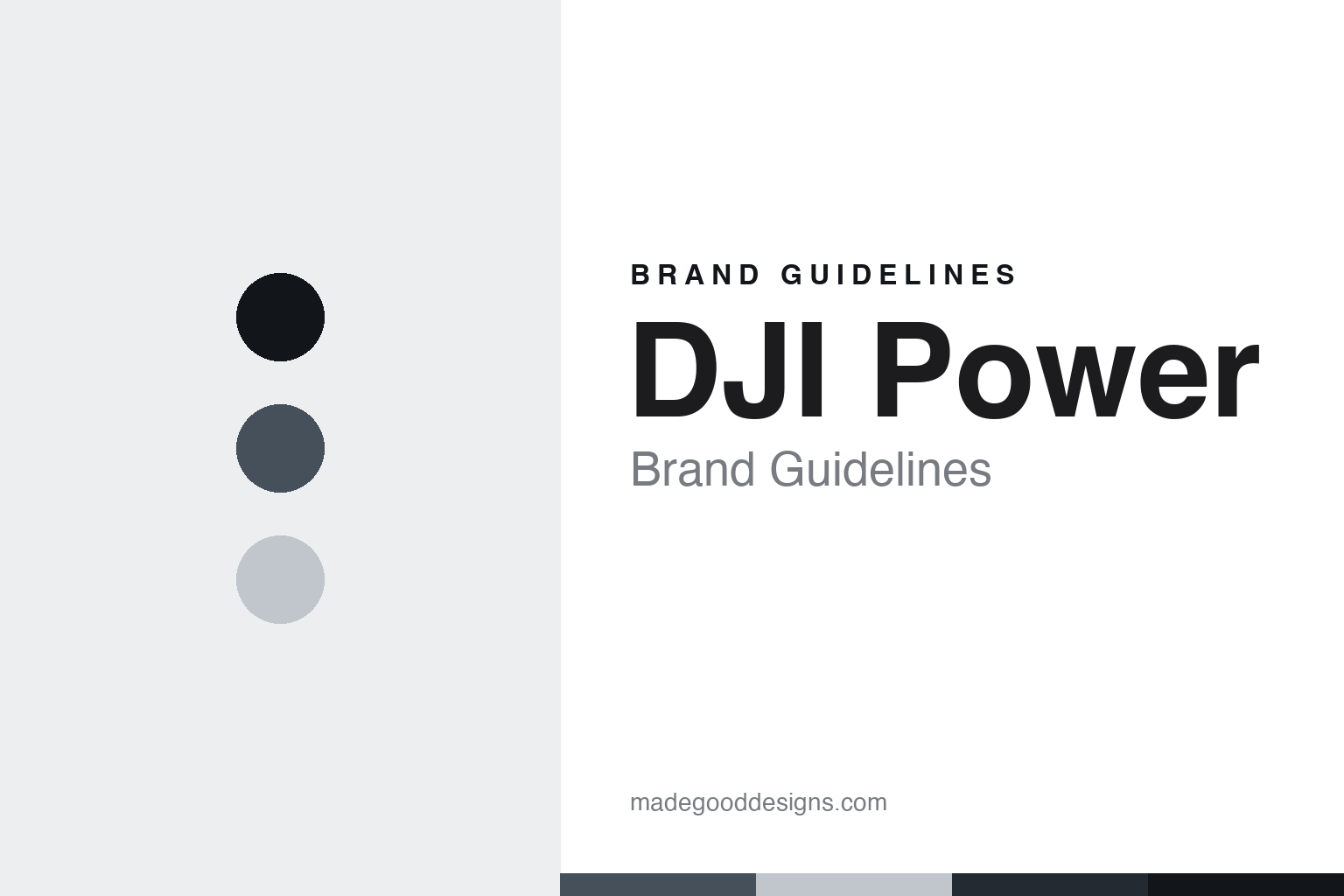
DJI Power lives in a drone graphite. Click a swatch to copy the hex.
DJI Power’s identity is engineered, precise and crossover — a drone graphite, an ink, a pale steel, a deep slate, and a paper. The palette leans drone graphite and pale steel: a cool, technical register that nods to precision engineering and fast charging rather than a loud logo colour. It signals the power station that charges its drones — engineered, quiet and purpose-built. The honest caveat: with no published brand hex, these values are an original, unofficial interpretation, not first-party colours.
The lesson is a drone graphite signals an engineered, crossover identity. DJI Power’s world is a power station that also gets a drone back in the air. For designers, it is a reminder that a cool drone graphite and a soft pale steel can carry a maker brand — a technical tone held as colour, not a product shot. Because these tones can fail as small text, keep type dark and let the colour live in the accents, palette and band. The takeaways: date the line to 2024; name DJI as the parent; lead with the drone fast-charge crossover; keep regulatory mentions drone-scoped; and treat any single hex as unofficial.
Typography
The register is an engineering sans — precise, quiet, crossover.
DJI Power’s identity carries a precise, quiet, crossover spirit — a precision-engineering entrant, not a legacy power brand. An engineering sans captures the mood: clean, exact and confident, the register of battery engineering applied to a new category. Set in a drone-graphite palette, the engineering sans feels precise and crossover — exactly the personality DJI Power carries. It behaves like a made, engineered thing rather than a loud logo, mirroring a battery pack and a fast-charge port. (DJI Power’s real gear and the DJI name are things we describe but do not reproduce, and the exact typeface is not ours to use.) Because it is not ours to use, the honest description is “an engineering-sans brand,” shown here in a stand-in. The type behaves like the brand: precise, quiet and crossover.
Aa
An engineering-sans brand — precise and crossover. (Specimen set in Space Grotesk, an engineering-sans STAND-IN; NOT the DJI logo or any product.)
The power station
DJI Power stands for the power station that charges its drones.
DJI Power brings the round its newcomer node. A drone-graphite palette, an engineering sans and a 2024 launch make one thing — the power station that charges its drones — the whole identity: engineered, precise and crossover. The drone-battery engineering is the pitch, and the field fast-charging is the proof. The point is a drone giant applying its engineering to a new category with a genuine crossover trick, in a round about where power stations are made and who owns them.
Put to work, the identity is the brand told straight, scope precise and framing neutral. A maker in this spirit would date the line to 2024, name DJI as the parent, and lead with the drone fast-charge crossover. A reader in this spirit would keep the facts right: DJI Power sells power gear as its heroes, led by the Power 1000 and Power 2000; it is a product line of DJI, launched in 2024; it is made in Shenzhen; and its differentiator is fast-charging DJI drone batteries in the field. DJI Power sits fifth in the round, after Goal Zero. The honest editorial moves are to date the line to 2024, to name DJI, to lead with the crossover, and to keep regulatory scrutiny drone-scoped and neutral.
For designers and brand-builders, DJI Power continues the power station: let a genuine crossover be the identity — and keep an adjacent controversy scoped and neutral. The lessons: diversify from a real engineering strength; find a differentiator only you can offer, here charging your own drones; scope a regulatory matter to the business it concerns; describe the crossover rather than depict a product; and never reproduce a logo. It is also a reminder to stay precise: DJI Power is the drone giant’s 2024 power-station line that turned its battery engineering into a station which fast-charges its own drones in the field — with the palette here an unofficial interpretation. The hook is that loop: DJI turned the battery and charging engineering behind its drones into a general-purpose power station, and closed the loop by making it fast-charge its own drone batteries in the field — a power station that gets the aircraft back in the air. Read that way, DJI Power is less a power station than an engineered crossover: precise, quiet, crossover. The lesson for a brand is that a genuine crossover and neutral framing reinforce each other, and scoping the controversy keeps the story earned. DJI Power made the-power-station-that-charges-its-drones the identity — proof that a crossover carries a round.
Explore & save
Keep DJI Power’s identity on hand — save it to a board in the Made Good inspiration library.
DJI Power identity set
Pin the drone-graphite palette and the engineering-sans register to your own board.