Eugène Jansson painted Stockholm after the sun had gone down: the water of Riddarfjärden seen from the heights of Södermalm, empty streets, a row of gas lamps and their reflections. The Thiel Gallery in Stockholm, which holds 20 of his works, says the intense blue of these twilight scenes earned him the nickname “the Blue Painter”. For designers, he is a case study in how far one hue can be pushed, and in how to keep a very dark image readable.
Who was Eugène Jansson?
The Nationalmuseum in Stockholm records Jansson as born in Stockholm on 18 March 1862 and dying in Skara on 15 June 1915. The Thiel Gallery adds that he was born and raised in Gamla Stan, the old town, and lived in Stockholm all his life. The Nationalmuseum notes that he came from a poor home, unlike many of the artists around him.
Accounts of his training differ slightly. The Thiel Gallery says he studied at the Technical School from 1878 to 1881 and then at the Academy of Fine Arts. The Norwegian encyclopedia Store norske leksikon has him studying under the history painter Edvard Perséus from 1878 and at the Academy in 1881–82. The London dealer Stephen Ongpin Fine Art lists all three in its biography.
Many Swedish painters of his generation trained in France. Jansson stayed at home. He joined the Artists’ Association (Konstnärsförbundet) when it was founded, according to the Thiel Gallery; Stephen Ongpin Fine Art dates that to 1886 and says he served as its secretary. The banker and collector Ernest Thiel became his patron. The Thiel Gallery says success around 1900 let him visit France and Italy, and Ongpin’s biography says Thiel paid for study trips to Paris in 1900 and to Italy and Germany in 1901.
The blue paintings: what to look at
Store norske leksikon dates Jansson’s breakthrough to about 1890, when he began painting atmospheric, deep blue evening and night scenes, often of Stockholm. The Nationalmuseum describes the style he developed in the 1890s as a frequently bluish palette with expressive, swirling brushwork. Four things are worth a designer’s attention.
One hue, many values
The night pictures are close to monochrome. Water, sky, rock and buildings are all blue, and the picture is built from differences in lightness instead of differences in colour. A single-hue interface theme works the same way.
Small lights as anchors
In the Riddarfjärden views, rows of lamps along the far shore and their streaked reflections are tiny, warm and widely spaced. The eye jumps from light to light and reads the curve of the bay from them. The Cleveland Museum of Art records that other artists called him “Paraffin Jansson”, because the light in his paintings reminded them of paraffin (kerosene) lamps.
Brushwork that shows direction
Jansson does not blend his strokes away. Long curved marks follow the surface they describe: across water, around a hill, along a road. The Nationalmuseum points out that the swirling lines he used for the water of Lake Mälaren reappear in his painting of a May Day procession, where they stand for the movement of a crowd. The Thiel Gallery compares the broad strokes of his street scenes to Edvard Munch.
High viewpoints and big empty areas
Many of the city views look down from a height, so the water or the street fills most of the canvas and the horizon sits high. Those large, empty areas are what make the few lights count.
Reading Evening Mood-Lidingö, 1900
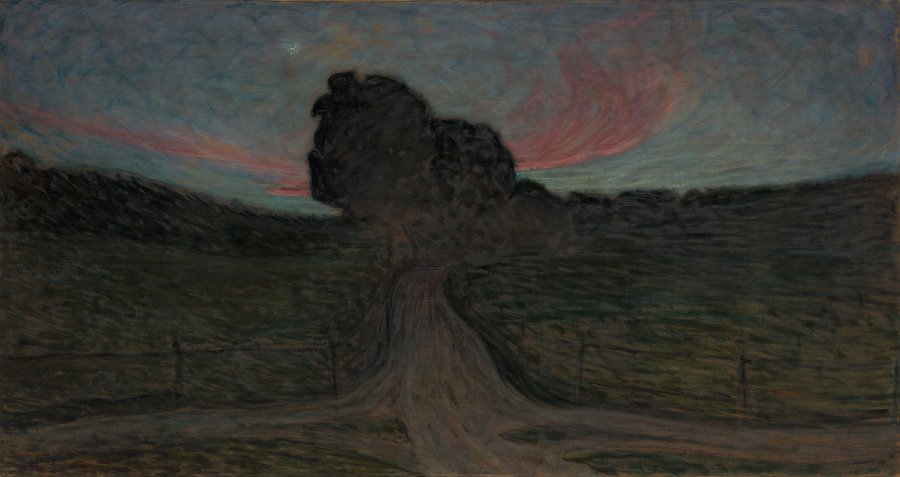
The Cleveland Museum of Art holds Evening Mood-Lidingö, an oil on canvas dated 1900 and measuring 90.1 × 168.6 cm unframed. The museum describes the subject as a field near Stockholm. It is not a city nocturne, but it uses the same methods in a rural setting.
The format is nearly twice as wide as it is tall. A pale track starts at the bottom edge, narrows and climbs to a dark clump of trees placed just left of centre. Fence posts cross the field in a low line. Above the trees, two wings of pink cloud spread outwards, and a single star sits to the upper left of the tree mass. Every stroke in the field and sky bends towards that centre, so the whole surface works like a set of converging guide lines.
Measured from the museum’s scan of this painting, the colours are darker and greyer than the picture feels. The sky reads as slate blue-grey near #40484b and #545654. The pink clouds sit around #6c4a47 and #5b4948. The track is a warm grey-brown near #463d33, the field a dark olive near #29281f, and the tree mass almost black at #191917. These are values from a digital scan, not the original pigments. The lesson is that the pink reads as bright only because everything around it is so dark and so neutral.
Career outline and key works
- May Day Demonstration (1896–1901). Oil on jute canvas, Nationalmuseum. The museum says it was begun in 1896 and finished in 1901, and that Jansson sympathised with the labour movement.
- Riddarfjärden, Stockholm (1898). Oil on canvas, 150 × 135 cm, Nationalmuseum. A view over the bay with the lamps of the far shore.
- Dawn over Riddarfjärden (1899). Oil on canvas, 150 × 201 cm, Prins Eugens Waldemarsudde, Stockholm.
- Evening Mood-Lidingö (1900). Cleveland Museum of Art, discussed above.
- Portrait of Ernest Thiel (1902). Oil on canvas, Thiel Gallery.
- The Naval Bathhouse (1907) and Self-portrait (1910). The self-portrait, 203 × 110 cm, is in the Nationalmuseum and shows the painter in a suit among bathers at the naval bathhouse.
The last two belong to a different phase. Around 1904–05 Jansson gave up the night views and turned to figure painting. Store norske leksikon dates the change to after 1905 and describes the subjects as men bathing or exercising in strong sunlight. The Thiel Gallery says these studies of sailors and athletes were strongly influenced by the sculpture of Gustav Vigeland. The Nationalmuseum connects them with vitalism, a movement centred on health and the body. Daylight replaces the blue dusk.
Jansson, Munch and Nordic Symbolism
Museums regularly place Jansson beside Edvard Munch. The Cleveland Museum of Art says he became aware of Munch’s work as early as 1884 and shared the aim of painting states of mind instead of outward appearances. Store norske leksikon sees Munch’s influence in the blue night scenes, and describes Jansson’s work as drawing on Romanticism, Post-Impressionism and Symbolism.
The wider context is covered in our guides to Symbolism in art and to Edvard Munch. For a contemporary Swedish treatment of the same evening light, compare Prince Eugen, whose museum at Waldemarsudde owns Dawn over Riddarfjärden.
How to borrow from Eugène Jansson today
- Build a dark theme from one hue. Choose a single blue and create five or six value steps from near-black to mid-tone. Use the steps for hierarchy and keep the hue constant.
- Ration the warm accent. In the nocturnes the lamps cover a tiny share of the surface. Give your accent colour the same job: one button, one data point, one line of a poster.
- Mute before you brighten. The Cleveland scan shows a pink that is closer to brick than to neon. Lower the lightness and saturation of the surroundings first, then see how little colour the accent needs.
- Let texture carry direction. Use line patterns, contour hatching or brush textures that follow the form, so that a background also points the eye. Converge them on the focal point, as the strokes in Evening Mood-Lidingö converge on the trees.
- Raise the horizon. Put the skyline high in a hero image and let the empty foreground hold the headline.
- Check contrast in the dark. A painting can sit at the edge of visibility; body text cannot. Test dark-on-dark type for legibility before you ship it.
To extract a working palette from a museum scan, load the image into the image colour picker, then build tints and shades in the colour palette generator. More public-domain museum images to study are collected in the MGD museum collection.
Frequently asked questions
Why is Eugène Jansson called the Blue Painter?
The Thiel Gallery in Stockholm says the nickname comes from the intense blue of his twilight scenes of the city. The Cleveland Museum of Art also records a second nickname, “Paraffin Jansson”, after the lamp-like light in his pictures.
Where can I see paintings by Eugène Jansson?
Mostly in Stockholm. The Thiel Gallery holds 20 works, the Nationalmuseum owns Riddarfjärden, Stockholm (1898) and the 1910 self-portrait, and Prins Eugens Waldemarsudde has Dawn over Riddarfjärden (1899). Outside Sweden, the National Museum in Oslo holds two paintings dated 1898, and the Cleveland Museum of Art has Evening Mood-Lidingö.
Was Eugène Jansson influenced by Edvard Munch?
Museums say so. The Cleveland Museum of Art states that he knew Munch’s work as early as 1884, and the Thiel Gallery compares the broad brushstrokes of his street scenes to Munch. Stephen Ongpin Fine Art links the influence to an exhibition of Munch’s work in Stockholm in 1894.
Are Eugène Jansson’s paintings in the public domain?
Jansson died in 1915, and the Cleveland Museum of Art releases its image of Evening Mood-Lidingö under a CC0 open-access designation, which is why it is reproduced here. Other museums set their own terms for their photographs, so check the rights statement on each collection page before reusing an image.