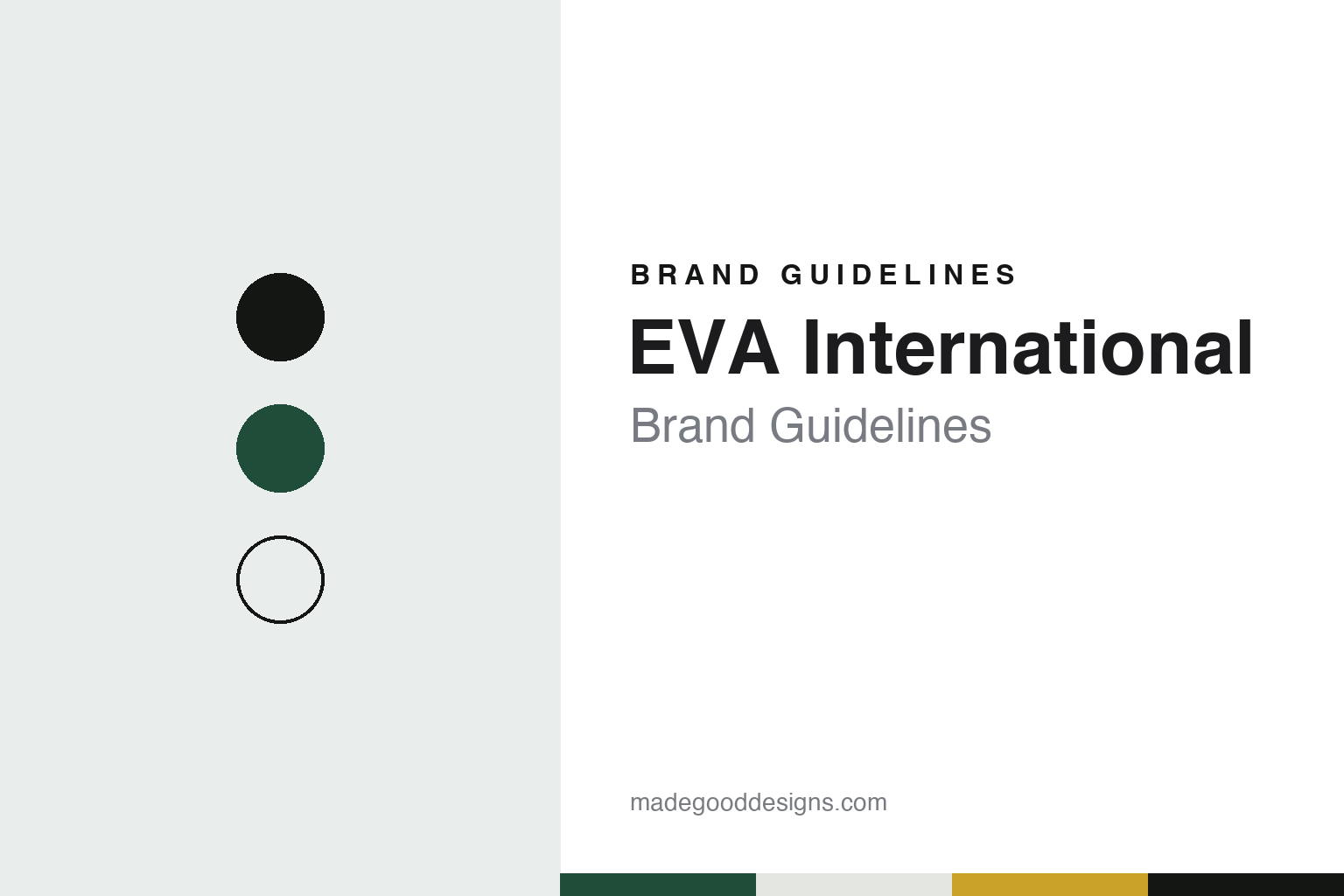
EVA International Brand Guidelines
Limerick’s open-call show that became a biennial.
Aa
Two constants: a Shannon green, limestone and harvest gold palette and a Plain grotesque register. Abstract homage — not an EVA International mark; no artwork, logo or edition graphic is reproduced.
The ’77 Exhibition
An open call in Limerick.
EVA International is a contemporary art exhibition held across the city of Limerick, in the Mid-West of Ireland, and it calls itself “Ireland’s Biennial.” Its own archive says it was founded by Limerick-based artists and academics in January 1977 as the ’77 Exhibition of Visual Arts. The committee wanted, in the words of the 1977 catalogue quoted on the organisation’s website, to give the public “an opportunity to visit and experience an exhibition not normally available in the region” and to “stimulate an awareness of the visual arts here.” RTÉ, Ireland’s public broadcaster, wrote in September 2023 that EVA originally stood for “exhibition of visual art.”
From the start it worked through an open call: artists submitted work and a panel chose what was shown. English Wikipedia, citing the organisation’s catalogues, says that open-call model has continued in every edition since 1977. It lists the venues of the first exhibition as the Municipal Art Gallery, now the Limerick City Gallery of Art, the Cummins Gallery, and the National Institute for Higher Education at Castletroy, which later became the University of Limerick.
Two years later the exhibition began inviting an outside selector. English Wikipedia says 1979 was the first time an invited international curator presided over EVA, a practice that continued in almost every later edition, with each year’s show chosen by a different curator. Between 1994 and 2010, it adds, an invited selection of artists was shown alongside those who answered the open call.
Colour
EVA, EV+A, e v + a.
The name has changed shape several times, and the changes are part of its visual history. English Wikipedia’s list of editions shows the early shows as “The 77 Exhibition” and “The 78 Exhibition,” then EVA with the year from 1979, and in 1988 the longer “Limerick Exhibition of Visual + Art.” From 1989 to 1998 the editions were styled EV+A, with a plus sign in the middle, and from 2000 to 2010 in lower case and spaced out as e v + a, often followed by a subtitle such as “friends + neighbours” (2000), “imagine limerick” (2004) or “reading the city” (2009). The plus sign and the lower-case spacing gave each era of the exhibition its own typographic form.
The organisation’s website says that after 33 years as an annual exhibition, 2012 was the first year of EVA International as a biennial, with Woodrow Kernohan appointed as director. English Wikipedia adds that the organisation was incorporated as a company limited by guarantee in 2012 and has since used the business name EVA International. The 2012 edition, titled After the Future, ran for 12 weeks and included a reconstruction of Luc Deleu’s Construction X, a large outdoor work built from shipping containers in the shape of the letter X, first staged in Arthur’s Quay Park for the 1994 edition. EVA says the 2012 edition also moved the open call online and received more than 2,000 proposals from artists in 76 countries.
The biennial editions followed in even-numbered years: Agitationism in 2014, part of Limerick’s year as Ireland’s National City of Culture, according to English Wikipedia; Still (the) Barbarians in 2016; and the 38th EVA International in 2018, the first under director Matt Packer, who was named director in March 2017 after running the CCA Centre for Contemporary Art in Derry, English Wikipedia says. The 39th edition was postponed from its July 2020 opening and unfolded in three phases; EVA says the first ran from 18 September to 15 November 2020 across venues in the city and online. Its organising idea was the “Golden Vein,” a 19th-century description of the farmland of the Limerick region.
Typography
Design and documentation.
Not every biennial is staged in a capital with a large museum behind it. Many of the events in this series grew up in smaller cities, or around one art form, and their identities reflect that. A visitor may meet the name on a banner in a provincial town, on a library wall or on a printed programme rather than on a museum façade, so the name has to carry most of the recognition on its own.
Short names do a lot of that work. Long official titles, often in two languages, are cut down to a handful of capitals: GIBCA in Gothenburg, RIBOCA in Riga, EVA in Limerick. An acronym reads the same in the local language and in English, fits a small poster or a social-media handle, and can be extended to side programmes and partner networks while keeping the parent name in view.
Some biennials define themselves by a medium rather than a place. A printmaking biennial such as Ljubljana’s, or a festival devoted to photography, draws its audience through the technique itself, and its graphic language can lean on that technique: paper, ink, the frame of a print. Others define themselves by movement. The Thailand Biennale changes host province with each edition, so its fixed national name sits beside a changing place name, year and theme.
Modest means show plainly in the design choices. Editions tend to reuse existing buildings, among them art halls, libraries and former industrial sites, rather than build pavilions, and a single strong edition graphic often has to work across every venue at once. This guide looks at how each event has handled those choices, using only what dated sources record.
Aa
A plain grotesque — after EV+A and e v + a. (Specimen set in Space Grotesk, a sans STAND-IN; NOT the EVA International logo.)
A city of venues
Galleries, a cathedral and a butcher’s shop.
EVA has always used the city as its exhibition space. English Wikipedia names the Limerick City Gallery of Art, the Hunt Museum and King John’s Castle among its venues over the years. For the 39th edition in 2020, EVA says, the venues included the City Gallery and the Hunt Museum alongside the Sailor’s Home, O’Connor’s Butchers and The Alteration Shop.
The 40th EVA International ran from 31 August to 29 October 2023. RTÉ’s review, published on 12 September 2023, counted more than 50 Irish and international artists across 17 venues, among them an old handball alley, the Limerick City Gallery, the University of Limerick, a primary school, a cathedral and a vegetarian café. Its guest programme, The Gleaners Society, was curated by Sebastian Cichocki, who took the agricultural practice of gleaning, collecting what is left in a field after the harvest, as its idea, RTÉ explained. Alongside it ran the Platform Commissions, a strand begun in 2018 for new work by artists based in Ireland.
The 41st EVA International took place across Limerick from 29 August to 26 October 2025, according to the organisation. Its guest programme was titled It Takes a Village, after the proverb about raising a child, and EVA says it worked with partners ranging from fishmongers and community networks to OFF-Biennale Budapest and Ormston House, a Limerick arts centre. The organisation’s current website gives each edition its own archive page with artists, venues and events, and publishes a downloadable visitor guide for recent editions. Its colours and typefaces are not set out in any published guideline, so the palette here is our own.
For a design guide, EVA International shows how an exhibition can keep its initials for nearly 50 years while their typography changes from EVA to EV+A to e v + a and back. Compare the Liverpool Biennial, another city-wide biennial across the Irish Sea, and the Folkestone Triennial, which also places art in a smaller city’s everyday sites. For this guide we use a Shannon green, a limestone grey and a harvest gold with a sans, an unofficial interpretation; no product or logo is reproduced.
Explore & save
Keep EVA International’s identity on hand — save it to a board in the Made Good inspiration library.
EVA International identity set
Pin the EVA International Shannon green, limestone and harvest gold palette and the Plain grotesque register to your own board.
Source & notes
Frequently Asked Questions
What font can I use to match the EVA International look?
This guide describes EVA International’s type as “A plain grotesque — after EV+A and e v + a”. Its type specimen is set in Space Grotesk from Google Fonts as a stand-in; Space Grotesk is not EVA International’s own lettering.
What colours are in the EVA International palette?
This guide’s EVA International palette is Shannon green #1F4D3A, Ink #141614, Limestone #E4E7E1, Harvest gold #C9A227 and Paper #F7F8F5. The tones are the guide’s own unofficial interpretation, not official EVA International hex codes.
When was EVA International founded?
EVA International was founded in January 1977, in Limerick, Ireland.
Who founded EVA International?
EVA International was founded by Limerick-based artists and academics in January 1977.