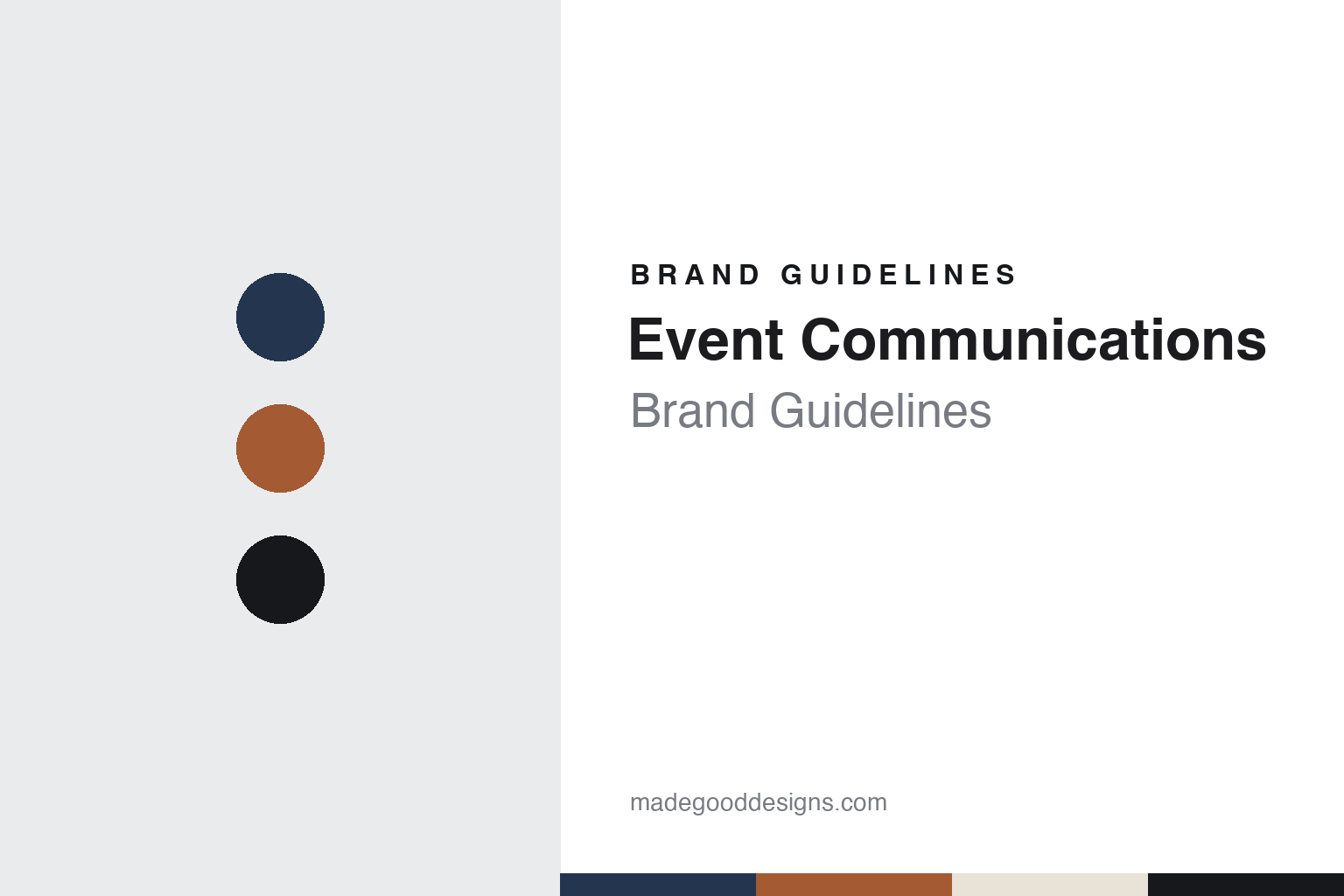
Event Communications Brand Guidelines
The London studio that turned museum stories into routes.
Aa
Two constants: a harbour navy, rivet copper and linen palette and a transitional serif register. Abstract homage — not an Event Communications asset or mark; no logo, exhibit or project image is reproduced.
After Vancouver
A researcher and a designer start a studio.
Event Communications, usually shortened to Event, is a museum and visitor-attraction design studio founded in London in 1986. Its origins lie in a world fair. In a profile published by The Irish Times on 12 January 2000, the Dublin-born co-founder Celestine “Cel” Phelan, who had a background in script and research work for radio and television at the Irish broadcaster RTÉ, said she had been asked to research the British pavilion at the Vancouver World Fair. On that project she met the designer Steve Simons, and the two set up their own museum and visitor-centre design company afterwards, in 1986.
The division of labour was clear from the start. Phelan told The Irish Times that content was her responsibility, along with bringing in the business and working with clients, while Simons, as creative director, led the presentational side. In practice that meant Phelan worked out a storyline with experts and researchers before design began, choosing objects to build a narrative through which visitors move, with quieter passages and a strong finale. The same profile listed early commissions that included presentations at the Imperial War Museum in London and the then-new Book of Kells exhibition at Trinity College Dublin.
English Wikipedia, citing The Irish Times, says the studio opened with two employees, and that it later ran offices in London and Dublin; an Irish subsidiary, Event Ireland, appears in its company listing. Phelan described the late 1980s and 1990s as a period when museums in Britain began charging for entry and becoming more dependent on visitors, and when new technology made it possible to layer information so that each visitor could go as deep as they wished. She said the studio had been fortunate to work through that change.
Colour
Nine galleries in Belfast, a docklands museum in Dublin.
In 2008 the founders stepped back. English Wikipedia, citing a Design Week report of 10 March 2008, says Cel Phelan and Steve Simons stepped down and a new management team took over, led by the museum design consultant James Alexander as chief executive and Esther Dugdale as creative director. The same article says the firm then widened its work from Europe to the Middle East, with projects in Oman and Kuwait, and later to China and Hong Kong.
The project that made the studio’s name outside the museum world opened in Belfast on 31 March 2012, days before the centenary of the Titanic’s maiden voyage. In a question-and-answer feature published in August 2012 by the trade site now called World Construction Network, James Alexander described the exhibition at Titanic Belfast as nine galleries with a narrative that runs chronologically: visitors enter the streets of Edwardian Belfast, then pass through the drawing offices, the shipyard, the launch and the fit-out, before the story moves forward to myths and legends and the discovery of the wreck in the 1980s. He said the studio built scale mock-ups of first-, second- and third-class cabins from surviving drawings, a walk-through projected space that takes visitors from the boiler rooms to the bridge, and a ride through the shipyard that includes a section of the Arrol Gantry in which the ship was built. With few original objects to show, he said, the team relied on moving and still footage projected at large scale. Research had begun in 2004, and an experts group checked the stories told.
Event used the same approach in Dublin. The Museums Journal, the magazine of the Museums Association, reported on 3 June 2019 that Epic, The Irish Emigration Museum, in a former dock building in the city, had been designed by Event Communications, “the same team that created Titanic”. The magazine described a series of galleries, each given to a different theme of the Irish diaspora, with touchscreens, motion-sensor quizzes and audio and video effects, and a genealogy centre on site.
Typography
Studios, spaces and the people who stage them.
Exhibition, museum and experience-design studios rarely sell a product with their name on it. What they publish instead is a body of work: galleries, visitor centres, pavilions and installations, each credited to the studio by the museum, the client or the trade press. A guide to their identity therefore starts with how they present that work, and with the names and wordmarks on their own websites.
Several of these practices are named after their founders or partners, and some shorten a longer name to initials: Ralph Appelbaum Associates calls itself RAA on its own site. Their websites show a wordmark, a project list and a few pages on the practice. Founders and partners appear in a professional role, as creative directors or principals, and team pages can list designers, content developers and model-makers alongside them, as Casson Mann’s does.
The project case study is the core format. A typical page names the client and the opening date, then shows the gallery graphics, wayfinding, display furniture, projections and interactive installations that make up the scheme; Casson Mann’s pages call this mix its scenography. Independent coverage, in titles such as Museums Journal, Blooloop and national newspapers, is the surest way to date and credit a project, because a single building can involve more than one design firm: English Wikipedia credits the conversion of the IKEA Museum in Älmhult to both WilkinsonEyre and Ralph Appelbaum Associates.
Corporate pages fill in the rest: office locations, practice history, renamings and, where it has happened, a change of ownership. This guide sets out what dated sources say about each studio, keeps company statements attributed, and leaves out awards and any claims about what an exhibition does for its visitors.
Aa
A transitional serif for a studio that began with scripts and storylines. (Specimen set in Source Serif 4, a serif STAND-IN; NOT the Event Communications logo.)
Chargeurs
From an independent studio to part of a French group.
In December 2021 the French industrial group Chargeurs bought all of the company, according to an AFP report carried by FashionUnited on 10 December 2021, adding it to the group’s museums division for an undisclosed amount. The report said Event employed about 50 people in London and Dublin and that James Alexander would continue to run it. Chargeurs had already assembled a group of museum-services companies that included exhibit builders and graphics producers.
That division now trades as Museum Studio, signed Chargeurs Museum Studio. Its website, read in November 2026, describes it as a group offering services from advisory work and content interpretation to exhibition design, engineering and build, publishing and cultural retail, with offices from Washington and Toronto to London, Paris, Milan, Riyadh, Muscat, Abu Dhabi, Mumbai and Hanoi; its network page dates Museum Studio itself to 2023. The former Event web address now leads to the Museum Studio site. In April 2025, the attractions trade site Blooloop reported, Museum Studio took a 51 per cent stake in Lord Cultural Resources, a cultural-planning practice founded in 1981. The Event name therefore now sits inside a larger group rather than standing alone.
The name itself is a single common word, the short form of Event Communications, and the projects described in the press are organised by place and story: a shipyard and its drawing offices in Belfast, a dock building in Dublin, a manuscript display in a university library. For a designer studying the studio, the useful record is the sequence of rooms rather than a house style of materials.
For a design guide, Event Communications shows how a museum studio can build a reputation on narrative structure — a route through galleries in story order — and how a founding name can pass into a larger group. Compare Casson Mann, the London exhibition designers founded in 1984, and Ralph Appelbaum Associates, the New York museum designers. For this guide we use a harbour navy, a rivet copper and a linen with a serif, an unofficial interpretation; no product or logo is reproduced.
Explore & save
Keep Event Communications’s identity on hand — save it to a board in the Made Good inspiration library.
Event Communications identity set
Pin the harbour navy, rivet copper and linen palette and the transitional serif register to your own board.
Source & notes
Frequently Asked Questions
What font can I use to match the Event Communications look?
This guide describes Event Communications’ type as “A transitional serif for a studio that began with scripts and storylines”. Its type specimen is set in Source Serif 4 from Google Fonts as a stand-in; Source Serif 4 is not Event Communications’ own lettering.
What colours are in the Event Communications palette?
This guide’s Event Communications palette is Harbour navy #24364F, Ink #17181C, Rivet copper #A45A33, Linen #E9E2D6 and Paper #F7F5F0. The tones are the guide’s own unofficial interpretation, not official Event Communications hex codes.
When was Event Communications founded?
Event Communications was founded in 1986, in London, United Kingdom.
Who founded Event Communications?
Event Communications was founded by Cel Phelan and Steve Simons in 1986.