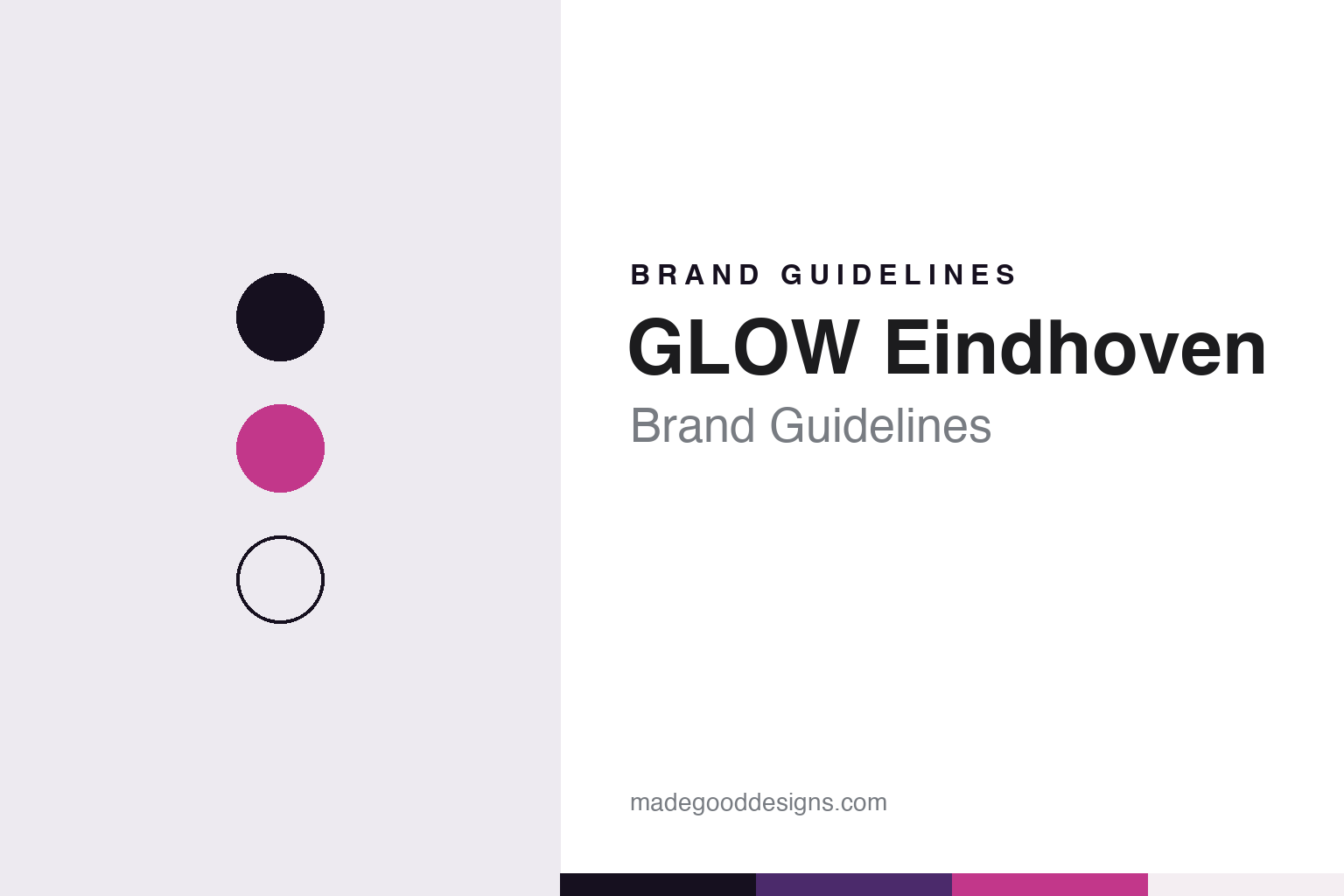
GLOW Eindhoven Brand Guidelines
Eight November nights of light art in the City of Light.
Aa
Two constants: a night violet and projection magenta palette and a wide display sans register. Abstract homage — not a GLOW artwork or mark; no logo, poster or installation is reproduced.
A festival for the City of Light
A city council, a lighting company and a trip to Lyon.
GLOW is a free light art festival in Eindhoven, in the south of the Netherlands. The festival writes its name in capitals and uses GLOW Eindhoven for the city edition. According to Dutch and English Wikipedia it was first held in November 2006, as an outdoor exhibition in which artists and designers from the Netherlands and abroad light up characteristic buildings and places, using projections as well as computers, sensors and animation.
Eindhoven’s nickname as a city of light predates the festival. English Wikipedia notes that the town was once a large producer of matches and, later, the home of incandescent bulb production by Philips; Dutch Wikipedia says the city is therefore known as the lichtstad, the city of light. Dutch broadcaster NOS reported in November 2025 that GLOW began in 2006 when the municipality and Philips Lighting wanted to give the “city of light” idea new life and put Eindhoven on the international map, and that the first edition showed a small selection of artworks.
The festival’s own account adds detail. It says the city council joined LUCI, a network of cities working on urban lighting, in 2006, and that the idea for a festival came after a visit to the Fête des Lumières in Lyon, made together with Stichting CityDynamiek Eindhoven, the municipal body then coordinating design, culture, sport and light in the city. GLOW names the Municipality of Eindhoven and Philips Lighting, now Signify, as its founding partners.
At the first festival, Dutch Wikipedia says, artworks stood in the city centre and along the banks of the river Dommel. As the event grew, the Strijp-S district and the campus of Eindhoven University of Technology were added. English Wikipedia describes a related strand, GLOW Next, for new light projects shown for the first time, which in 2016 were exhibited on the university campus for its sixtieth anniversary.
Colour
One route, eight evenings, a new theme.
The festival runs for eight evenings in November. Visitors follow a walking route of about 5 kilometres through the city centre; the festival describes it as a loop, and English Wikipedia says the route changes every year to bring different parts of the city into view. Printed maps are handed out at information points at the Central Station and on Stadhuisplein, and an app shows the route on a phone.
NOS wrote in 2025 that GLOW is known for large, colourful projections on characteristic buildings such as the Catharinakerk and the Blob, a drop-shaped modern building, and that the route takes in work by local and international light artists alongside pieces made by residents of the city centre and by primary-school children. It named one recurring work, the Renaissance Tunnel by an Italian family of light makers, whose arches of coloured lamps are modelled on cathedral architecture; versions stood on the Demer shopping street in 2010, outside the Central Station in 2011 and on Stadhuisplein in 2015.
Each edition has a theme. Dutch Wikipedia says the 2021 edition, Moved by Light, was spread over four areas of the city: the centre, Strijp-S and Strijp-T, Campina and the university campus. The 2020 edition did not take place; director Ronald Ramakers told NOS that the team instead lit the whole city blue for three days and nights, with a thousand red balloons. The twentieth edition, from 8 to 15 November 2025, took The Light as its theme and brought back favourites from earlier years. Omroep Brabant reported that it drew 800,000 visitors in Eindhoven.
The 2026 edition, the festival’s 21st, ran from 7 to 14 November under the theme CONNECT. Omroep Brabant reported in November 2026 that the Eindhoven route passed about thirty works, open from 6.30pm to 11pm, including a fifteen-minute drone show with a hundred drones at the Philips Stadion, a projection show on the facades of the Markt made with LEGO, and a work that wrapped the 55-metre Hooghuis in mist. The festival says the Eindhoven design studio TWOFIFTYK made the drone work, that director Philip Ross led his first edition, and that almost ninety installations were shown across the city and the region.
Typography
How light festivals present themselves.
Light festivals usually name themselves in one of two ways. Some join a city’s name to a word for light, as Lyon’s Fête des Lumières and the Festival of Lights in Berlin do; others use a coined word, as Vivid Sydney and GLOW Eindhoven do, with the city added alongside. Most are held on autumn or winter evenings, when it is dark early: Lyon’s festival runs over four evenings around 8 December, while Sydney’s takes place in May and June, the start of the southern winter.
The organisers are mostly public bodies. The Fête des Lumières is organised by the City of Lyon, and Vivid Sydney is owned, managed and produced by Destination NSW, the New South Wales Government’s tourism and major events agency. Other festivals are run by foundations, non-profit organisations or production companies working with their city.
The format is broadly shared. Visitors follow a route of installations through a city centre, usually on foot, and the largest works are projections on landmark buildings: a cathedral, a town hall, an opera house. The works come from invited artists, lighting designers and studios, and many festivals name each work and its makers in a printed or online programme and on a map of the route.
Each edition brings new works and, often, a new theme, poster or campaign image, so a festival’s look can change completely from year to year while its name, its route and its main buildings stay the same. This guide sets out what can be checked about each festival: who started it and when, who organises it now, where it takes place and how its works and imagery are described in dated sources.
Aa
A wide display sans for a name set in capitals. (Specimen set in Syne, a sans STAND-IN; NOT the GLOW logo.)
GLOW Eindhoven
A foundation, a city edition and a region.
GLOW is organised by a non-profit foundation, Stichting GLOW, which says it is governed under a supervisory-board model, with a small core team working year-round and extra staff and volunteers joining in the run-up to November. Partners and a friends programme support the festival and the festival says it involves students, residents and schoolchildren through education and community projects.
Since 2023 the name has also travelled beyond the city. The festival and Dutch Wikipedia say that in that year GLOW was first held in nearby municipalities, among them Oirschot and Waalre; NOS dated the regional editions to 2024. In 2026 five neighbouring municipalities, among them Oirschot, Veldhoven, Helmond and Laarbeek, home of the village of Lieshout, each had their own GLOW route, and the festival counts around fifty works across the five. Omroep Brabant reported that one of the regional works brought the patterns of the Vlisco textile factory in Helmond to life on its building. Dutch Wikipedia also records a first GLOW edition abroad, in Puebla, Mexico, in April 2026.
The festival’s logo, typeface and colours are not described in the sources used for this guide. What the festival does show consistently is the capitalised name, the city added after it, a single word for each year’s theme, and a fixed November week. The identity here is our own reading of the subject: dark streets, violet night air and the bright colour of projections on brick and concrete.
For a design guide, GLOW Eindhoven shows how a city can turn an industrial nickname into a yearly public event, with one short name that can be lent to neighbouring towns. Compare Fête des Lumières, the Lyon festival that inspired it, and Signify, the former Philips Lighting and one of its founding partners. For this guide we use a deep violet, a projection magenta and a mist white with a sans, an unofficial interpretation; no product or logo is reproduced.
Explore & save
Keep GLOW Eindhoven’s identity on hand — save it to a board in the Made Good inspiration library.
GLOW Eindhoven identity set
Pin the GLOW Eindhoven night violet and projection magenta palette and the wide display sans register to your own board.
Source & notes
Frequently Asked Questions
What font can I use to match the GLOW Eindhoven look?
This guide describes GLOW Eindhoven’s type as “A wide display sans for a name set in capitals”. Its type specimen is set in Syne from Google Fonts as a stand-in; Syne is not GLOW Eindhoven’s own lettering.
What colours are in the GLOW Eindhoven palette?
This guide’s GLOW Eindhoven palette is Night street #16101F, Deep violet #4B2A6B, Projection magenta #C2378A, Mist white #F4EEF2 and Paper #F8F7F5. The tones are the guide’s own unofficial interpretation, not official GLOW Eindhoven hex codes.