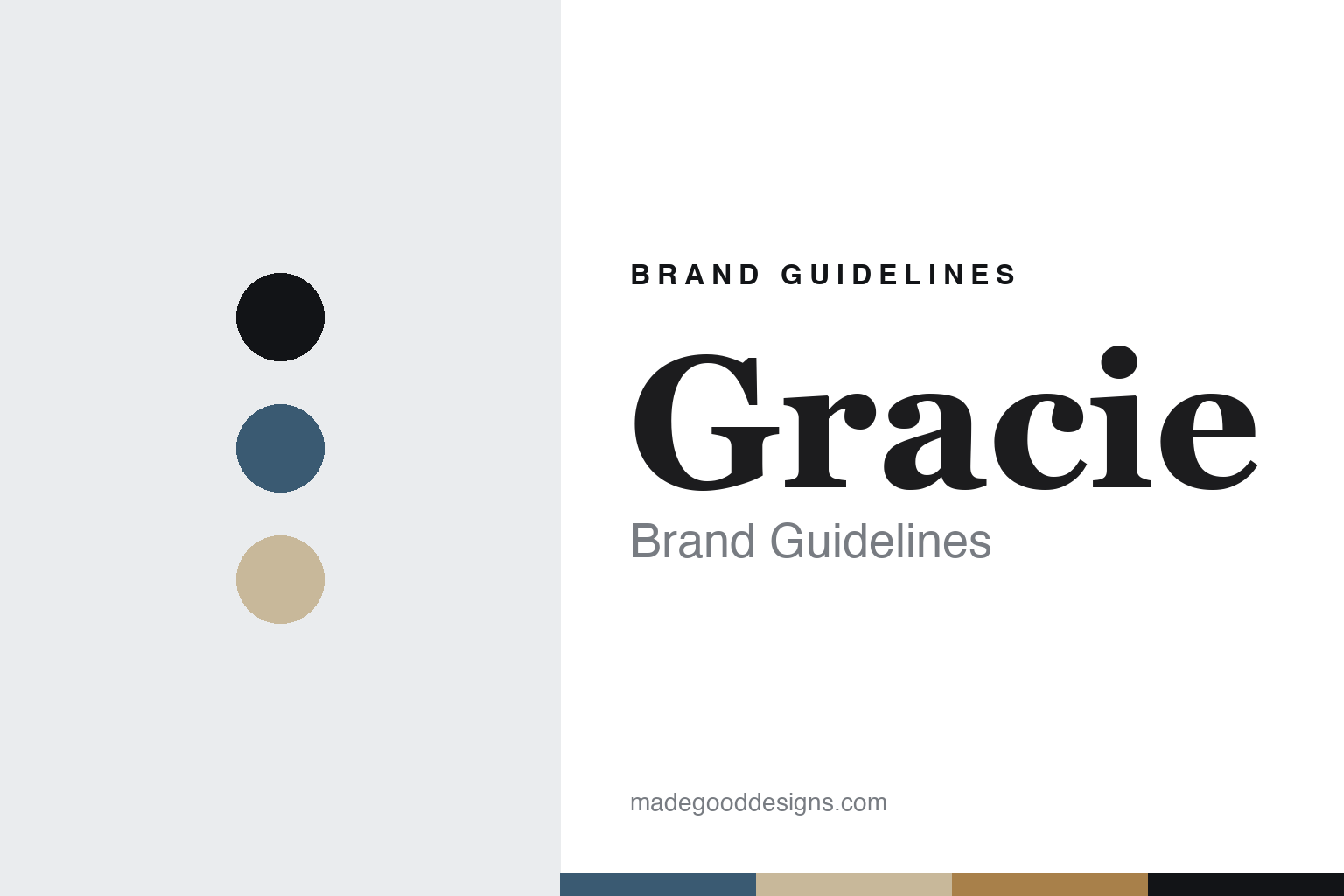
Gracie Brand Guidelines
Painted in two studios.
Aa
Two constants: a heritage-blue palette and a heritage serif register. Abstract homage — not a Gracie design or wordmark.
Painted in two studios
Gracie, America’s oldest hand-painted wallpaper house, paints in both China and New York.
Gracie is a lesson in honest geography as the story. America’s oldest hand-painted wallpaper house, its scenic and chinoiserie panels are painted in two places at once — a long-held studio in China and a production studio in New York — a maker whose American name sits over a craft rooted partly abroad. A wallpaper, painted across two studios.
Its identity is the hand-painted chinoiserie. Gracie’s bespoke, hand-painted scenic panels, made since 1898, are the work it is known for. A heritage, made a signature. A house that first re-imported the craft to America.
(Honest notes, so the story stays precise. Gracie — Charles R. Gracie & Sons — was founded in 1898 in New York by Charles R. Gracie, and is family-run into a fourth generation, with Jennifer and Michael Gracie leading; it is widely called America’s oldest hand-painted wallpaper house. On where it is painted we are precise: the traditional chinoiserie hand-painting has long been rooted in China, and Gracie has maintained a studio there — run by the same Chinese family for around fifty years — alongside a production department of about fifteen people in New York. So “America’s oldest” describes the firm, not the painting location; much scenic work is painted in China. The craft draws on Chinese hand-painting traditions from the 1700s, which we credit and never reproduce. Its designs are its IP, and there is no official brand hex — these tones are an unofficial interpretation. This is design commentary and does not promote any product.)
Colour
Gracie lives in a heritage-blue palette. Click a swatch to copy the hex.
Gracie’s identity is heritage, painterly and refined — a heritage blue, an ink, a silk, a sepia, and a chalk. The palette leans heritage blue and sepia: the register of an aged, hand-painted scenic ground. It signals history and craft over show. The honest caveat: with no published brand hex, these values are an original, unofficial interpretation, not first-party colours.
The lesson is a heritage-blue palette signals a heritage, painterly identity. Gracie’s world is a hand-painted, long-established, chinoiserie object. For designers, it is a reminder that an aged blue and a warm sepia can carry a brand built on a craft and a century — the blue of a painted scenic ground and the sepia of an old panel. Because these tones can fail as small text, keep type dark and let the colour live in the accents, palette and band. The takeaways: keep the craft; be honest where it is painted; credit the tradition; and treat any single hex as unofficial.
Typography
The register is a heritage serif — classical, refined, aged.
Gracie’s identity carries a classical, refined, aged spirit — a heritage object, not a modern one. A heritage serif captures the mood: high-contrast, elegant and old, the register of a house painting scenics since 1898. Set in a heritage-blue palette, the heritage serif feels classical and refined — exactly the personality Gracie carries. It is aged rather than new, mirroring a hand-painted scenic panel. (Gracie’s real designs and wordmark are things we describe but do not reproduce, and the exact typeface is not ours to use.) Because it is not ours to use, the honest description is “a heritage-serif spirit,” shown here in a stand-in. The type behaves like the maker: classical, refined and aged.
Aa
A heritage-serif spirit — classical and refined. (Specimen set in Playfair Display, a heritage-serif STAND-IN; NOT the Gracie wordmark or any wallpaper design.)
Honest geography as identity
Gracie stands for painting across two studios.
Gracie is a lesson in making honest geography the story. A heritage-blue palette, a heritage serif and hand-painted chinoiserie make a two-studio craft the whole maker — heritage, painterly and refined. The geography is the differentiator. The differentiator is a genuine truth — America’s oldest hand-painted wallpaper house, whose scenic painting is done across studios in both China and New York, not in one place alone.
Put to work, the identity is honest geography as design. A maker building in this spirit would keep a long-held craft alive across the places it lives, be plain that “oldest” describes the firm rather than the painting, and credit the tradition it draws on, so the customer buys into a real heritage rather than a marketing line. It would treat both its studios as part of the story. It would never let a proud American date obscure where the brush actually moves. The lesson Gracie teaches is that honest geography can build a brand: the century gives it authority, and the honesty gives it integrity. The geography is the personality, and the painting is the proof.
For designers and brand-builders, Gracie offers a clear takeaway: let the date and the place both be true. The lessons: keep the craft; name the studios; credit the tradition; and don’t let heritage hide geography. It is also a reminder to stay precise: Gracie is America’s oldest hand-painted wallpaper house, founded in 1898 by Charles R. Gracie, painting scenic panels across its China and New York studios — with the palette here an unofficial interpretation. Gracie made honest geography the maker — proof that where a thing is painted can be the difference.
Explore & save
Keep Gracie’s identity on hand — save it to a board in the Made Good inspiration library.
Gracie identity set
Pin the heritage-blue palette and the heritage-serif register to your own board.