Grinling Gibbons turned a wall into a stage for light. His cascades of pears, grapes, roses, wheat ears and leaves, carved so thin that leaves curl away from the panel, were made to catch candlelight and throw shadow. The Victoria and Albert Museum and the Cleveland Museum of Art both record that he was born in Rotterdam to English parents. The V&A and Apollo magazine agree that he came to England at about 19, working first in York and then at Deptford, the royal dockyard town downstream from London.
The four public-domain images below, from the Art Institute of Chicago, the Cleveland Museum of Art and the Met, show carvings from country-house interiors.
What to look at in Grinling Gibbons’s carving
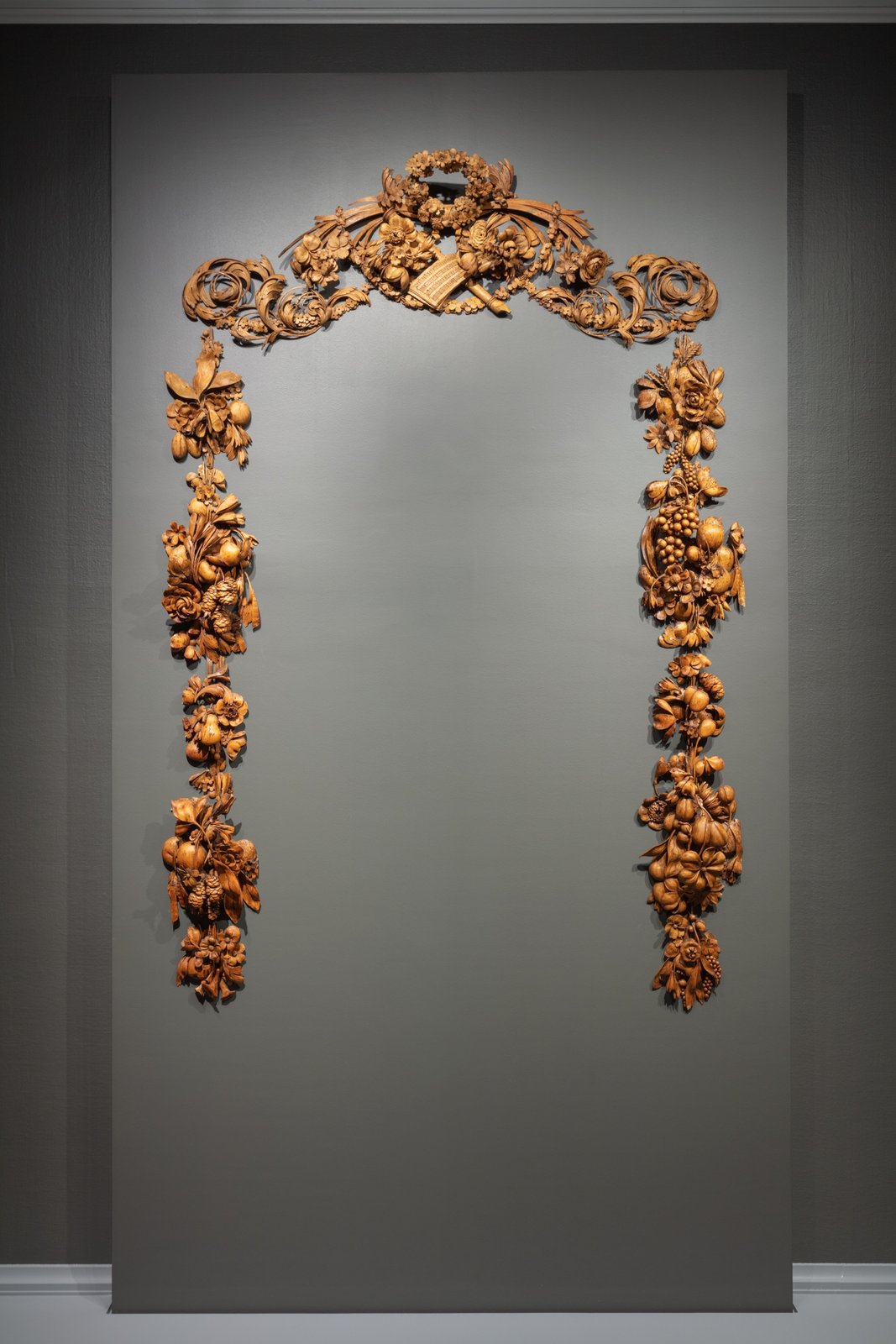
Composition. Start with the Art Institute of Chicago’s overmantel from Cassiobury Park, dated about 1685. Two long drops of fruit and flowers hang down each side, and a scrolled crest ties them together at the top. The centre is empty. The carving was a frame for something else, a painting or a mirror, so the ornament gathers at the edges and leaves the middle quiet. The two drops differ cluster by cluster: pine cones and pears on the left, grapes and gourds on the right.
Rhythm. Each drop is a chain of bunches, thick, then thin, then thick again. The eye moves down in steps. In the crest, leaf scrolls curl into tight spirals at both ends like volutes, and a sheet of music and a wind instrument sit at the centre. That shift of scale, from big fruit to fine stems to tiny lettering-like lines of notation, is what gives the piece its texture.
Palette. Gibbons carved mainly in limewood, which the V&A describes as pale and fine-grained. Measured from the museum’s scan of this object, the garlands run from a light honey highlight around #cfac80 through #b09070 and a mid brown near #7d4b29 to deep shadow at #341d11. The grey around them, near #59544d, is the gallery wall in the photograph, not the original setting. The V&A notes that he set pale carving against dark backgrounds, a high-contrast effect fashionable in the Baroque period, and Apollo adds that his limewood was left unpainted and attached to darker oak panelling.
Light. Look at the shadows rather than the wood. Each undercut leaf casts its own small shadow, so the carving reads as a drawing in dark accents.
Career outline and key works
The V&A and Apollo both tell the story of his discovery. Shortly before 18 January 1671, the diarist John Evelyn saw him at Deptford carving a wooden version of Tintoretto’s Crucifixion; Evelyn then presented him to Charles II at Whitehall. Royal work followed at Windsor Castle, and the V&A records that in 1693 he was appointed Master Carver to the Crown under William III.
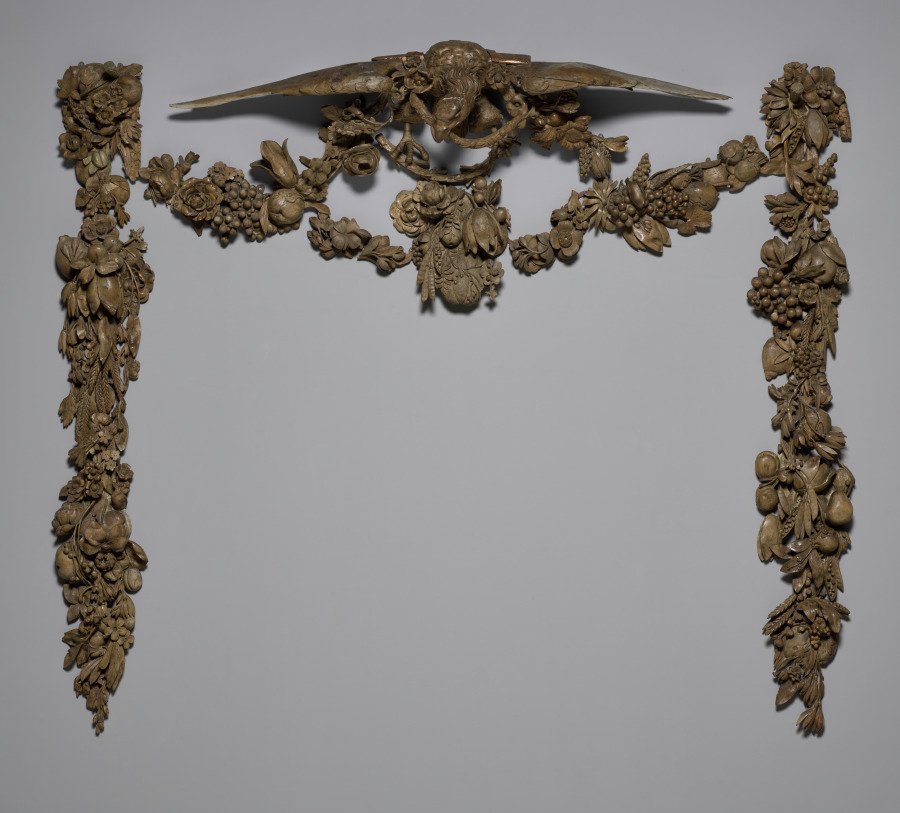
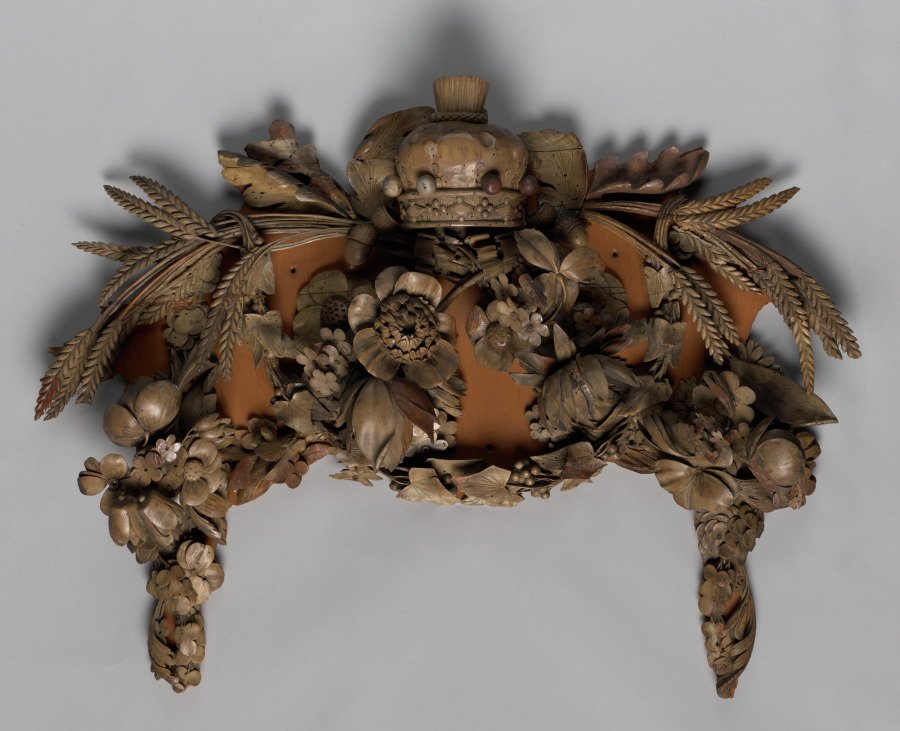
Country houses made his name in the 1670s and 1680s. Cassiobury Park in Hertfordshire, the seat of the Earl of Essex, was one of his earliest commissions according to the Cleveland Museum of Art, which holds an overmantel from the Green Drawing Room dated about 1675–77 and an overdoor from the Inner Library. The house was pulled down in 1922 and its fittings sold, but Cleveland notes that photographs taken before demolition allow surviving carvings to be placed. The Art Institute of Chicago dates its Cassiobury overmantel later, to about 1685.
In 1682 he carved a large panel that Charles II sent as a gift to Cosimo III de’ Medici, Grand Duke of Tuscany; the V&A and Apollo both date it to 1682 and place it in Florence, at the Palazzo Pitti. The V&A notes that he carved his own signature prominently on it. The Carved Room at Petworth House in West Sussex, with its limewood carving of musical instruments and picture borders, is dated about 1690 by the V&A and about 1692 by Apollo.
His public work followed Christopher Wren’s rebuilding of London. The choir stalls and bishop’s throne at St Paul’s Cathedral date to 1696–98, according to Building Conservation and a Britannica caption, and Apollo notes that he carved in oak there rather than his usual limewood. The V&A also lists a limewood carving of 1694 at Trinity College Library, Cambridge. Alongside wood, the V&A records a parallel career in stone and bronze from the early 1680s, including a partnership with the sculptor Arnold Quellin formed in 1681 and the marble font at St James’s Piccadilly, installed in 1686.
Technique: how the carvings were built
The wood. Apollo describes limewood as the timber that resisted the chisel least for naturalistic leaves and flowers, its grain allowing very thin edges and stems. The V&A’s limewood cravat of about 1690, a carved imitation of needle lace, shows how far this could go: the museum records that Horace Walpole, a later owner, wore it as a joke.
Depth by undercutting. The V&A explains that he undercut deeply to create volume and paper-thin forms, while solid blocks behind the visible surface were only roughed out. Parts the viewer could not see were left largely uncarved.
Layers. Look at how depth is stacked in the Cleveland overdoor: wheat ears and oak leaves form a back layer, flowers and fruit sit in front, and a crown rises from the centre as the top layer.
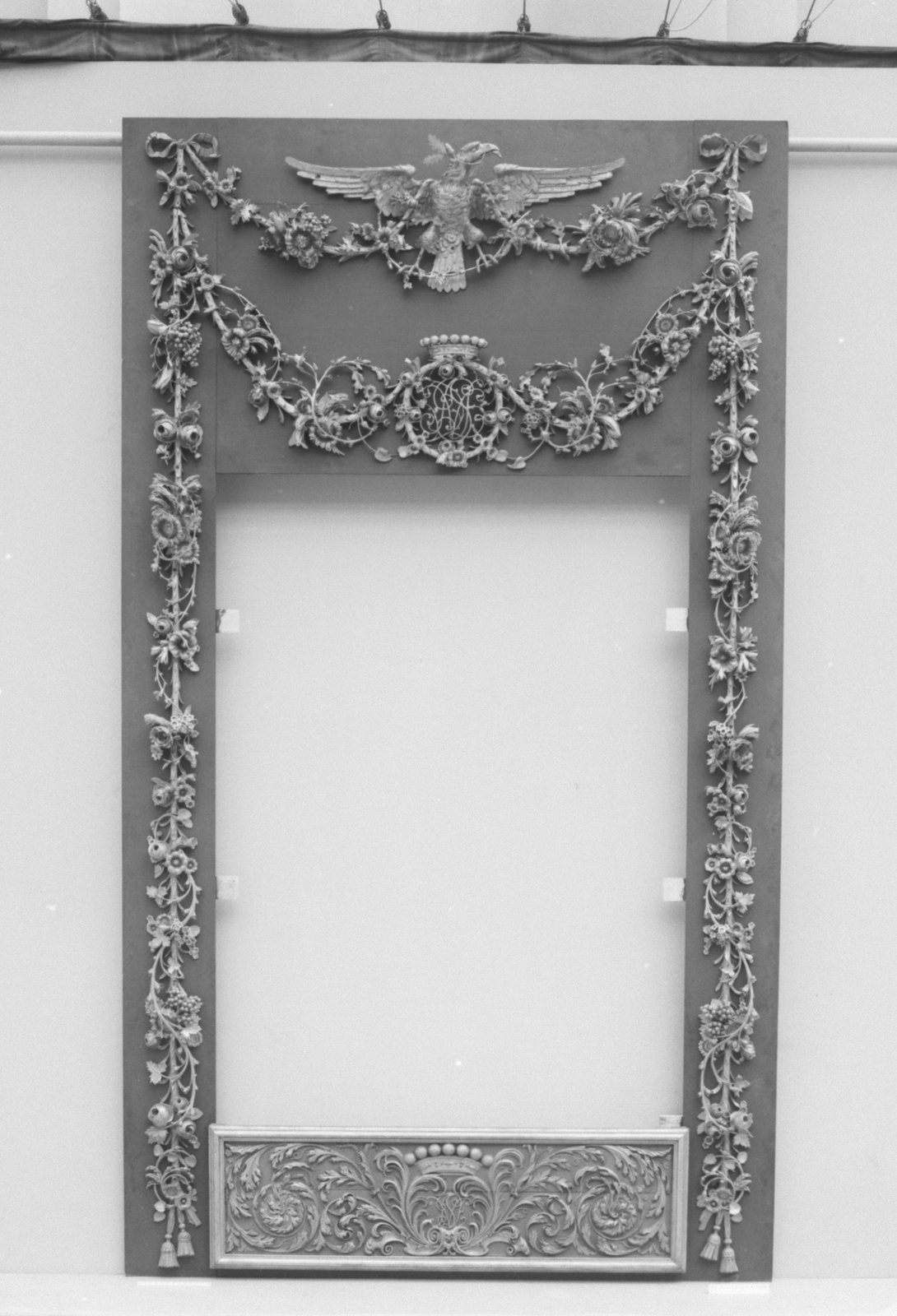
He also worked at scale through a workshop. The V&A records that from 1672 he took on journeymen and apprentices, bought in skilled Flemish carvers, and by the 1680s ran a substantial carving workshop; associates named by the museum include Jonathan Maine, Thomas Young and Samuel Watson. That is why attribution needs care. Apollo cautions that pieces attributed to him may be by his workshop or by contemporary English carvers. The Met catalogues its gilded oak overmantel, dated about 1675, as attributed to Gibbons rather than documented.
How designers can borrow Grinling Gibbons’s ideas
Frame, don’t fill. His overmantels put the ornament on the edges and leave the centre free for the main content. On a landing page, a book cover or packaging, decorate the border or the corners and give the headline or product an untouched field.
Build depth in layers. Treat a composition as background, middle and foreground: wheat behind, flowers in front, crown on top. In UI, that means a clear z-order with only a few elements on top carrying the strongest shadow.
Use pale on dark. Light carving on dark oak is the core of his effect. A warm honey tone like #cfac80 on a near-black brown such as #341d11 gives strong contrast without the harshness of pure white on black. Try it for headings or line illustration on dark backgrounds, and test the pair in our colour palette generator.
Spend detail where the eye lands. Gibbons left hidden surfaces rough. Put fine detail in the hero image or first screen and keep secondary areas simple.
Vary within a system. Mirror the outline, vary the motifs in each slot. For more ideas from nature, see our guide to botanical illustration, and for still-life arrangement, our guide to still life painting.
Gibbons in the Baroque interior
His carvings belong to whole rooms. Cleveland explains that interiors of the late 1600s and early 1700s were planned for symmetry and height, with mantels, mirrors, paintings and carved decoration stacked to create a focal point at the end of a room. Gibbons’s overmantels were one layer of that stack. To see the wider style he worked within, read our guide to Baroque art. For a French contemporary who also made furniture and fittings the focal point of a room, compare our guide to André-Charles Boulle.
Where to see his work
In Britain, the V&A lists Windsor Castle, Hampton Court Palace, Petworth House, Sudbury Hall, St Paul’s Cathedral and Trinity College Library, Cambridge, among documented or attributed sites, and holds the limewood cravat. The Cosimo panel is in Florence, and Cassiobury carvings are in Chicago and Cleveland. For more public-domain carving, metalwork and ornament, browse the MGD museum collection and its ornament theme.
Frequently asked questions
Who was Grinling Gibbons?
He was a carver and sculptor (1648–1721), born in Rotterdam to an English family, who worked in England from about the age of 19. He was appointed Master Carver to the Crown in 1693 and is known for limewood garlands of fruit, flowers and leaves.
What wood did Grinling Gibbons use?
Mainly limewood, which the V&A describes as pale and fine-grained. He also carved in oak, for example at St Paul’s Cathedral, and worked in stone, marble and bronze.
How did Gibbons make his carvings look so deep?
He undercut forms deeply so that leaves and petals stand free of the panel and roughed out hidden areas, according to the V&A; the Cleveland overdoor shows how leaves, fruit and flowers are stacked in distinct planes.
Where can I see Grinling Gibbons carvings?
Petworth House, Windsor Castle and St Paul’s Cathedral in England, the V&A, the Palazzo Pitti in Florence, and Cassiobury carvings in Chicago and Cleveland.