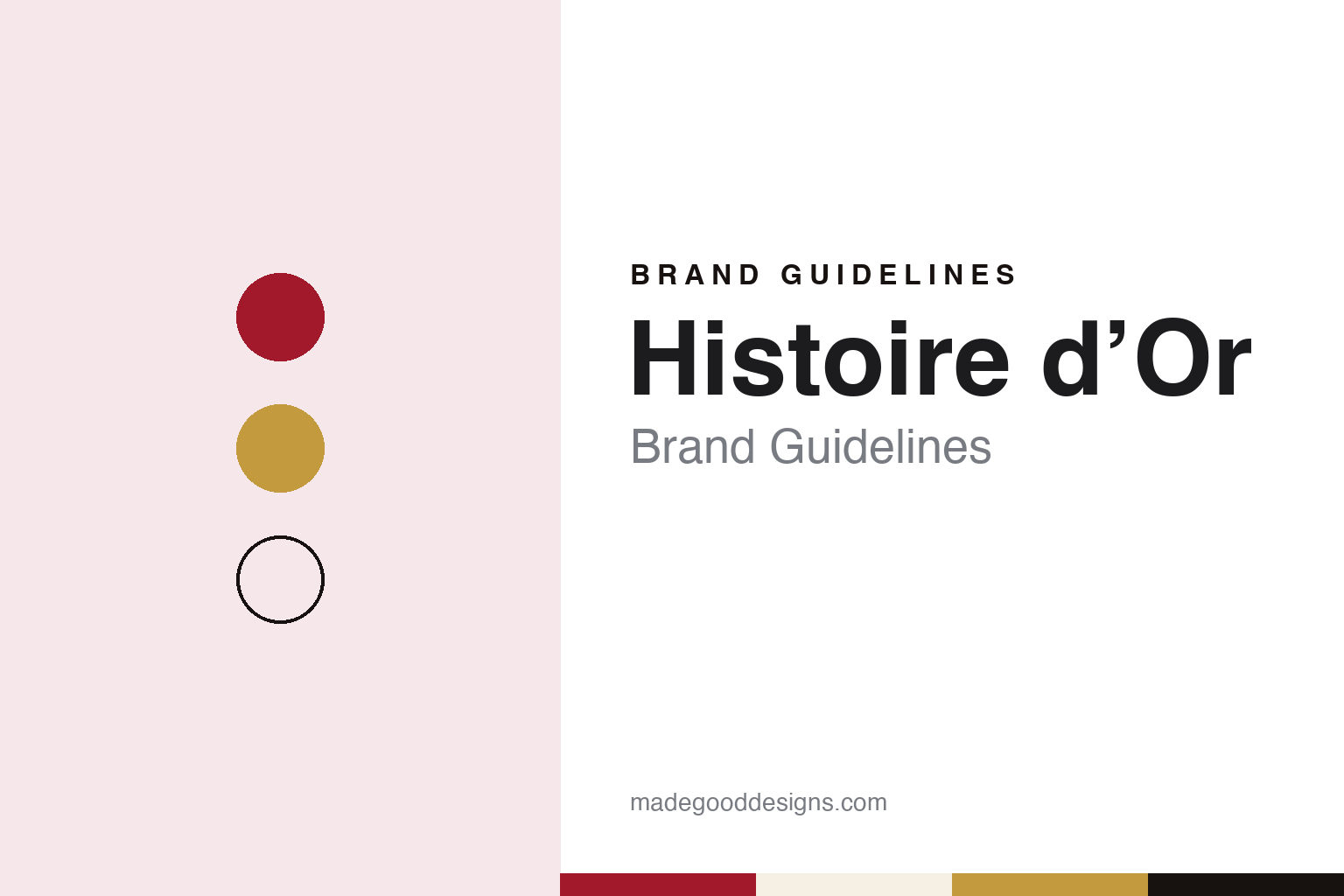
Histoire d’Or Brand Guidelines
The French jewellery chain that wanted gold in every story.
Aa
Two constants: a red, gold and cream palette and a display serif register. Abstract homage — not a Histoire d’Or product or mark; no jewel, logo or shopfront is reproduced.
A story of gold
A jeweller meant to be open to everyone.
Histoire d’Or, French for “story of gold,” is a chain of jewellery shops that its parent company, THOM, says was launched in 1986. THOM tells the brand’s origin as a founding story rather than a biography: a young man went round the jewellers of Cannes looking for a gift for his mother, found that jewellery seemed reserved for a privileged few, and imagined a different kind of shop, “open and generous” rather than exclusive and intimidating, with no limit on price, style or the occasion being marked. The company does not name him in that account.
That idea still frames how the brand describes itself. THOM calls Histoire d’Or “the great jeweller of all possibilities” and uses the line “add gold to all your stories” in English; the brand’s French website speaks of helping customers write their finest stories, from births and christenings to Christmas, Mother’s Day and Valentine’s Day. Its shops, the company says, are built on an open-fronted architectural concept with red as the identity colour, and on merchandising and store layout designed to help people choose a gift for themselves or for someone else.
Histoire d’Or grew in French shopping centres. When the investment firm Bridgepoint describes the business it backed, it calls Histoire d’Or and Marc Orian the number one and number two in French jewellery retail, selling affordable precious jewellery from more than 570 stores, mainly in shopping malls. THOM dates the purchase of Marc Orian, which it calls the first jewellery chain to open in shopping centres, to 2010, and says the group launched a third French banner, TrésOr, in 2013, the same year the histoiredor.com online shop opened.
Colour
Private-equity owners and a European group.
Histoire d’Or has been owned by investment funds for most of its modern history. Bridgepoint says Histoire d’Or and Marc Orian were acquired and merged at the same time, to create a leading French jewellery retailer and a base for buying chains elsewhere in Europe. By July 2016 the group, then called Thom Europe, was controlled by funds managed by Bridgepoint, Apax Partners, Altamir and Qualium Investissement, together with its management, the Italian investment news site BeBeez reported. It ran 572 directly operated stores, mostly in shopping centres, under three main banners: Histoire d’Or, Marc Orian and TrésOr.
That month Thom Europe bought Stroili, the Italian jewellery chain based in Udine, BeBeez reported; THOM also dates the purchase of the Italian brand Franco Gioielli and the German chain Orovivo to 2016. In 2021 Bridgepoint sold the group to Altamir and funds managed by Amboise Partners, Bridgepoint says. The same year THOM moved into fashion jewellery: in a decision dated 23 June 2021, France’s competition authority, the Autorité de la concurrence, examined the joint takeover of the assets of the jewellery brand Agatha by Thom and the jeweller Altesse, following rulings of the Bobigny commercial court in February 2021. The decision lists Thom’s French banners at the time as Histoire d’Or, Marc-Orian, TrésOr, J’M and Smizze.
THOM has kept buying since. It says it created a watch and jewellery wholesale arm, Timeway, after acquiring Venson Paris in September 2021; bought the fashion brands Be Maad, Clyda and Scooter in 2023 and the jeweller Deloison in 2024; and created a brand called Coutumes in 2025. In its own figures for 2025, THOM describes a group of ten brands in seven countries, with more than 1,120 points of sale and about 6,450 employees. Its executive team has been led since November 2023 by group chief executive Flavien d’Audiffret, and Maurice Tchenio, a co-founder of Apax Partners, became chairman of its supervisory board on 1 July 2026, the company says.
Typography
Design and documentation.
Jewellery and accessories chains sell through the shop itself as much as through any advertising, so the sign over the door, the colour of the shopfront and the way a window is arranged carry most of the identity. Histoire d’Or, the French chain, is one example: its parent company, THOM, says its stores use an open front, a single identity colour, red, and a layout meant to help customers choose a gift.
The formats in this guide run from watch and fine-jewellery boutiques to mall shops and fashion-accessories stores. Bucherer, in Lucerne, sells many watch and jewellery brands alongside its own fine jewellery, which Luxury London reported in December 2025 is designed and made in an atelier at its headquarters. At the other end of the range are chains selling fashion jewellery and accessories from small units and department-store corners, a format that France’s competition authority described in June 2021 when it reviewed the takeover of the Agatha brand’s 32 boutiques and 40 corners.
Ownership varies as widely as format. Some of the chains covered here in Switzerland, France, the Netherlands, England, Spain, Poland, Germany, Australia and the United States are family businesses, some are listed on a stock exchange, and some belong to private-equity funds or to larger groups. Bucherer was family-owned from 1888 until Rolex bought it in a deal announced in August 2023, while Histoire d’Or has passed between investment funds since the merger that created THOM.
Each guide sets out what can be checked: who founded the chain and when, who owns it now, which own-label collections and services the company names, and how it presents its founders and owners on its corporate pages. Where a fact rests only on the company’s own word, the guide says so.
Aa
A high-contrast display serif for a French jeweller launched in 1986. (Specimen set in DM Serif Display, a serif STAND-IN; NOT the Histoire d’Or logo.)
Histoire d’Or
Red shopfronts and open doors.
Histoire d’Or is the brand THOM grew from: the group dates its own story to the brand’s launch in 1986. THOM gives it 426 stores in four countries; besides France, the company lists Histoire d’Or among its banners in the Benelux countries, alongside Marc Orian, and in Italy, alongside Stroili and Franco Gioielli. The brand’s French website sells rings, necklaces, earrings and watches, wedding bands, engagement rings and signet rings, and a collection called Mon Premier Diamant, and it offers an engraving service for medals and other pieces. THOM says the brand’s website drew 56.7 million visits in 2025, and that it keeps building links between the shops and online sales; in the Benelux countries, the company says, its Histoire d’Or and Marc Orian business runs 28 stores.
The visual identity is the store. THOM describes an open shopfront without the barriers of a traditional jeweller, a single identity colour, red, and merchandising designed to make choosing quick. Bridgepoint, for its part, describes the business as affordable precious jewellery sold mainly in shopping malls.
For a design guide, Histoire d’Or shows how a jewellery chain can make a single colour and an open shopfront carry a whole network of shops; compare Lucardi, a Dutch jewellery chain, and Apart, a Polish one. For this guide we use red, gold and cream with a display serif, an unofficial interpretation; no product or logo is reproduced.
Explore & save
Keep Histoire d’Or’s identity on hand — save it to a board in the Made Good inspiration library.
Histoire d’Or identity set
Pin the Histoire d’Or red, gold and cream palette and the display serif register to your own board.
Source & notes
Frequently Asked Questions
What font can I use to match the Histoire d’Or look?
This guide describes Histoire d’Or’s type as “A high-contrast display serif for a French jeweller launched in 1986”. Its type specimen is set in DM Serif Display from Google Fonts as a stand-in; DM Serif Display is not Histoire d’Or’s own lettering.
What colours are in the Histoire d’Or palette?
This guide’s Histoire d’Or palette is Story red #A3192C, Ink #17110F, Gold leaf #C39A3E, Cream #F6EFE4 and Paper #FBF8F3. The tones are the guide’s own unofficial interpretation, not official Histoire d’Or hex codes.
When was Histoire d’Or launched?
Histoire d’Or was launched in 1986, in France. Histoire d’Or is known for Gold and diamond jewellery in shopping-centre stores.